
ESD Chair & Sit-Stand Stool for SMT Factories
Every operator who touches a PCB is a potential ESD source, and the seat they use all shift is the part of the control system most often done wrong. Run the ESD seat check, then see the S-505140 spec.
Aug 26, 2026 · Updated Aug 31, 2026 · Jason Wu
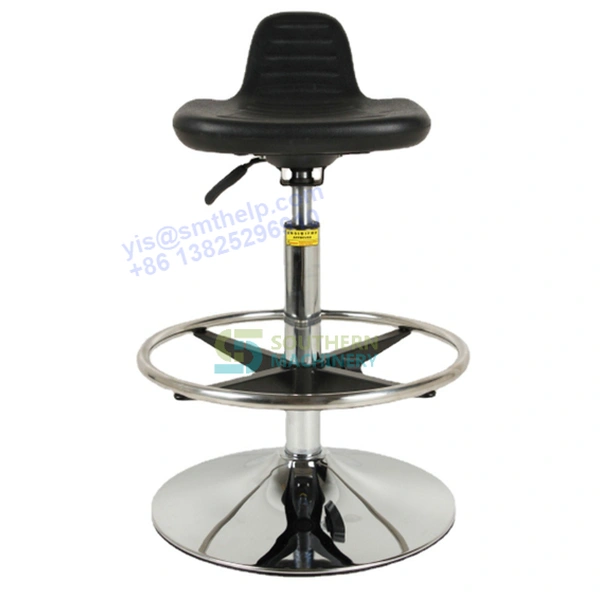
In an SMT factory, every person who touches a PCB — at manual insertion, inspection, rework or kitting — is a potential source of electrostatic discharge. The seat they spend eight to twelve hours on is the part of the ESD control system most often done wrong, and the most visible when an auditor walks the floor.
An ESD chair dissipates static charge from the operator instead of letting it build up and discharge into sensitive electronics. Southern Machinery's ESD chairs and sit-stand stools are built for that environment: electrostatic-dissipative construction, adjustable height and angle, and operator comfort for long shifts. This guide gives you a way to check your own seating before you request a quote.
The ESD risk nobody watches
ESD is one of the most underestimated quality risks in electronics manufacturing:
- Damage below human perception. Sensitivity often starts well below the ~3,000 V a person can feel, so an operator can damage a device without noticing.
- Latent failures. ESD damage is frequently invisible to the eye and undetectable by AOI; it can pass final test and fail only months later in the field.
- One discharge scraps a board. A single uncontrolled event can scrap a populated board worth far more than the seating that would have prevented it.
- It is auditable. Programs such as IEC 61340-5-1 and ANSI ESD S20.20 are referenced by automotive, medical and industrial customers, who now expect documented ESD control from their EMS partners.
An ESD-protected workstation is a system — dissipative flooring, wrist straps, ionizers, ESD-safe storage and ESD seating. The chair is the part that follows the operator all day.
The ESD Seat Check
Run this on your current benches. It needs no purchase:
- Trace the static path. When an operator sits on a conventional, non-conductive seat and moves, does charge have a controlled path to ground — or does it accumulate?
- Verify the dissipative range. Does the seating's surface system resistance sit in the dissipative window (roughly 10⁴–10⁹ ohms), the range most ESD programs require?
- Check the standard. Is the seating specified to a recognized standard such as DIN EN 61340-5-1, or is it "anti-static" by label only?
- Audit the audit trail. Could you show an automotive or medical auditor the spec sheet for every seat on the line?
The check tells you whether your seating is real control or a compliance gap.
The Vehicle: the S-505140 and sit-stand stool
Southern Machinery's ESD seating line includes the ESD Chair (Model S-505140) — a height-adjustable, 360° rotating anti-static chair for sit-down stations — and an ESD Sit-Stand Stool with adjustable height and angle for standing-height or mixed workstations.
Verified S-505140 configuration:
- Electrostatic performance — surface system resistance in the 10⁴–10⁹ ohm dissipative range, conforming to DIN EN 61340-5-1.
- Dimensions — seat approx. 320 × 300 mm, backrest approx. 170 × 150 mm.
- Height adjustment — 400–550 mm selectable; sit-stand stools add angle adjustment for standing-height benches.
- Load capacity — rated to 200 kg maximum.
- Materials — PU polyurethane foam surface (wear-resistant, cleanable); anti-slip base; height-adjustable, removable foot ring.
- Mobility — 360° rotation; manual-move base with no casters that could damage ESD flooring; air-lift height adjustment.
The S-505140 is specified for dust-free environments, with an easy-to-clean PU surface suited to medical and optics production.
Where it fits on the line
ESD seating is workplace infrastructure rather than a process machine — but it is just as important to yield:
- SMT line — operators at stencil printing, pick-and-place loading, AOI verification and reflow load/unload.
- THT insertion — manual and semi-automatic stations where sit-stand stools let operators alternate posture across a shift.
- Soldering and touch-up — post-solder inspection and rework benches.
- Inspection and rework — AOI/SPI review, X-ray and rework benches where boards are handled repeatedly.
- Kitting and storage — alongside Southern Machinery's ESD magazine racks, ESD boxes and ESD trolleys.
Because one supplier outfits the full line — SMT, THT, wave soldering, board handling, inspection — plus ESD products, the seating slots into a broader workplace-compliance program.
Make it a recurring check
ESD programs drift: new benches, new operators, a customer audit. Re-run the ESD Seat Check whenever you add a workstation or change an auditor's requirement — the seating that passed last year may not carry this year's spec.
Your next step
Send your bench heights, shift patterns and ESD program requirements to jasonwu@smthelp.com or WhatsApp +86 136 0256 2576. The engineering team recommends the seating configuration for your line and helps you prepare for an ESD audit. Watch the sit-stand stool demo on the Southern Machinery YouTube channel (youtube.com/@Smthelping).
FAQ
What is an ESD chair used for? It eliminates static electricity at the bench, providing a controlled dissipative path so operator-generated charge does not accumulate and discharge into sensitive PCBs during handling, inspection or rework.
What is the difference between an ESD chair and a sit-stand stool? The S-505140 is a height-adjustable, 360° rotating seat for sit-down stations. A sit-stand stool adds angle adjustment so operators can work at standing-height benches or alternate posture across a shift. Both are electrostatic-dissipative.
How do ESD chairs protect PCBs? The seat and backrest use dissipative material in the 10⁴–10⁹ ohm range (DIN EN 61340-5-1), so charge drains to ground slowly instead of building up — the operator never becomes a high-voltage source near the board.
Do they meet ESD standards? The S-505140 is specified as electrostatically dissipative per DIN EN 61340-5-1, in the range most ESD programs (IEC 61340-5-1 / ANSI ESD S20.20) require.
Which industries use ESD seating? EMS and ODM factories, automotive, medical, industrial control, LED lighting and power supply manufacturing — any facility where operators handle populated boards or ESD-sensitive components.
Jason Wu
Founder & CEO, Southern Machinery (Shenzhen Southern Machinery Sales and Service Co., Ltd.)
Email: jasonwu@smthelp.com / info@smthelp.com
WhatsApp: +86 13602562576
Catalog & manuals: file.autoinsertion.com | Machine photos: ph.smthelp.com
LinkedIn: linkedin.com/in/smtsupplier | YouTube: youtube.com/c/Smthelping
Comments
Comments appear after approval.