
Never Reopen a Cold Account on the Product That Went Cold
Nine consecutive orders through 2023 and 2024, then silence. The account in Central Europe came back through a fixture cleaning requirement — a product line that had never been sold there.
Aug 30, 2026 · Updated Aug 30, 2026 · Jason Wu
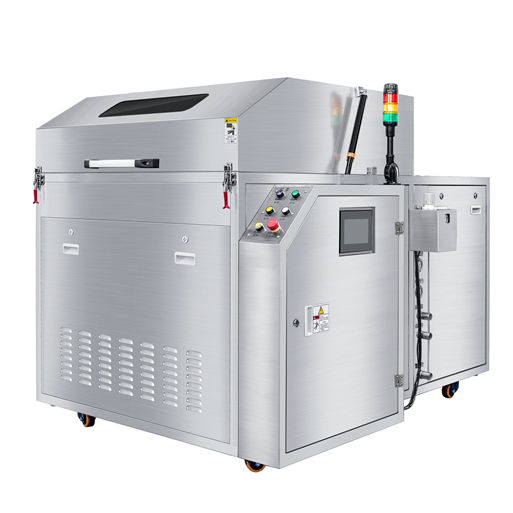
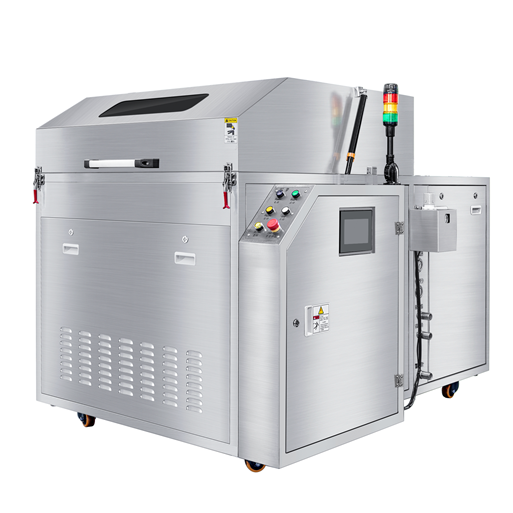
An aqueous pallet and fixture cleaning system. Cleaning is a recurring problem on any wave soldering line, which is what makes it a better re-entry point than the product that went quiet. Product page: smthelp.com/sme-5200-aqueous-pallet-cleaning-system-southern-machinery.html
Nine orders, then nothing — and the way back in was not through the door that closed
A Central European electronics manufacturer running through-hole insertion equipment placed nine consecutive orders between Oct 2023 and Oct 2024. Then the account went quiet for roughly fifteen months.
Leon Hong picked it up again in Dec 2025. The re-engagement did not reopen on the product line that had gone quiet. It came in through a fixture cleaning requirement — a conversation that had never happened on this account before.
A lapsed account needs a reason to come back, and the old product is not one
The instinct on a cold account is to reopen on what you last sold. It is the fastest path to a quotation and the slowest path to an order, because if that product line stalled once, the reason it stalled is still sitting there. Asking again reproduces the original answer with a fifteen-month delay.
There is a subtler problem underneath. Fifteen months is long enough for the line to have changed. New machines, different boards, new process engineers, possibly a different buyer. Quoting from the old file risks repeating whatever went wrong the first time, and it also signals that you have not been paying attention.
So the real requirement is not a quotation. It is a reason to talk that is not about the thing that stopped. On a wave soldering line, cleaning is that reason: pallets and fixtures accumulate flux residue continuously, it is nobody's favourite job, and it recurs whether or not the last order went through. That is the property to screen for: a problem that arrives on a cycle, not one that waits for a capital approval.
Re-enter on a new line
Five steps, all of which can happen in one day.
1. Re-qualify before you quote. Background research, requirement capture, product study — then the proposal. Not the 2024 specification. The current one.
2. Pick an entry point with a recurring pain attached. Cleaning, consumables, wear parts. Anything that hurts on a cycle rather than on a capital decision.
3. Build the proposal around the current configuration. Their present palette and fixture set, not the one in your old file.
4. Include freight in the first quotation. A first quote that excludes freight generates a second round, and a second round on a re-engagement is where attention is lost.
5. Be ready to take the order the same day. If the re-qualification is complete, there is no reason to wait. Sitting on a finished proposal for a week gives a fifteen-month-old silence another week to re-establish itself.
Five steps, one day, one order
On 21 Jan 2026 the rep ran the full sequence: background research, the fixture cleaning machine enquiry, requirement capture, product study, the proposal, and a quotation including freight. A spare parts order was received the same day.
The proposal was built around the customer's current palette and fixture set. Nine orders of history meant the packaging and documentation expectations were already known, which is the quiet advantage of a lapsed account over a cold one — you are not starting from zero, you are starting from a specification you once got right.
Evidence: delivery and re-engagement record from our project system. Dates are real; no pricing and no customer identity. No production measurements are available for the earlier orders.
The cold-account audit
List every account that has not ordered in twelve months. Next to each, write the product you last sold them — and then cross it off as an entry point. What is left is your re-engagement list.
Next in this series: a Mexican industrial supplier with six categories already running, who asked about laser welding — as a distributor, not as a buyer.
This article is part of Case Files: 20 Real SMT/THT Projects — twenty de-identified field projects from Southern Machinery. Each one carries the symptom the customer reported, the engineering decision we made, and the delivery record that followed. Customer names, prices and contract values are removed; dates, team members and machine classes are real.
Pick the re-entry point
Open your dormant account list and, for each one, name a product you have never sold them. That is the re-entry point.
If pallet and fixture cleaning is on your list, send us your fixture dimensions and flux type.
Note: This configuration is a draft and must be finalized and reviewed by our senior Sales Engineer (Jason Wu).
Action Required: Please provide your Gerber file or PCB drawings to info@smthelp.com for an accurate capacity simulation and nozzle engineering validation.
Comments
Comments appear after approval.