
S100B Desktop Selective Soldering — Fixture-Less THT Soldering for HMLV
For HMLV factories, through-hole soldering is the bottleneck: wave needs fixtures, hand soldering is slow. Run the Fixture-Less Solder Decision, then see how the S100B removes both.
Aug 22, 2026 · Updated Aug 31, 2026 · Jason Wu
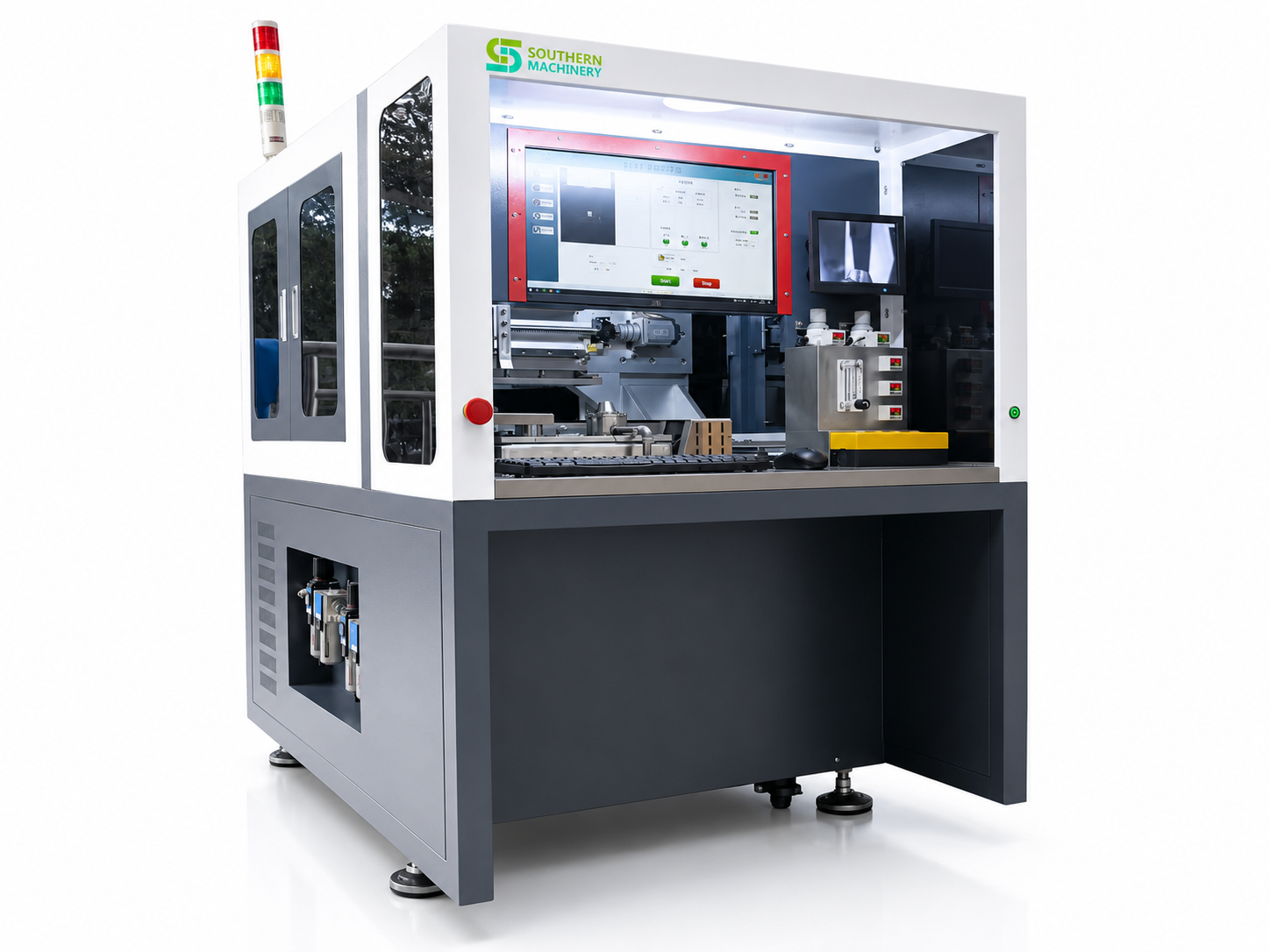
For EMS and ODM factories running high-mix, low-volume (HMLV) boards, through-hole soldering is usually the bottleneck: a full wave soldering line needs dedicated fixtures, and hand soldering is slow and inconsistent. The S100B desktop selective soldering machine from Southern Machinery targets exactly this gap — programmable selective fluxing and soldering with ultra-fast changeover and no fixture.
The cost of the wrong soldering method
On HMLV boards, the deciding cost is usually changeover and fixture overhead, not raw joint speed:
- Hand soldering is flexible but slow per joint and operator-dependent — quality drifts with skill and fatigue.
- Full wave soldering gives high throughput but needs dedicated pallets per board and long setup per product change.
- Selective soldering is the middle route: it automates the process, keeps solder away from heat-sensitive SMT components, and removes the fixture cost and setup time of a wave machine.
The Fixture-Less Solder Decision
Score your soldering method against this comparison:
| Decision factor | Hand soldering | Full Wave Soldering | Selective (S100B class) |
|---|---|---|---|
| Fixture need | None | Dedicated pallets per board | None in the fixture-less workflow |
| Changeover time | Instant, but slow per joint | Long setup per product change | Fast — change the program, not tooling |
| Thermal exposure | Localized (iron tip) | Whole board over the wave | Only programmed joints see solder |
| Consistency | Operator dependent | High | High — PC-controlled paths |
| Labor per joint | High | Low | Low |
| Best fit | Low volume, low complexity | High volume, stable mix | HMLV, rework, mixed technology |
For HMLV production, the fixture-less desktop machine removes the overhead that makes wave impractical and the inconsistency that makes hand soldering risky.
The Vehicle: how the S100B solders
The S100B is a desktop selective soldering machine used to solder THT components on PCB assemblies where a full wave line is not practical. Instead of passing the whole board over a solder wave, the machine moves the PCB over a controlled solder nozzle and applies solder only to the programmed joints.
- High-mix products where board types change frequently.
- Mixed SMT and THT areas that cannot tolerate full-board wave exposure.
- Prototype and NPI runs, and PCB rework and repair soldering.
- Line-side stations beside an SMT or THT line.
Where it fits in a complete line
The S100B is an offline, desktop machine: boards are loaded and unloaded manually, and soldering runs automatically from a PC program.
- After SMT placement and reflow — solder THT components on boards only partially assembled on the SMT line.
- After THT auto insertion — finish through-hole joints after axial, radial or odd-form insertion.
- Beside the main line — a flexible station for small batches and rework without stopping the primary line.
- Before AOI — finished boards enter inspection with complete, repeatable solder joints.
Southern Machinery supplies whole-line solutions beyond a single machine: SMT placement, THT auto insertion (axial, radial, odd-form), wave soldering, board handling, stencil printing, and inspection such as SPI and AOI. The S100B can be quoted as part of a complete line or as a standalone station.
Make it a recurring check, not a one-off
Product mixes shift constantly in HMLV shops. Re-run the Fixture-Less Solder Decision when you take on a new board family, add prototype/NPI volume, or see hand-solder rework eating capacity. The right tool for a 5-joint prototype is not the right tool for a 50-joint stable product — and the S100B sits precisely in that variable middle.
Your next step
Send your PCB dimensions, joint count, solder alloy and production volume to info@smthelp.com or WhatsApp +86 136 0256 2576. Southern Machinery confirms solder area, nozzle set, nitrogen and utilities before quotation. Reference configurations (such as the SO-300 series: 300 × 300 mm max solder area, ±0.1 mm positioning accuracy, 15 kg solder pot, 3 kW bottom IR preheat at 25–240 °C) are documented on smthelp.com — ask for the S100B configuration sheet matched to your boards.
FAQ
What is a desktop selective soldering machine? A compact selective soldering system that automates THT joint soldering by moving the PCB over a controlled solder nozzle, applying solder only to programmed locations. "Desktop" refers to its small footprint versus full-size wave lines.
What can the S100B solder? Through-hole components such as connectors, relays, coils, terminal blocks and other THT parts where selective, program-controlled soldering is preferred — including mixed SMT/THT assemblies, high-mix products, prototypes and rework.
Do I need nitrogen? Many selective soldering processes benefit from nitrogen, which improves wetting and reduces solder dross. Confirm purity, pressure and flow requirements for your alloy and quality targets with the supplier.
How fast is changeover? The fixture-less HMLV workflow is designed for fast changeover — the program changes, not the tooling. Confirm exact procedure and times with Southern Machinery for your product set.
Can it integrate into an existing SMT line? Yes. The S100B is an offline station, so it can sit beside an existing line or in a rework area, and can be included in a complete Southern Machinery line (SMT, THT, wave, board handling, SPI/AOI).
Jason Wu
Founder & CEO, Southern Machinery (Shenzhen Southern Machinery Sales and Service Co., Ltd.)
Email: jasonwu@smthelp.com / info@smthelp.com
WhatsApp: +86 13602562576
Catalog & manuals: file.autoinsertion.com | Machine photos: ph.smthelp.com
LinkedIn: linkedin.com/in/smtsupplier | YouTube: youtube.com/c/Smthelping
Comments
Comments appear after approval.