
SFY02 AGV Robots for SMT Material Handling
The SFY02 AGV moves SMT reels, stencils and PCBs autonomously, cutting manual handling and improving material traceability on the floor.
Aug 15, 2026 · Updated Aug 31, 2026 · Jason Wu
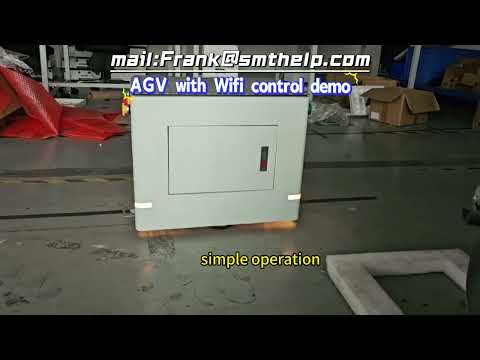
SFY02 AGV Robots for SMT Material Handling
Automated Guided Vehicles are changing how PCB assembly factories move materials. Instead of operators pushing carts of SMT reels, stencils and finished boards across the floor, AGVs transport these items autonomously — reducing manual handling, cutting transit time, and improving material traceability. The SFY02 AGV from Southern Machinery adds a WiFi API so transport can be triggered automatically by the line itself.
Why manual transport quietly costs you
Cart-pushing is invisible overhead that compounds across every shift:
- Operator hours lost to walking. Moving reels and boards between stations pulls people away from changeovers and inspection.
- Handling damage. Every manual transfer is a chance to drop a reel, scratch a board, or mis-load a feeder.
- Weak traceability. Hand-carried materials are hard to log against work orders, which hurts lot control and audits.
- Line starvation. Materials arriving late stop expensive machines that should never wait.
The Material-Flow Audit
A named method to make material transport a planned, automated system.
1. Map. List every material move between storage, kitting and production — reels, stencils, PCBs and fixtures. The reason is to quantify walking time you can redeploy to value work.
2. Navigate. Choose the navigation method that fits your floor: magnetic tape, QR-code, or SLAM mapping. SLAM and QR need minimal floor modification, so the choice is driven by whether routes change often.
3. Connect. Use the SFY02 WiFi API to dispatch and monitor the vehicle through MES or warehouse software. The point is that a Pick and Place line can trigger a reel-change delivery automatically, not by a phone call.
4. Scale. Plan fleet coordination through one control system. As transport volume grows, you add vehicles rather than re-engineer the layout, keeping the payback on track.
How the SFY02 maps to your floor
The SFY02 AGV is a self-driving mobile robot that transports materials between fixed points, typically moving:
- SMT component reels and trays between warehouse, kitting and Pick and Place machines.
- PCBs and magazines between stencil printing, placement, reflow and inspection.
- Wave-soldering pallets and fixtures to and from the soldering line.
- Finished PCBA panels from final assembly to test or packaging.
Navigation combines sensors, cameras and control software; the SFY02 exposes a WiFi API for MES, ERP and WMS integration, enabling end-to-end material traceability. It operates safely around operators with obstacle detection, emergency stop and controlled speeds.
For evaluation, confirm these parameters with the supplier: payload capacity and platform size, navigation technology, docking accuracy, WiFi/Ethernet API method, battery runtime and opportunity charging, safety features, and fleet scalability. Exact payload and interface details are confirmed at quotation against your actual payload and floor layout — a live demonstration with your materials is recommended.
Because the AGV communicates through the factory network, it integrates with MES, ERP and warehouse systems for end-to-end material traceability. In a full SMT/THT line — insertion, wave soldering, board handling, storage and AGV material flow — Southern Machinery positions the AGV alongside its complete line equipment, serving 237+ global customers since 2011.
Where the SFY02 fits your floor
- EMS contract manufacturing — high-mix, low-volume lines with constant reel-change transport demand.
- LED lighting and display assembly — moving large LED panels and MCPCB boards that are heavy to handle manually.
- Automotive electronics — traceable material flow between kitting and SMT lines for lot control.
- Industrial control and power supply — steady, repeatable transport through wave soldering and test.
Buyer checklist
- Payload and platform size — must fit your largest reel rack, magazine or pallet.
- Navigation technology — magnetic tape, QR-code, or SLAM mapping by floor layout.
- Docking accuracy — repeatable positioning tolerance for racks and conveyors.
- Connectivity and API — WiFi/Ethernet API for MES/WMS dispatch and monitoring.
- Battery and charging — runtime per charge and opportunity-charging support.
- Safety features — obstacle detection, emergency stop, controlled speed in operator areas.
Before you commit, request a live demonstration with your actual payload and floor layout. Southern Machinery offers AGV-compatible reel racks and smart storage systems; for third-party racks, verify the docking interface and payload dimensions with the supplier. As a planning benchmark, calculate current manual-transport labor hours per shift, the cost of handling-related defects, and the value of real-time material visibility — for many EMS operations the payback comes from combined labor, quality and traceability gains rather than any single factor, so review the full transport workflow before fixing a vehicle count.
Run the loop
Re-run the Material-Flow Audit whenever a new line, product family or storage zone is added. That loop keeps moves mapped, navigation matched, and the API connected, so transport scales with production instead of strangling it.
Your next step
Email jasonwu@smthelp.com describing your current material-transport method and operator hours per shift for an SFY02 configuration and demonstration plan.
FAQ
Can an AGV work alongside people on a busy SMT floor?
Yes. Modern AGVs include obstacle-detection sensors, emergency stops and controlled speeds so they operate safely around operators and static equipment.
Do I need to modify my floor to use an AGV?
It depends on navigation. Magnetic-tape guidance requires installed tape; SLAM or QR-based navigation works on existing floors with minimal modification.
Can the AGV dock with my existing reel racks and storage?
Southern Machinery offers AGV-compatible reel racks and smart storage systems. For third-party racks, verify the docking interface and payload dimensions with the supplier.
How does the AGV connect to my MES or ERP?
The SFY02 exposes a WiFi API enabling dispatch and status monitoring through factory software. Confirm the specific integration method and protocol for your systems.
Is an AGV cost-effective for a single line?
It depends on transport volume. High-mix, low-volume EMS lines and multi-line factories see the fastest payback; a single low-volume line may be better served by manual carts initially.
Jason Wu
Founder & CEO, Southern Machinery (Shenzhen Southern Machinery Sales and Service Co., Ltd.)
Email: jasonwu@smthelp.com / info@smthelp.com
WhatsApp: +86 13602562576
Catalog & manuals: file.autoinsertion.com | Machine photos: ph.smthelp.com
LinkedIn: linkedin.com/in/smtsupplier | YouTube: youtube.com/c/Smthelping
Comments
Comments appear after approval.