
Small Orders Do Not Need a Cheaper Part, They Need a Shorter Cycle
Brass splice clips to a home appliance manufacturer in Ecuador: research to dispatch in six days. The unit value does not justify a long administrative cycle, and the line stops just the same when the part is missing.
Aug 30, 2026 · Updated Aug 30, 2026 · Jason Wu
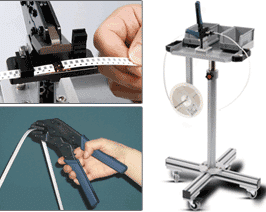
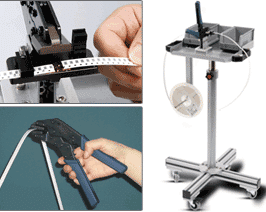
An SMT splicing table and brass splice clips. The clips join carrier tape so a feeder does not run empty during changeover - a part worth almost nothing that stops a line when it is missing. Product page: smthelp.com/product/smt-splicing-tool-embossed-feeder-tape-brass-stitch-and-tape-splice
The cheapest part on your line has the most expensive failure mode
A home appliance manufacturer in Ecuador operating its own SMT lines returned to us in January 2026 for splice clips - the brass clips used to join carrier tape so a feeder does not run empty during a changeover.
The unit value is close to nothing. The consequence of not having one is a feeder running dry mid-run, an operator stopping to reload, and a changeover that is no longer a changeover. Small consumable orders are disproportionately expensive to get wrong, and almost every procurement system is built to get them wrong.
Your process costs more than the part
Here is the arithmetic nobody writes down. A consumable order worth very little passes through the same approval, quotation, invoicing, and freight steps as an order a hundred times larger. The administrative cost per unit is enormous, and the delay is worse: the freight and the commercial invoice have to be right the first time, because a small shipment held at customs costs more than the goods it is carrying.
So the rational response inside a large buying organisation is to batch small orders together and order them rarely. That response is correct for administrative cost and wrong for everything else, because it converts a cheap part into a stock-out risk.
The failure is structural rather than personal. Nobody is at fault; the process simply applies the same cycle time to an item with a two-week lead time and one with a two-year lead time.
Compress the cycle, do not discount the part
Four moves that work on small consumable orders.
1. Decide the cycle time by consequence, not by value. If a missing part stops a line, the cycle target is days. Set the target first, then design backwards into it.
2. Do the paperwork in one session. PI, photographic confirmation of the goods, commercial invoice, and freight, all handled together. The single biggest saving available is doing four steps in one working session instead of spreading them across four days.
3. Photograph the goods before they leave. It takes two minutes and it removes any later dispute about what was actually shipped - which on a small order is the dispute you can least afford to have.
4. Issue the tracking number with the dispatch, not on request. A buyer who has to ask for tracking is a buyer who has already spent time they did not budget.
Six days, and one session did most of it
The account first appears in our records under an earlier company name, dating back to 2018, when it purchased SMT factory supplies. It returned in January 2026 under its current name. That history is why we could move fast: no onboarding, no new vendor file, no first-order caution.
Background research and product study took place on January 30, 2026. On February 3, 2026, the PI, photographic confirmation of the goods, commercial invoice, and freight arrangements were all handled in one working session. Stocking, dispatch, and the tracking number followed on February 5, 2026.
Research to dispatch: six days. When a delivery problem surfaced on February 13, 2026, Jason Wu handled it directly rather than routing it through a ticket. It was closed the same week—fourteen days from inquiry to closure, including the issue.
Evidence: delivery record from our project system. Dates are real; no pricing, no customer identity, no quantities published.
The cycle-time question
Ask your supplier what the fastest order they have ever shipped for you took, and what made it fast. Then ask why that is not the standard. The answer is usually that nobody asked.
Next in this series: four unrelated requirement categories in Argentina, consolidated into one programme instead of three sourcing exercises.
This article is part of Case Files: 20 Real SMT/THT Projects - twenty de-identified field projects from Southern Machinery. Each one carries the symptom the customer reported, the engineering decision we made, and the delivery record that followed. Customer names, prices, and contract values are removed; dates, team members, and machine classes are real.
Time the next one
Take your five smallest recurring orders and write down how many days each one takes from request to dispatch.
If any of them take longer than the part would take to run out, send us the list.
Note: This configuration is a draft and must be finalized and reviewed by our senior Sales Engineer (Jason Wu).
Action Required: Please provide your Gerber file or PCB drawings to info@smthelp.com for an accurate capacity simulation and nozzle engineering validation.
Comments
Comments appear after approval.