
Odd-Form Parts Defeat Standard Feeders — Engineer Around Yours
Standard feeders can't hold your odd-form parts. Run the Feeder Fit Audit, then see how a custom feeder targets a 10x cost-saving benchmark.
Aug 21, 2026 · Updated Aug 31, 2026 · Jason Wu
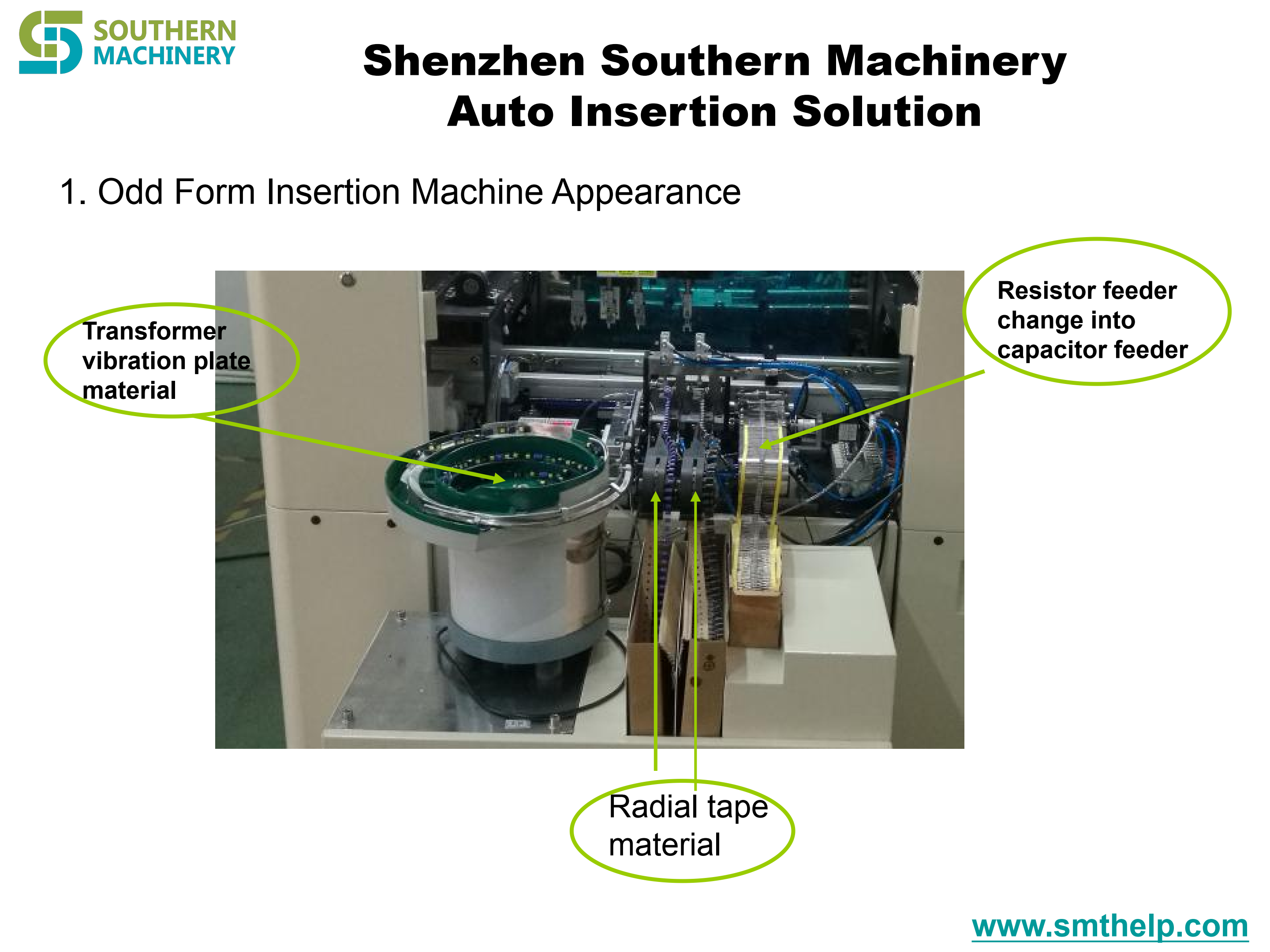
Odd-form components — transformers, relays, connectors, terminal blocks, fuse holders, radial capacitors — are the parts that keep manual operators on the DIP line. They don't fit standard SMT tape-and-reel feeders, so most EMS factories accept slow hand insertion as the only option. That acceptance hides a real cost: hand insertion is the slowest, most error-prone step on the board, and it concentrates exactly where your BOM is hardest to automate. Treat it as fixed and you cap throughput at headcount.
Southern Machinery (founded 2011, Shenzhen, China; 237+ global customers) takes the opposite approach: instead of forcing your component into a standard feeder, we design the feeder around your part. A customized THT odd-form feeder matches the presentation, orientation, and pitch of your specific component, so the S-70LD odd-form insertion machine can feed and place it reliably, shift after shift.
Why standard feeders break odd-form automation
A standard feeder has a fixed geometry. Odd-form parts have none, so the mismatch surfaces as process failure:
- No presentation match — the part won't sit in a tape or bowl, so it can't be fed at all.
- Orientation drift — a loose part rotates or flips, causing reversed or mis-seated insertion.
- Floating-high leads — inconsistent seating leaves open or weak joints at wave.
- Missed insertions — an operator skips the awkward part, caught only at final inspection.
- Reversed polarity — a 180-degree-wrong component, a warranty-level field failure.
Every one of these is a handling defect, not a parts defect. Engineering the feeder removes the mismatch.
The Feeder Fit Audit
Score whether a custom feeder beats hand insertion for your part. The audit uses your components:
1. Count the odd-form tail. What share of your THT BOM — often 5–20% — defeats standard automation and stays manual?
2. List packaging. Tape, tube, vibration plate, or bulk? The feeder type must match your incoming material strategy.
3. Measure the envelope. Part dimensions, height, and lead geometry decide whether a custom design can present it repeatably.
4. Set the target. Define the cost-saving benchmark you want to model — many factories use a 10x cost-saving target for the hardest manual parts, then validate it with their own labor and defect numbers.
The audit tells you whether a custom feeder is worth engineering for your mix — and for the awkward tail, it usually is.
The Vehicle: how the S-70LD with custom feeders works
The customized feeder is the material-handling front end of the odd-form insertion machine. It takes a non-standard through-hole part in whatever package it arrives — taped, tubed, in a vibration plate, or loose — and presents it to the insertion head in the correct position and orientation, every cycle. A vision system then locates the part and checks polarity before insertion; a 180-degree-reversed component is rejected, not inserted. Southern Machinery's S-70LD carries up to 4 feeders, configurable as tape feeders or vibration plates, and custom geometry is built for parts no off-the-shelf feeder can hold.
Verified specification from the Southern Machinery product page:
| Parameter | Specification |
|---|---|
| Feeders | Up to 4, tape or vibration plate, adjustable to the component |
| Component envelope | 3×3 to 30×30 mm, up to 50 mm tall |
| Insertion rate | 4,000 CPH, ±0.05 mm (radial resistor 3,800 CPH) |
| PCB range | 50×50–300×300 mm, 0.8–5.0 mm thick |
| Utilities | 220V 0.8 kVA, 0.4–0.6 MPa, ≤75 dB, ~1,000 kg |
| Vision | Locates part, checks polarity, rejects reversed before insertion |
| Tube feeding | Ladder-style multi-layer automatic feeding |
| Integration | Inline station with SMEMA handshake, upstream of wave |
Confirm the final configuration against your component samples and board files before ordering.
Where it fits in a complete line
The custom feeder does not work alone — it is one module in the full SMT/THT ecosystem: SMT Placement → Radial Insertion (S-3010B class) → S-70LD Odd-Form with custom feeders → Wave Soldering (S-WS350B class) → Board Handling & Cleaning (SME-5200) → AOI/SPI. The S-70LD connects to your existing conveyor via SMEMA handshake upstream of wave soldering, so you add it without re-engineering the line. Feeders swap per SKU, supporting mixed production across PCB variants.
The ROI case
The cost case starts with what manual odd-form insertion actually costs: several seconds per part, dependent on operator skill that is hard to keep, plus rework of 3–5 minutes per board for floating-high, missed, or reversed defects. Automating with a custom feeder moves those parts from hand to machine — operators shift to line supervision, every part seats to a programmed depth, and the machine runs at a steady 4,000 CPH instead of fluctuating with fatigue. A 10x cost-saving target is the design benchmark Southern Machinery's engineering aims for on the hardest manual parts; it is a figure to validate with your own numbers, not a fixed result. Validate it with your own labor rate, defect cost, and volume, and re-run this audit-and-improvement loop as your BOM and mix change.
Your next step
Send us your component samples and BOM — our engineering team designs the feeder around your part, not the other way around, and quotes the complete S-70LD solution. Southern Machinery (Shenzhen, China, since 2011, 237+ global customers) supplies SMT / THT, wave soldering, board handling and inspection, with installation, training and spare parts for the full line.
FAQ
What is a THT odd-form feeder? A material-handling device that presents non-standard through-hole components — transformers, relays, connectors, terminal blocks — to an auto insertion machine in the correct position and orientation, as a tape feeder, vibration plate, tube/ladder feeder, or a custom design.
Which components can a custom feeder handle? Transformers, relays, connectors, fuse holders, terminal blocks, radial E-CAP capacitors, resistors, inductors, and optoelectronic parts — extended to parts standard off-the-shelf feeders cannot present reliably.
How fast is odd-form insertion versus manual? The S-70LD runs up to 4,000 CPH (3,800 for radial resistors) consistently without fatigue; manual insertion is far slower and varies with operator skill.
Does the S-70LD work with my existing DIP line? Yes — it is an inline station with SMEMA handshake, connecting to your conveyor upstream of wave soldering without changing wave, cleaning, or board handling.
Jason Wu
Founder & CEO, Southern Machinery (Shenzhen Southern Machinery Sales and Service Co., Ltd.)
Email: jasonwu@smthelp.com / info@smthelp.com
WhatsApp: +86 13602562576
Catalog & manuals: file.autoinsertion.com | Machine photos: ph.smthelp.com
LinkedIn: linkedin.com/in/smtsupplier | YouTube: youtube.com/c/Smthelping
Comments
Comments appear after approval.