
Manual Odd-Form Insertion Is Your Hidden Cost Center — Automate It
The operator's wage is visible; the rework, scrap and field returns from hand insertion are not. Run the Odd-Form Cost Audit first.
Aug 19, 2026 · Updated Aug 31, 2026 · Jason Wu
A hand-inserted transformer looks identical to a machine-inserted one — until after wave soldering. Then the floating-high pin, the reversed electrolytic and the half-seated connector appear at AOI or, worse, at functional test. Most EMS factories price odd-form insertion by the operator's wage and stop there. The real bill is the rework bench, the through-hole damage from desoldering, and the returns that arrive months later. The wage is visible; the rest of the cost is not.
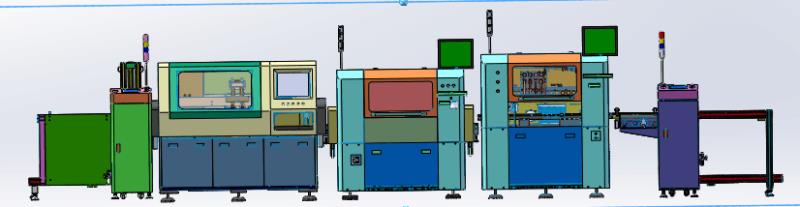
Southern Machinery's radial feeder odd-form insertion cell — the S-70LD class platform — moves those parts off the manual bench. Radial tape feeders and vibration plates present the components, an industrial PC with vision guidance reads each part's lead geometry regardless of how it is presented, orients it, checks polarity before placement, and seats every lead to a programmed depth on a fixed cycle.
Why hand insertion of odd-form parts breaks yield
Odd-form components — transformers, relays, connectors, fuse holders, terminal blocks, radial electrolytics, inductors, lamps, optoelectronics — arrive in trays, tubes and loose bags. Lead pitches vary and bodies are asymmetric. That is why they are still hand-plugged, and why they generate the widest quality variance on the DIP line:
- Floating high. A body that is not fully seated leaves the leads short in the barrel, and the wave produces a weak or open joint.
- Reverse insertion. A 180°-rotated electrolytic or diode passes visual check and fails at functional test.
- Misinsertion and bent leads. Off-axis pushing on a 6–10 pin connector bends a lead outside the hole entirely.
- Cycle-time drift. A hand-inserted odd-form part takes roughly 4–10 seconds depending on operator familiarity and part orientation, so line balance changes hour by hour.
- Skill dependency. Output and defect rate track the individual operator, so turnover translates directly into yield loss.
The Odd-Form Cost Audit
Before you specify a machine, quantify what manual insertion actually costs you. Use your own boards:
1. Count the odd-form content. Parts per board × boards per run. Four odd-form parts across 5,000 boards is 20,000 manual insertions — and the 4–10 second spread on each one is where unplanned labor hides.
2. Separate visible from hidden cost. Wage per shift is visible. Rework after wave soldering is 3–5 minutes per board including desoldering, clearing the barrels, reinserting and re-soldering — often with collateral damage to neighbouring parts.
3. Weight the field-failure exposure. On a transformer or connector with 6–10 pins, one non-seated pin can produce a field failure costing many times the board's assembly value to repair. Multiply by your warranty terms, not by your scrap rate.
4. Check feedability, then envelope. For each part, ask: radial tape, vibration plate, or neither? Then confirm body size, height, lead span and PCB dimensions against the machine envelope in the table below.
The Vehicle: how the radial feeder odd-form inserter works
The S-70LD class platform is an inline station, not a bench tool. It accepts boards over a SMEMA handshake, feeds odd-form parts from radial tape or adjustable vibration plates, uses vision to locate and orient each component, rejects reversed parts before placement, then inserts to a programmed depth with controlled force and returns the board to the conveyor.
Published reference specification for the S-70LD platform:
| Parameter | Specification |
|---|---|
| Insertion speed | 4,000 CPH (3,800 CPH for radial resistor insertion) |
| Placement accuracy | ±0.05 mm |
| Insertion heads | 4 |
| Feeders | 4 (radial tape or vibration plate, adjustable) |
| Component body size | 3 × 3 mm to 30 × 30 mm |
| Component height | up to 50 mm |
| PCB size | 50 × 50 mm to 300 × 300 mm |
| PCB thickness | 0.8–5.0 mm |
| Vision | lead-geometry recognition with polarity checking |
| Power supply | 220 V AC, 0.8 kVA |
| Air pressure | 0.4–0.6 MPa |
| Noise | ≤ 75 dB |
| Machine weight | approx. 1,000 kg |
| Line integration | SMEMA inline handshake |
Validate cycle time on your own boards and component set before ordering — a datasheet CPH figure is a ceiling, not a forecast.
Where it fits in a complete line
Boards reach the DIP section already SMD-populated: paste printing → SPI → pick and place → reflow → AOI. In the THT block, the S-70LD class odd-form inserter runs alongside Southern Machinery's S-3010B radial insertion machine, which covers standard radial-taped parts at a rated 22,000 CPH with 2.5–10.0 mm lead spans and 0–360° insertion in 1° increments. Together they clear the manual bench. Downstream, boards flow into wave soldering — S-WS350B lead-free dual wave or S-WS450 — then cleaning and final AOI. Support equipment such as the S-680A reel scrap tape cutter handles feeder tape waste. Because the inserter is inline, you upgrade the bottleneck rather than rebuilding the line.
The ROI case
The original video framed this as a 10x cost saving. Treat that as a planning benchmark to model with your own numbers, not an outcome anyone can promise. The mechanics behind it are concrete: a fixed automated cycle replaces a 4–10 second manual variance; polarity checking and depth control remove the three classic manual defects before the board reaches the wave; and throughput stops depending on which operators you can recruit and retain. Build the model in four columns — labor hours, rework minutes, scrap value, warranty exposure — then re-measure after commissioning and feed the result back into the audit. That audit-and-improvement loop is what turns a purchase decision into a process capability, and it is also how you decide whether head count, feeder count or a second machine is the right next investment.
Your next step
Send your odd-form part list, board drawings and target output for an engineering review. Southern Machinery's engineers will confirm feedability part by part, size the head and feeder count, and propose a line position upstream of wave soldering. Southern Machinery (Shenzhen, China, since 2011, 237+ global customers) supplies SMT and THT insertion, wave soldering, board handling and inspection, with installation, training and spare parts. Contact details are below.
FAQ
What is a radial feeder odd-form insertion machine? A THT auto insertion machine that feeds odd-form parts from radial tape or vibration feeders and inserts them into plated through-holes automatically, using vision to locate, orient and seat each part.
Which components can it handle? Transformers, relays, connectors, fuse holders, terminal blocks, radial electrolytic capacitors, inductors, lamps and optoelectronic parts — typically 3 × 3 mm to 30 × 30 mm bodies up to 50 mm tall on the S-70LD reference envelope.
How is this different from a radial insertion machine? The S-3010B is optimized for standard radial-taped components at a rated 22,000 CPH. The S-70LD class handles non-standard bodies at 4,000 CPH with vision guidance and polarity checking. Many THT lines run both.
Can it join an existing wave soldering line? Yes. It accepts boards via SMEMA handshake and returns them to the same conveyor upstream of wave soldering, so existing wave, cleaning and conveyor equipment stays in place.
Jason Wu
Founder & CEO, Southern Machinery (Shenzhen Southern Machinery Sales and Service Co., Ltd.)
Email: jasonwu@smthelp.com / info@smthelp.com
WhatsApp: +86 13602562576
Catalog & manuals: file.autoinsertion.com | Machine photos: ph.smthelp.com
LinkedIn: linkedin.com/in/smtsupplier | YouTube: youtube.com/c/Smthelping
Comments
Comments appear after approval.