
Anti-Static PCB Basket Trolley with Detachable Frame: Modular ESD Board Storage by Southern Machinery
Fixed, non-ESD carts trap operators, generate static at every transfer, and fail customer 5S audits. Run the Detachable-Frame Trolley Audit, then see how Southern Machinery's modular baskets transform the workbench.
Aug 15, 2026 · Updated Aug 31, 2026 · Jason Wu

A bare cart looks harmless until you audit a shift. Boards get scratched in transit, static climbs at every hand-off, WIP stacks in the aisle, and the first customer 5S walk-through spots the mess instantly. The Southern Machinery Anti-Static PCB Basket Trolley with Detachable Frame eradicates those failures at the source: ESD baskets that unclip from a modular frame so the cart comes to the operator, not the other way round.
Southern Machinery's detachable-frame trolley is an ESD-safe board-handling cart for moving and storing printed circuit boards (WIP) between SMT printing, reflow, THT insertion, wave soldering, and inspection — built so each basket lifts off independently for loading, cleaning, and swapping at the bench.
Why fixed, non-ESD handling breaks quality, capacity, or cost
The problem is rarely a bad operator. It is a cart that fights the work.
- Baskets trap the operator. Fixed baskets force people to lean into the cart to load and clean. Detachable baskets move to the bench instead, which is ergonomically and queue-wise cheaper.
- One broken part downs the whole cart. When baskets are welded in, a cracked tray takes the entire trolley out of service. Detachable baskets isolate the damage to one cheap part.
- Static builds at every transfer. Boards slid on bare metal or non-ESD surfaces accumulate charge that silently degrades sensitive ICs long before test catches anything.
- Rigid wheels fight the aisle. Loaded carts with fixed casters are hard to turn in a narrow line; universal wheels with brakes fix both the pivot and the parking.
- The chaos is audit-visible. Non-ESD carts and loose WIP show up in the first five minutes of a customer 5S or ESD audit, and that is a relationship cost, not just a floor cost.
The Detachable-Frame Trolley Audit
Run this on your own line-side WIP flow before you spec a cart. It takes one walk of the floor.
1. Map every hand-off. Walk a board from reflow outfeed to the next station and count each place it is lifted, slid, or stacked. Each hand-off is a scratch and a static event; most floors underestimate the count by half.
2. Check the surface resistance. Measure the cart and basket material with a surface-resistance meter. Anything outside 10⁶–10⁹ Ω is either non-ESD or a conductor that needs grounding — both fail an ESD audit as-is.
3. Test the cleaning cycle. Time how long it takes to clear a basket between batches. Welded-in baskets mean moving the whole cart to a wash station; detachable baskets clean at the bench in the same footprint.
4. Count the single points of failure. List which basket or weld, if damaged, stops the cart. A design where one broken part sidelines the whole trolley is a recurring downtime charge you can design out.
The audit usually shows the cart, not the operator, is the constraint.
The Vehicle: how the detachable-frame trolley works
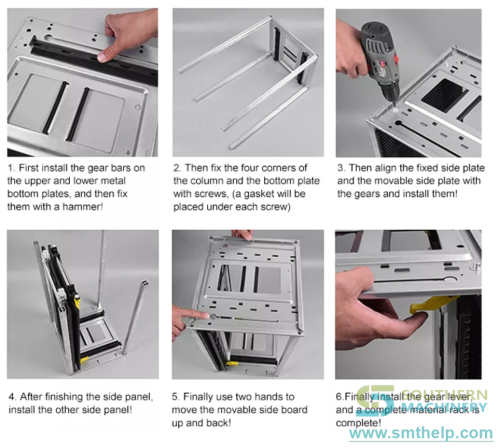
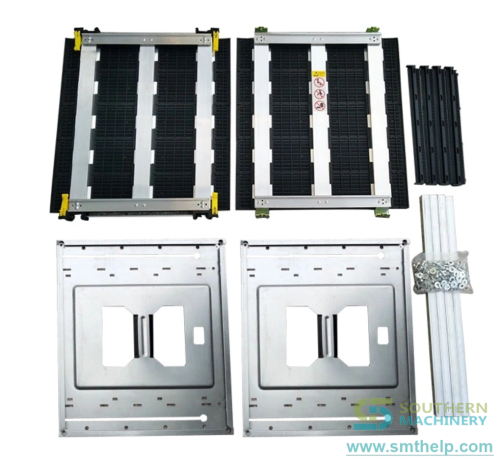
The trolley is a modular stainless-steel frame holding individually detachable ESD PP baskets. Operators clip baskets off at the workbench, load boards, and clip them back — so loading and cleaning happen at the bench, not by leaning into a loaded cart. A divider kit re-sizes each basket for different board footprints, and universal casters (two braked) move WIP between stations and park it at line side.
| Parameter | Specification |
|---|---|
| Frame material | Modular stainless steel, bolt-together sections |
| Basket material | ESD-safe PP, surface resistance 10⁶–10⁹ Ω |
| Detachable baskets | 8–16 per trolley, individually clip-on |
| Adjustable layer pitch | 50 mm increments |
| Total load capacity | 80–120 kg |
| Wheels | 4 × universal casters, 2 with brakes |
| Dimensions (L×W×H) | approx. 900 × 600 × 1500 mm |
| ESD compliance | ANSI/ESD S20.20 workflow, grounded frame |
| Dividers | Optional kits for mixed board sizes |
Confirm basket count and pitch against your largest board and your bench depth before quotation.
Where it fits
The trolley lives at every WIP buffer on a mixed-technology line: between reflow and THT, between insertion and wave, between test and packing. Because it is ESD-safe and modular, it replaces the bare carts and improvised shelving that accumulate at those buffers. It pairs naturally with Southern Machinery board handling — loaders, unloaders, and PCB turn conveyors — so WIP moves from machine to trolley to machine without a bare-handed transfer that breaks the static chain.
The ROI case
Model the effect as four separate lines rather than one blended "trolley saving." Quality: ESD-safe handling removes the silent component degradation that shows up as intermittent field returns. Capacity: detachable baskets let one operator load and clear several trolleys without walking carts to a wash bay, so line-side WIP does not stall during changeover. Downtime: a cracked welded basket no longer sidelines the whole cart. Audit: a clean, grounded, labelled trolley turns a 5S penalty into a non-event. None of these is a guaranteed number — treat any payback you model as a planning benchmark built from your own scrap, rework, and audit data.
Re-run the Detachable-Frame Trolley Audit after every new product family and every customer audit. That audit-and-improvement loop keeps WIP flow ahead of the next walk-through instead of scrambling for it.
Your next step
Send your largest and smallest board dimensions, your typical WIP batch size, and a photo of the cart you use today. Our engineers return a detachable-frame trolley configuration — basket count, pitch, divider kit, and caster spec — and a layout showing where it lands at your line-side buffers. Southern Machinery (Shenzhen, since 2011, 237+ global customers) supplies SMT and THT line equipment with installation, training, and spare-part support.
FAQ
What does "detachable frame" mean here? The ESD baskets clip on and off the frame individually, so operators load, clean, and swap them at the workbench instead of leaning into a fixed cart or wheeling the whole unit to a wash bay.
Is it actually ESD-safe? The baskets are ESD PP held within 10⁶–10⁹ Ω and the frame is grounded, supporting an ANSI/ESD S20.20 workflow. Confirm with a surface-resistance meter during incoming inspection.
How is it different from the welded-frame version? A welded-frame trolley is rigid and lower cost, but a damaged basket takes the whole cart out of service. The detachable version trades a little cost for isolation of failures and bench-level cleaning.
Can the baskets hold different board sizes? Yes. Divider kits re-size each basket, and the layer pitch adjusts in 50 mm steps, so one trolley serves mixed board families on the same line.
Jason Wu
Founder & CEO, Southern Machinery (Shenzhen Southern Machinery Sales and Service Co., Ltd.)
Email: jasonwu@smthelp.com / info@smthelp.com
WhatsApp: +86 13602562576
Catalog & manuals: file.autoinsertion.com | Machine photos: ph.smthelp.com
LinkedIn: linkedin.com/in/smtsupplier | YouTube: youtube.com/c/Smthelping
Comments
Comments appear after approval.