
Loose and Stripped Screws Are a Process Defect — Automate the Torque
Manual screwdriving is inconsistent by definition. Run the Torque Consistency Audit, then see how the screw fastening robot drives every point the same way.
Aug 21, 2026 · Updated Aug 31, 2026 · Jason Wu
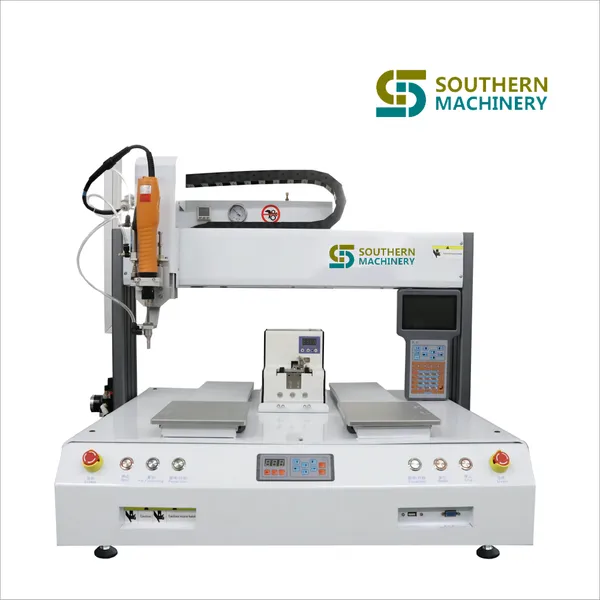
Manual screw fastening is one of the most repeated and most variable steps in electronics assembly. One operator, one screwdriver, dozens of fastening points per unit — and every point depends on that operator's wrist, attention and consistency for the whole shift. Loose, stripped or missing screws don't show up until final test or, worse, the field. By then the cost is a return, not a re-torque.
Southern Machinery's Automatic Screw Tightening Machine — the Screw Fastening Drive Robot — combines an electric screwdriver with an automatic screw feeder so the head drives a screw, lifts, and is continuously re-fed for the next point. It replaces hand screwdrivers with a programmable, closed-loop fastening platform for multi-station assemblies using the same screw spec.
Watch the robot run: Automatic Screw Tightening Machine by Southern Machinery.
Why hand screwdriving breaks yield
A hand driver has no memory and no enforcement. Across a shift it produces a distribution of outcomes:
- Loose screws from a tired or rushed operator — the most common final-test failure.
- Stripped heads from over-torque, especially on brittle or small fasteners.
- Missing screws on a long fastening pattern, caught only at final inspection.
- Ergonomic strain on high-volume runs, which is itself a turnover and consistency risk.
Every one of these is a process defect, not a parts defect. Automating the step removes the human variance from the torque.
The Torque Consistency Audit
Score your fastening risk before specifying a robot. The audit uses your product:
- Count the fastening points. How many screws per unit, and how many units per shift? Manual variance scales with both.
- List the screw spec. Material, head type, diameter, length and torque requirement decide feeder and screwdriver compatibility.
- Map the access. Where are the points, what is the access direction, and can a programmable head reach them without a fixture redesign?
- Decide the verification scope. Do you need per-screw torque data, MES integration, or just consistent driving with an abnormal-fastening alarm?
The audit tells you whether manual screwdriving is still defensible at your volume — and past a certain point, it isn't.
The Vehicle: how the screw fastening robot works
The machine automates fastening into PCBs, housings, enclosures and assembled products. Instead of an operator picking up and driving each screw, it feeds screws automatically, positions the screwdriver over each point with a programmable movement system, drives with consistent torque and depth, then lifts and moves on.
Verified specification from the Southern Machinery product page:
| Parameter | Specification |
|---|---|
| Repeatability accuracy | ±0.02 mm |
| Program memory | 999 programs |
| Programming | Drag-and-teach |
| Maximum PCB size | 200 × 280 mm |
| Movement range | X 580 mm, Y1 & Y2 280 mm, Z 100 mm |
| Axis speed | 600 mm/s (Z-axis 400 mm/s) |
| Screw feeding | Pick-and-place or magnetic |
| Screwdriver | SD / KILEWS / HIOS compatible |
| Drive mode | Closed-loop motor |
| Control | Microcontroller + touch panel |
| Power | AC 220 ± 10%, 50/60 Hz (110 V option) |
| Air pressure | 4.5–6 kg/cm² |
| CCD camera | Optional |
| Core components warranty | 1 year |
Confirm the final configuration against your screw list and product drawings before ordering.
Where it fits in a complete line
The screw tightening machine sits at the end of assembly, after wave or selective soldering, in the final-assembly / box-build stage: SMT (print → place → reflow), THT (insertion → wave → lead cut), inspection (AOI / SPI), then final assembly (screw fastening, PCB mounting, connectors, labeling), then test and packing. One operator loads the workpiece; the robot handles the fastening cycle. With 999 programs, a single unit switches between product variants quickly — an important feature for high-mix EMS.
The ROI case
The most direct return is labor replacement: one machine with one operator replaces several manual screwdriving stations, and the operator only loads. Because every screw is driven with the same torque and depth, rework from loose, stripped or missing screws drops sharply. Other benefits: closed-loop motor and ±0.02 mm repeatability eliminate hand-driver variance; continuous automatic feeding keeps the cycle moving; missing-screw and abnormal-fastening alarms catch problems during the cycle, not at final test; 999-program memory supports mixed-model production without mechanical changeover; and the repetitive strain of manual screwdriving disappears from the line. The exact payback depends on your screw count, labor cost and defect rate — model it with your own numbers.
Make it a recurring check
Re-run the Torque Consistency Audit when you add a product variant, change screw spec, or take on a program where fastening verification is contractually required. For automatic loading / unloading of the workpiece, discuss fixture design and station layout with Southern Machinery's engineers.
Your next step
Send us your screw list, product drawings or photos, and target output — our engineers recommend a practical configuration from a single workstation to a wider assembly automation solution. Southern Machinery (Shenzhen, China, since 2011, 237+ global customers) supplies SMT / THT, wave soldering, board handling and inspection, with installation, training and spare parts for the full line.
FAQ
What screws can it handle? Compatible with SD, KILEWS and HIOS screwdrivers; supports pick-and-place or magnetic feeding. Confirm material, head type, diameter, length and torque for your configuration.
Does it integrate with existing lines? Yes — a programmable desktop / standalone robot (max PCB 200 × 280 mm) placed at the final-assembly stage; Southern Machinery advises on fixture design and semi / automatic loading.
How is it programmed? Drag-and-teach with up to 999 stored programs on a microcontroller + touch panel — operators teach fastening positions directly, no specialized programming skills needed.
How does automation improve quality? Every screw is driven with consistent torque by a closed-loop motor at ±0.02 mm repeatability, with alarms for abnormal fastening — eliminating the loose / stripped / missing-screw defects of hand assembly.
Jason Wu
Founder & CEO, Southern Machinery (Shenzhen Southern Machinery Sales and Service Co., Ltd.)
Email: jasonwu@smthelp.com / info@smthelp.com
WhatsApp: +86 13602562576
Catalog & manuals: file.autoinsertion.com | Machine photos: ph.smthelp.com
LinkedIn: linkedin.com/in/smtsupplier | YouTube: youtube.com/c/Smthelping
Comments
Comments appear after approval.