
The Capacitor That Keeps Your Line Human
Your SMT side is repeatable and your THT side is still people. Often the whole difference is one taped radial capacitor nobody can feed consistently.
Jul 4, 2026 · Updated Aug 29, 2026 · Jason Wu
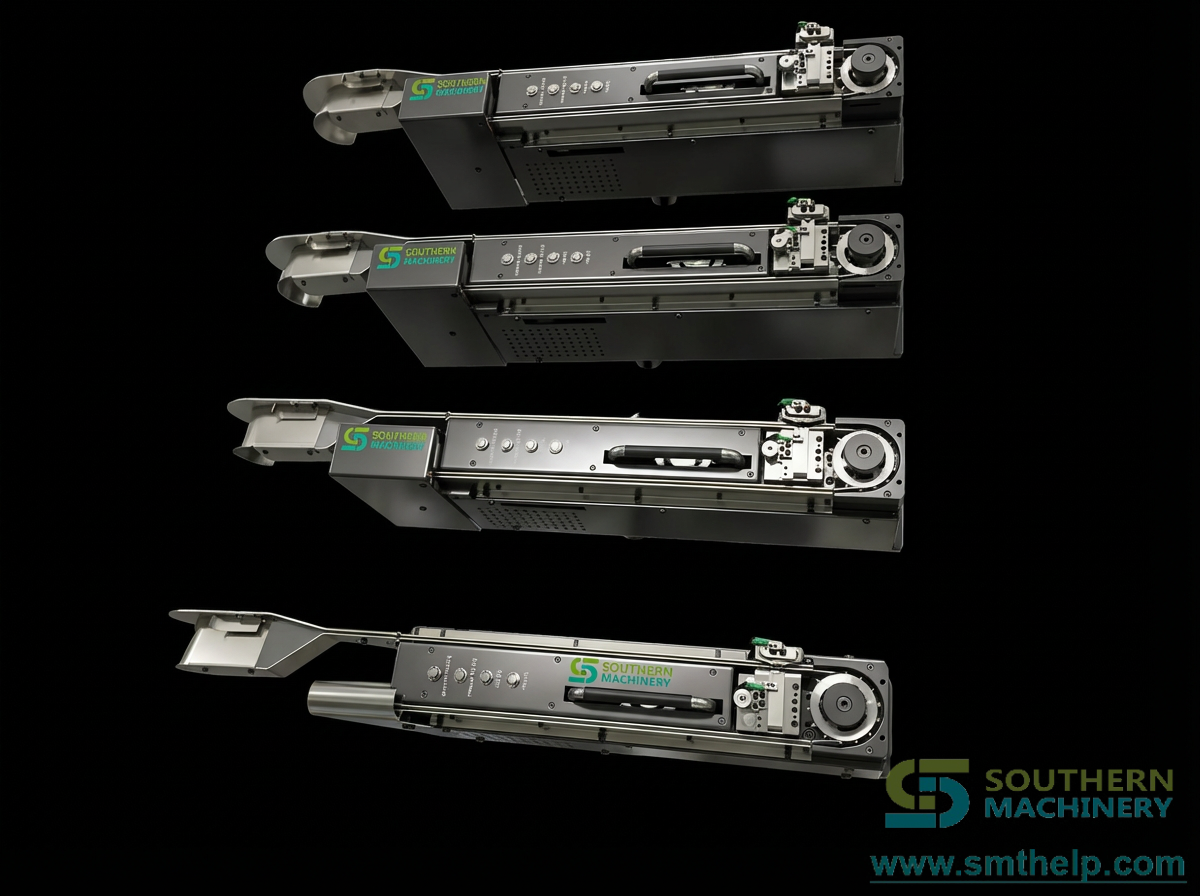
One taped capacitor is holding your automation project hostage.
Not the mounter, not the reflow oven, not the budget. It is the radial electrolytic that still gets hand-cut, hand-formed and hand-fed — because nobody has ever specified how that part arrives at the pick point.
Everything upstream of it is repeatable. Everything downstream waits on it.
Why radial parts stay manual when everything else automated
The component itself is not the problem. Radial parts survive in power supplies, LED drivers, industrial control boards and automotive modules for good reasons: thermal performance, mechanical strength, cost, and approved vendor lists nobody wants to reopen.
What makes them a bottleneck is that they arrive needing work before they can be placed:
- Leads must be cut to a consistent length.
- Some parts need bending or forming before insertion.
- Tape pitch has to match the feeder — and 12.7 mm and 15 mm are not interchangeable.
- Orientation has to stay stable from tape to pick point.
- Every operator does it slightly differently, so the process drifts between shifts.
That last one is the expensive one. Manual feeding does not produce a defect rate you can dial in — it produces variation, and variation is what makes your downstream AOI data useless.
The Lead Geometry Audit: five questions before you spec a feeder
Answer these in order. Skipping to question five is how factories buy feeders that sit in a crate.
1. What exactly is the part? Capacitor, varistor, LED, connector. Body size drives tooling; the reference range for this feeder class runs from roughly 2 × 2 × 2 mm up to 15 × 15 × 30 mm.
2. What is the lead? Diameter in the 0.3–1.0 mm band is the documented reference. Lead stiffness determines how aggressively you can cut and form before the part moves.
3. What is the tape pitch — verified, not assumed? 12.7 mm or 15 mm. Measure the actual tape. Mismatch here is the single most common reason a feeder underperforms on arrival.
4. What does "formed" mean for this board? Straight cut, bent lead, formed lead, insertion angle. Each one is a different mechanism, and it is cheaper to decide now than to retrofit.
5. Who is picking, and from where? SMT mounter, THT insertion head, or robot. Working height, signal interface and pick-up clearance all have to match. A feeder that presents the part perfectly to the wrong machine is a paperweight.
The reference figures for this class also include a cycle time under one second per component and ±0.2 mm feeding accuracy, on 24 V DC with 0.4–0.6 MPa compressed air. Treat all of these as source-document examples: final values are confirmed against your component drawing and the actual feeder build.
Where the feeder actually sits in the line
A feeder is not an accessory you bolt on at the end. It has to be designed into the flow.
In an SMT-led mixed line, it typically supports a mounter or dedicated placement station: loader → conveyor → stencil printer → pick-and-place, with the radial feeder covering selected leaded parts → reflow → AOI → unload.
In a THT automation line, it feeds the insertion step: loader → radial tape feeder with lead preparation → radial insertion or robotic placement → clinching or fixture support → wave or selective soldering → THT AOI / ICT / FCT → NG/OK sorting.
In a traceability-driven plant, it becomes part of material management: part-number recognition, quantity tracking, setup error prevention and maintenance data. How deep that integration goes depends on the feeder model and your MES.
We build radial tape feeders around the five audit answers — body size, lead diameter, tape pitch, forming requirement, and target machine interface. Southern Machinery has supplied SMT and THT automation from Shenzhen since 2011 and supports 237+ global customers, but the relevant part is narrower: we will tell you when a standard platform fits and when you need custom tooling.
Close the loop: keep the audit alive
Re-run the Lead Geometry Audit every time you onboard a new radial part number, and keep the answers in one sheet your setup technicians can reach. Most feeder "failures" we see in the field are not mechanical — they are a new part number introduced without re-checking pitch and lead diameter.
On maintenance, three areas carry almost all the risk: tape transport (loading, debris, pitch mismatch), component processing (worn cutting blades, forming die alignment, unstable air pressure), and electrical or pneumatic faults (worn seals, loose connectors, jams tripping motor overload). Preventive cleaning, scheduled wear-part replacement, filtered stable air and regular tape-path checks cover most of it.
Your next step
Send the component drawing or a few samples, the tape specification, the PCB insertion requirement, and the model of the mounter or insertion machine that has to pick the part. We will confirm whether a standard radial tape feeder covers it or whether you need custom tooling — and if the honest answer is "you do not need this machine yet," you will get that answer.
Catalog and documentation: file.autoinsertion.com. Installed machines and detail photos: ph.smthelp.com. Process videos: youtube.com/c/Smthelping.
Jason Wu
Founder & CEO, Southern Machinery (Shenzhen Southern Machinery Sales and Service Co., Ltd.)
Email: jasonwu@smthelp.com / info@smthelp.com
WhatsApp: +86 13602562576
Catalog & manuals: file.autoinsertion.com | Machine photos: ph.smthelp.com
LinkedIn: linkedin.com/in/smtsupplier | YouTube: youtube.com/c/Smthelping
Comments
Comments appear after approval.