
Custom SMT Nozzles and Grippers for Odd-Form Automation
Custom SMT nozzles and grippers that let an existing mounter place off-center, irregular odd-form parts your standard tooling cannot hold reliably.
Aug 4, 2026 · Updated Aug 31, 2026 · Jason Wu
Custom SMT Nozzles and Grippers for Odd-Form Automation
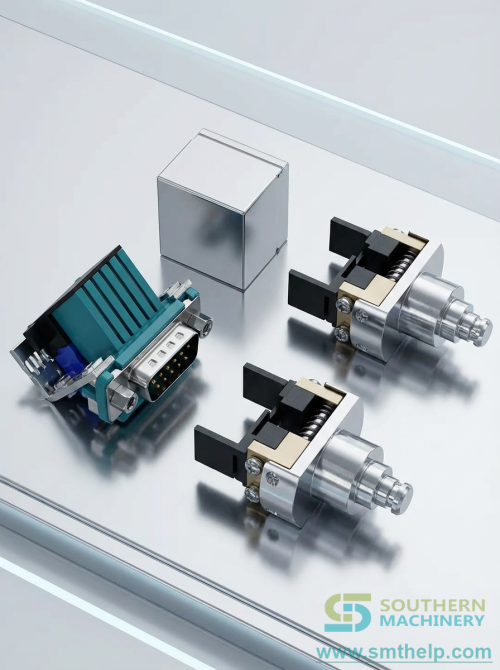
An odd-form connector with an off-center housing can stop a high-speed SMT line faster than any scrap event. Standard nozzles are built for regular packages, so when a relay, shield or terminal has no flat pickup face, the line either stalls or falls back to manual placement. Southern Machinery builds custom SMT nozzles and mechanical grippers as end-of-arm tooling that matches the actual part, the host mounter and the surrounding process — so irregular components stay in the automated flow instead of on an operator's bench.
The cost you haven't named: standard tooling on odd-form parts
Most factories buy nozzles by catalog and only discover the gap when an irregular part hits the line. The real cost is not the tool — it is the automation that quietly drops out.
- Off-center mass defeats a centered vacuum. Many odd-form parts carry their weight away from the pickup point, so a standard nozzle either misses grip or rotates the part during transfer, breaking placement accuracy.
- Limited or curved pickup surfaces. Shields, housings and connectors often present no flat face for a vacuum seal, forcing manual placement or a fragile makeshift adapter that nobody wants to own.
- Clearance collisions at the head. A generic tool may not respect surrounding components or the head travel envelope, risking damaged leads, board scratches or a jammed feeder lane.
- Hidden rework and traceability loss. When odd-form parts fall out of the automated flow, every manual touch adds handling risk and breaks the clean placement record your audit expects.
The Odd-Form Pickup Tooling Audit
Before ordering any custom nozzle or gripper, frame the problem as a repeatable audit rather than a one-off purchase. Call it the Odd-Form Pickup Tooling Audit.
1. Profile the part. Capture the package geometry, center of gravity, permitted contact surfaces and lead layout from the real component — not a catalog photo. The audit starts with the physical part on the bench, because every downstream decision depends on what the part actually is.
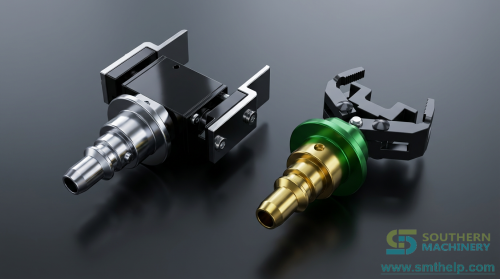
2. Choose the grip method. Decide between a custom vacuum nozzle and a mechanical gripper based on the pickup surface and required engagement. A gripper is a candidate where no stable vacuum face exists and side clearance allows controlled holding of the part.
3. Match the host interface. Confirm the mounter or robotic cell mounting head, program requirements and the clearance available during pickup and placement. The tool is only useful if it physically and electronically fits the host machine you already run.
4. Validate the cycle. Run the actual component through pick, orient, place and inspection on the target line before release. Sign-off on a sample run, not on a drawing, becomes the acceptance test that protects both sides.
The vehicle: Southern Machinery custom nozzle & gripper service
The framework above maps directly onto how a custom tool is engineered and delivered for a real production line.
- Profile the part → sample-based engineering. We start from your component drawings and physical samples, mapping mass distribution, contact limits and orientation so the tool follows the part rather than forcing the part to fit a generic nozzle.
- Choose the grip method → vacuum or gripper design. For parts with a usable surface we build a custom vacuum nozzle; where geometry needs side engagement we design a mechanical gripper sized to the available clearance around the head.
- Match the host interface → mounter-compatible mounting. Each tool is built around the target mounting head or robotic cell interface, including the program and clearance envelope, so it drops into the existing line without rework or a new control scheme.
- Validate the cycle → integrated line review. We can place the tooling within a broader SMT and THT flow — feeders, odd-form insertion, board handling, inspection and soldering — so pickup is reviewed as part of the whole process.
Specification note: nozzle bore, grip force, body material, mounting style and cycle rating should be confirmed at quotation, because they depend on your specific component, host machine and line process rather than a single default design.
| Parameter | Value |
| Component size range | 3 × 3 × 3 mm to 60 × 60 × 40 mm (sample dependent) |
| Pickup method | Custom vacuum nozzle or mechanical gripper |
| Grip repeatability | ±0.05 mm typical (confirmed at quotation) |
| Host compatibility | SMT mounter or robotic cell with defined mounting head |
| Permitted contact surfaces | Defined per component sample |
| Body material options | Aluminium, PEEK, antistatic polymers |
| Engineering lead-time | Subject to component complexity and review |
| Validation method | Sample run on target line before release |
The loop: re-qualify on every product change
Odd-form programs change more often than people plan for, and a tool that worked for last quarter's connector may not hold the next one. Build a loop: every time a new component family enters the line, repeat the Odd-Form Pickup Tooling Audit on that part, re-profile its mass and contact surfaces, and re-validate the pick-and-place cycle on the host mounter before ramping volume. Keep the original audit as the baseline and compare grip performance across product changes, so a drift in placement accuracy is caught at the tooling review instead of on a customer return. The loop is what keeps custom tooling earning its place instead of becoming a one-part curiosity sitting in a drawer.

Your next step
Send us your component drawings, physical samples and the host mounter model you run today. We will return a tooling concept — vacuum nozzle or mechanical gripper — matched to your part geometry, clearance and line sequence, plus what to confirm at quotation. Reach Jason at jasonwu@smthelp.com or on WhatsApp +86 13602562576.
FAQ
Can a custom nozzle work with an existing SMT mounter?
It can, provided the nozzle interface, pickup method, clearance and program match the machine. Share the host equipment details for technical confirmation before any build starts.
When is a mechanical gripper preferable to a vacuum nozzle?
A gripper is a candidate when the component has no reliable vacuum pickup surface or needs controlled side engagement. The final choice depends on geometry and the clearance available at the head.
Which files should we provide for a quotation or feasibility review?
Provide component drawings, samples where possible, packaging details, host-machine information and your desired production flow so the audit can be completed on the real part.
Can Southern Machinery support both SMT and THT automation?
Yes. Southern Machinery, founded in Shenzhen, China in 2011, focuses on SMT and THT PCB assembly automation equipment, including wave soldering, board handling, inspection and integrated line solutions for global manufacturers.
Jason Wu
Founder & CEO, Southern Machinery (Shenzhen Southern Machinery Sales and Service Co., Ltd.)
Email: jasonwu@smthelp.com / info@smthelp.com
WhatsApp: +86 13602562576
Catalog & manuals: file.autoinsertion.com | Machine photos: ph.smthelp.com
LinkedIn: linkedin.com/in/smtsupplier | YouTube: youtube.com/c/Smthelping
Comments
Comments appear after approval.