
Desktop Selective Soldering S-100B by Southern Machinery
The S-100B Desktop Selective Soldering Machine by Southern Machinery delivers ±0.1 mm precision for R&D sampling and small-batch PCB assembly. Its compact 550×650×650 mm, 450 kg desktop footprint supports 350×300 mm soldering area and 0.2–6 mm PCB thickness, with jet-valve flux and a 12 kg solder pot integrating into SMT/THT lines to reduce rework, stabilize joint quality, and lower cost per joint. Built by Southern Machinery — founded 2011 in Shenzhen, serving 237+ global customers — it offers high-efficiency, cost-effective automation with global service, spare parts, and professional training for EMS, ODM, automotive and medical teams needing traceable, repeatable soldering without wave line overhead.
Sep 7, 2026 · Updated Sep 7, 2026 · Jason Wu
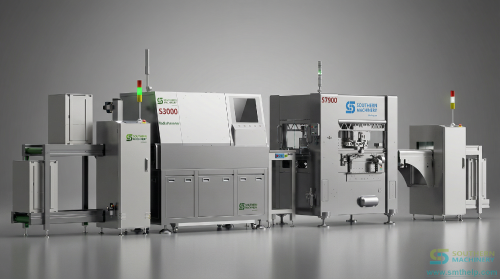
Desktop Selective Soldering S-100B by Southern Machinery
The S-100B Desktop Selective Soldering Machine by Southern Machinery is a compact XYZ selective soldering system for R&D sampling and small-batch THT production. What is this machine used for? It selectively solders through-hole joints with ±0.1 mm position accuracy on boards 0.2–6 mm thick, using jet-valve flux and a 12 kg solder pot within a 550×650×650 mm, 450 kg desktop footprint.
1. Your Defects Are Not a Material Problem — They Are a Selectivity Problem
Most rework in low-volume THT does not come from bad solder. It comes from heating everything when you only needed one joint.
If you still run prototypes through a full wave or hand-solder connectors, you pay with bridges, lifted pads, and inconsistent fillets. The S-100B reframes the question: what if you only heated the exact joint that needs solder, at the temperature and angle it needs?
That shift — from batch heating to point heating — is why selective soldering matters for R&D and 10–500-board runs.
Why It Matters for EMS and OEM Teams
In automotive, aerospace, and medical electronics, one cold joint fails a test or field qualification. Selective soldering isolates thermal stress to the target, protecting nearby SMT joints already reflowed. For sampling, it means your pilot run actually predicts mass production.
2. Why R&D and Small-Batch Lines Quietly Lose Yield
The prototype passes, the pre-production batch does not. Design is the same, operator is the same — yet yield drops.
The hidden困境 is not skill. It is repeatability without traceability.
The Invisible Cost of Hand and Wave in Small Batches
- Hand soldering depends on wrist angle and dwell time. Knowledge stays in the operator, not the process. PC software cannot trace a hand.
- Wave soldering is economic at 1,000+ boards with stable panels. For 20–200 boards, setup, nitrogen, flux, and board handling dominate, and thermal shadowing creates defects on mixed SMT/THT boards.
You wanted flexibility. You got variability. That is the analysis industrial-control and medical buyers recognize: the line is flexible, quality is not repeatable.
3. Selective vs Wave vs Manual — Which Fits R&D and Small-Batch Assembly?
Use this 4-step decision model before requesting any quotation.
Step 1 — Map Your Board Reality
List max board size, thickness, keep-out. S-100B supports 350×250 mm, 300×300 mm, 350×300 mm, 400×300 mm and PCB 0.2–6 mm. If panel exceeds 400×300 mm, you need offline or inline selective, not desktop.
Step 2 — Classify Joint Difficulty
Separate easy joints (2.54 mm connectors) from difficult ones (large ground planes, transformers). Selective excels where thermal mass varies — jet flux plus 0–350°C nitrogen preheat adapts per joint; wave applies one profile to all.
Step 3 — Model Batch Economics
Calculate cost per good board, including setup, nitrogen 1–2 m³/hour (example), flux 1L capacity, and rework. Desktop selective wins when rework exceeds wave amortization; wave wins above ~300 boards/shift with identical panels.
Step 4 — Demand Traceability
If your customer requires traceability — medical and automotive do — PC-monitored XYZ motion (±0.1 mm) beats memory-based hand soldering. S-100B logs critical parameters via PC software with full traceability.

| Criterion | S-100B Desktop Selective | Wave Soldering | Hand Soldering |
|---|---|---|---|
| Ideal volume | R&D, 10–500 boards | 1k+ identical | Rework, 1–5 |
| Accuracy | ±0.1 mm, PC XYZ | Full board | Operator dependent |
| Thermal impact | Local | Whole board | Local unlogged |
| Traceability | PC software, full | Limited | None |
| Changeover | Program per joint | Tooling, slower | N/A |
| Footprint | 550×650×650 mm, 450 kg | Large line | Bench |
4. How the S-100B Executes the Decision Model
A decision model without an execution system is just theory. The S-100B lands selective soldering in labs without rebuilding the line.
How Does the S-100B Cut Cost per Joint While Keeping ±0.1 mm Accuracy?
Jet-valve flux applies only where needed, nitrogen 0–350°C preheats locally, and a 12 kg pot with XYZ motion delivers solder at ±0.1 mm. Single-phase 220V 50Hz and 1–2 m³/hour nitrogen keep utilities simple. You do not heat the whole board to fix one joint, so you do not pay for energy and rework on joints that were already good.
Key Selection Parameters — Confirm Before RFQ
| Parameter | S-100B (per source) | Buyer Check |
|---|---|---|
| Model | S-100B | Desktop vs inline need |
| Dimensions | 550×650×650 mm | Bench clearance |
| Weight | 450 kg | Floor load |
| Power | Single phase 220V 50Hz | Lab supply |
| Max solder area | 350×250 / 300×300 / 350×300 / 400×300 mm | Panel size |
| PCB thickness | 0.2–6 mm | Stack-up |
| Position accuracy | ±0.1 mm | Keep-out |
| Flux system | Jet valve, 1L | Compatibility |
| N2 temperature | 0–350°C | Profile |
| N2 consumption | 1–2 m³/hour (example) | Cost |
| Solder pot | 12 kgs/furnace | Alloy |
Not specified in source — contact Southern Machinery to confirm: nozzle options, preheat power, SMEMA, software version.
How It Fits a Complete PCB Assembly Line
S-100B integrates after SMT and THT insertion:
- SMT front end: stencil printer → pick-and-place → reflow → SPI/AOI — see SMT Machine and Peripheral Equipment
- THT cell: auto insertion → board handling conveyor → S-100B — see Board Handling System
- Post-solder: inspection, cleaning, functional test
For high volume, Southern Machinery also offers wave soldering (Wave Soldering Machines) and inline selective systems.
ROI and Quality Value — Formula Then Example
ROI formula (example, subject to final technical confirmation):
Annual saving = (Rework hours saved × labor rate) + (Scrap saved × board cost) + (Nitrogen/flux delta) − (Amortization + training)
Payback months = Investment / (Annual saving / 12)
Example (illustrative, depending on configuration): 80 boards/month, 40 joints/board, 3% hand defect rate = 96 defects/month. At 8 min/defect → 12.8 hours rework. With S-100B at 0.5% (example) → 16 defects → 2.1 hours. Saved 10.7 hours × $18 (example) = $193/month + 4 boards saved × $25 (example) = $100 → $293/month → $3,516/year before nitrogen delta. Actual depends on board — subject to final technical confirmation. No guaranteed ROI.

5. Building a Repeatable Knowledge System Beyond One Machine
A machine solves today. A repeatable system solves the next 100 boards.
What Happens After Installation?
Southern Machinery, founded 2011 in Shenzhen, serves 237+ global customers with high-efficiency, cost-effective SMT/THT automation, spare parts, professional training, and global service. For S-100B, the cycle is:
- Program library — Save per-board recipes (flux, preheat, drag speed, pot temp) in PC software.
- Weekly trace review — Export logs to link defects to parameters, not operator mood.
- Quarterly line checklist — Review handling and inspection so selective does not bottleneck when volume grows.
Subscribe to the [PCB Assembly Automation] series. Next month: “S-100B vs Inline Selective: When Does Desktop Hit Its Limit?”
6. Your Next Step — From Sample to Verified Process
If your prototype has 10+ through-hole joints and batch is 20–500 boards, test selective soldering on your actual board.
Do this next:
- Measure largest PCB and heaviest joint — confirm within 400×300 mm and 0.2–6 mm.
- Send Gerber/BOM for joint assessment — we mark selective vs wave/hand.
- Request pre-filled S-100B quote with nitrogen/flux estimate.
→ Contact: Get a quote | Global services | Catalog: file.autoinsertion.com
Southern Machinery — Smart EMS Factory Partner. Since 2011 in Shenzhen.
FAQ
Q1: What is the S-100B used for?
A: Selectively soldering through-hole joints for R&D and small-batch PCB assembly with ±0.1 mm XYZ accuracy, protecting nearby SMT joints.
Q2: What board sizes and thickness does it support?
A: Per source: 350×250 mm, 300×300 mm, 350×300 mm, 400×300 mm; PCB 0.2–6 mm. Confirm within 400×300 mm max.
Q3: How accurate and how is flux applied?
A: ±0.1 mm PC-controlled XYZ; jet valve flux 1L; nitrogen 0–350°C; 12 kg solder pot.
Q4: Selective vs wave for small batches?
A: Selective is per-joint traceable, ideal for 10–500 mixed boards. Wave is economical for 1k+ identical boards but heats the whole board.
Q5: Utilities and footprint?
A: 550×650×650 mm, 450 kg, single-phase 220V 50Hz, 1–2 m³/hour nitrogen (example). Confirm supply.
Q6: Can it integrate into a full line?
A: Yes, after THT insertion and board handling, before inspection. Southern Machinery provides full SMT/THT, handling, soldering, inspection — see www.smthelp.com.
---
Next article teaser: Next article compares desktop vs inline selective TCO at 500 vs 5,000 boards/month with a reusable TCO sheet for your RFQ.
Comments
Comments appear after approval.