
Stacks of Bare Boards Deserve an Automated Handoff
Manual stacking damages bare boards and breaks flow. Run the Bare-Board Handoff Audit, then see how the SLC4601 automates both ends.
Aug 17, 2026 · Updated Aug 31, 2026 · Jason Wu
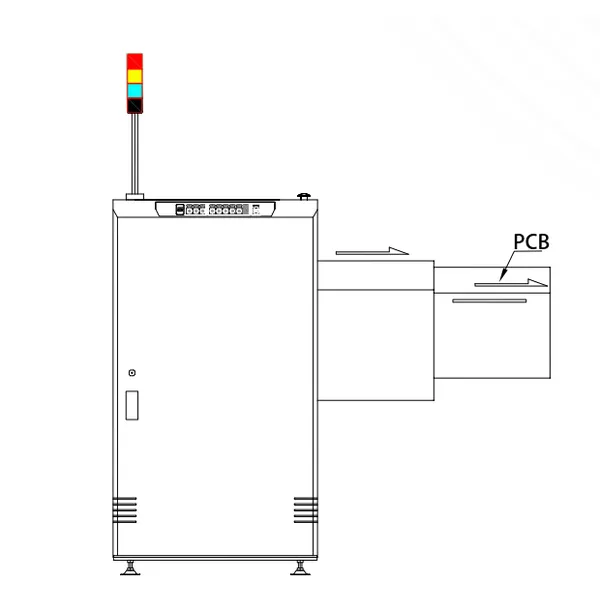
Bare boards arrive in stacks and leave in stacks, and the work between those two points is usually done by hand. An operator unstacks the bottom board, places it on the belt, and at the other end someone stacks finished boards back up — all shift long. It is repetitive, slow, and a steady source of scratches, flex damage, and ESD events. Worse, the line only moves as fast as the person at each end, so both ends cap throughput at once.
Southern Machinery's destacker PCB loader and stacker PCB unloader — the SLC4601 reference model — automate exactly this step. The destacker separates bare boards from a stack one by one and feeds them onto the conveyor at SMEMA-compatible speed; the stacker collects finished boards back into stacks at the outfeed, protecting them for the next process.
Why manual stacking breaks yield
A hand at each end of the line introduces variance the process cannot absorb:
- Scratched and flexed boards — manual separation stresses thin panels, especially below 0.4 mm.
- ESD events — every bare-board touch is a chance to damage sensitive circuitry invisibly.
- Bent edges and misstack — finished boards stacked by hand shift and can be mishandled at outfeed.
- Throttled feed — the unstacker slows as the operator tires and the stack runs low.
- Two tied-up operators — one at line start, one at line end, neither adding value upstream.
Every one of these is a handling defect, not a process defect. Automating both ends removes the human from the board's most exposed moments.
The Bare-Board Handoff Audit
Score your board handling before specifying a destacker/stacker. The audit uses your board mix:
1. Count the stack. How many boards per magazine, and at what thickness? That sets stack capacity and separation method.
2. Measure the panel. Maximum width and minimum thickness decide whether push-type or vacuum lift destacking fits your boards.
3. Confirm the line height. Conveyor height and direction must match the rest of the line so the loader drops in without rework.
4. Check the signal. SMEMA handshake keeps the loader releasing only when the next station is ready — confirm it syncs with your printers and placers.
The audit tells you whether manual unstacking is still defensible at your volume — and past a certain point, it isn't.
The Vehicle: how the SLC4601 works
The SLC4601 holds a stack of bare PCBs on a lift table and separates the bottom board, then transfers it onto the line conveyor; the stacker reverses the action at the outfeed. A single belt drive and PLC control keep the move consistent every cycle, and the standard SMEMA signal means it stops and starts automatically with the conveyor — it cannot pile up or starve the line. Vacuum-lift variants suit thin or flexible boards where push-type separation would stress them.
Verified specification from the Southern Machinery product data:
| Parameter | Specification |
|---|---|
| Stack capacity | Up to 200 boards (at 0.4 mm thickness) |
| Maximum board width | 460 mm |
| Minimum board thickness | 0.4 mm |
| Conveyor speed | Up to 10,000 mm/min |
| Conveyor height | 900 ± 20 mm (standard SMEMA band) |
| PCB direction | Left → Right |
| Communication | SMEMA signal plug |
| Control | PLC, single belt drive |
| Power | Single-phase 220 V, 50/60 Hz, 80 W |
| Footprint / weight | 889 × 589 × 1200 mm / 180 kg |
Confirm your board thickness range and separation method against the machine before ordering.
Where it fits in a complete line
The destacker loader is the first station of a typical SMT line, and the stacker unloader is usually the last: Bare board stack → Destacker loader → Stencil printer → SPI → Pick & place → Reflow → AOI → Stacker unloader. On THT lines the same loader feeds the insertion cell and the stacker collects boards after wave soldering and lead cutting. Southern Machinery supplies the whole chain around these endpoints — shuttle conveyors, 90° turn modules, NG/OK buffers, magazine loaders, and vertical buffers — so a destacker from the same supplier matches conveyor height, rail width, and signal logic, avoiding the usual mixed-vendor integration headache.
The ROI case
The business case for a destacker/stacker pair is among the fastest in board handling. One loader replaces an operator at line start and one stacker replaces an operator at line end — on a two-shift line that is four operator positions per day, per line. A machine separates and feeds at the same speed and orientation every cycle, so consistency holds as the shift wears on, and fewer hands on bare boards means fewer scratches, ESD events, and bent edges that surface only after printing or reflow. The exact payback depends on your labor cost and board damage rate — model it with your own numbers, and re-run the Bare-Board Handoff Audit when you change board size or thickness; this audit-and-improvement loop keeps the handling matched to your mix as it changes.
Your next step
Send us your board size, thickness, and stack count — our engineers recommend an SLC4601 configuration and show how it links to your existing conveyors. Southern Machinery (Shenzhen, China, since 2011, 237+ global customers) supplies loaders, unloaders, destackers, stackers, conveyors, and buffers as individual machines or a complete line, with installation, training, and spare parts.
FAQ
What is a destacker PCB loader? It separates bare PCBs from a stack one at a time and feeds them onto an SMT or THT line conveyor, replacing manual unstacking at the line input.
What is a stacker PCB unloader? It collects finished boards from the line conveyor and stacks them onto a magazine or pallet at the outfeed, protecting them for the next process step.
How many boards can the SLC4601 hold? It has a 200-board stack capacity at 0.4 mm thickness, supports boards up to 460 mm wide, and feeds at conveyor speeds up to 10,000 mm/min.
Does it work with existing SMT equipment? Yes — the SLC4601 uses standard SMEMA signal communication and a 900 ± 20 mm conveyor height, so it syncs with printers, placers, reflow ovens, and conveyors from other vendors.
Can Southern Machinery supply the full handling system? Yes — shuttle conveyors, turn modules, NG/OK buffers, magazine loaders/unloaders, and vacuum loaders can all come from one supplier with matched heights and signals.
Jason Wu
Founder & CEO, Southern Machinery (Shenzhen Southern Machinery Sales and Service Co., Ltd.)
Email: jasonwu@smthelp.com / info@smthelp.com
WhatsApp: +86 13602562576
Catalog & manuals: file.autoinsertion.com | Machine photos: ph.smthelp.com
LinkedIn: linkedin.com/in/smtsupplier | YouTube: youtube.com/c/Smthelping
Comments
Comments appear after approval.