
Fixture-Free Selective Wave Soldering Machine
A floor-standing, fixture-free selective wave soldering machine that programs the board in software and solders only where the process specifies.
Aug 15, 2026 · Updated Aug 31, 2026 · Jason Wu
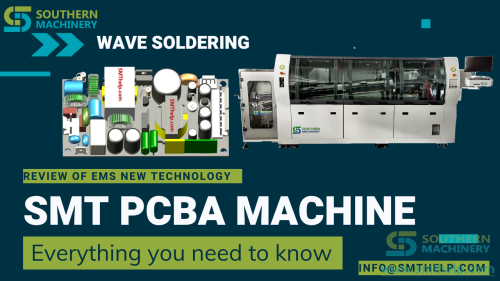
Fully Automatic Selective Wave Soldering Machine: Fixture-Free THT Soldering by Southern Machinery
A new board variant should mean a new program, not a new pallet sitting in a queue for tooling. On most THT lines, every variant change triggers a fixture order, a lead time and a line stop — and that hidden tax is why small and mid batches get soldered by hand even when a machine would be cleaner. Southern Machinery's fully automatic selective wave soldering machine removes the pallet from the equation: the board is held and programmed directly in software, then molten solder is applied only where the program specifies.
The cost you haven't named: the fixture tax on THT
Traditional THT soldering usually resolves into three expensive options, and each one carries a tax most factories accept without measuring it.
- Fixture cost and changeover time. Every board variant needs tooling, and every tooling change stops the line. The cost is not just the pallet — it is the waiting.
- Whole-board wave on small jobs. Running a small board through a full wave line wastes flux, solder and energy on areas that were never going to be soldered.
- Hand soldering variance. Where fixtures are too costly to justify, operators solder by hand, and joint quality drifts shift to shift with the person on the bench.
- Changeover as a software gap. When changeover is a physical tool rather than a file, high-mix production pays a tax on every new customer order.
The Four-Mode Selective Soldering Framework
Frame the buying decision as a repeatable framework rather than a feature list. Call it the Four-Mode Selective Soldering Framework.
1. Define the joint map. List every through-hole, leaded and odd-form joint on the board and separate the ones that need solder from the ones that must stay clean. The board, not a pallet, drives the program.
2. Match the welding mode. Pick the mode per joint: spot welding for isolated pins, drag welding for lines of pins, continuous spot welding for repeated single points, and continuous drag welding for longer runs. The four modes cover most joint geometries.
3. Set the program as the changeover. Store each board as a software file so a variant change is a load step, not a tooling order. This is what turns high-mix THT from a fixture problem into a data problem.
4. Lock consistency at the wave. Hold solder temperature, dwell and nitrogen (where used) to a repeatable setting so joint quality stays stable across shifts and operators.
The vehicle: Fully Automatic Selective Wave Soldering Machine
The framework maps directly onto the machine's operation.
- Define the joint map → software-held board. The machine holds and programs the board directly, applying molten solder only where the program specifies — in spot, drag, continuous spot or continuous drag mode.
- Match the welding mode → four modes built in. It handles connectors, PCB components, LED strings, circuit boards and general electronics processing across the four welding modes without hardware change.
- Set the program as the changeover → fast variant switch. For EMS, ODM, automotive electronics, medical electronics and industrial control factories, changeover becomes a programming step that removes fixture budgets.
- Lock consistency at the wave → stable joints. By soldering only the defined joints, it keeps joints consistent shift after shift and is a practical replacement for hand soldering and a flexible alternative to whole-board wave soldering.
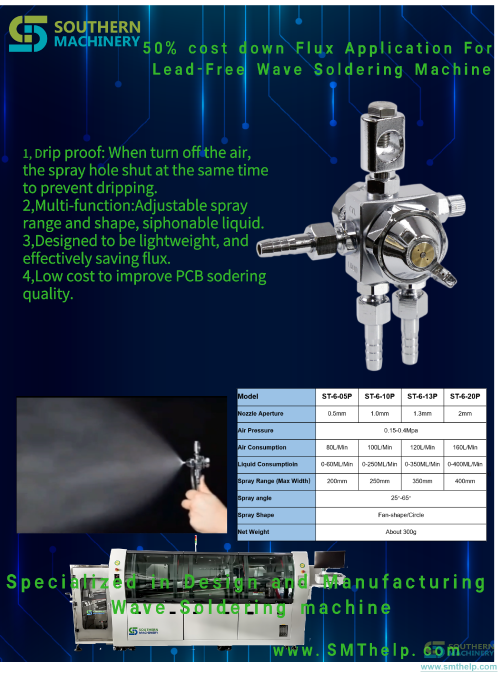
Flux application is part of the same controlled process: the board receives flux only where the program calls for it, which supports lead-free profiles while limiting flux consumption on areas that stay dry.
Specification note: solder pot capacity, peak temperature range, nitrogen option, conveyor width and throughput should be confirmed at quotation, since they depend on your board size and mix.

In a line context, the fixture-free machine slots after auto-insertion: insertion places the THT parts, and selective soldering completes the joints without a dedicated pallet for each variant.
The loop: re-program at every variant change
Product mixes change, and so does the joint map. Build a loop: every time a new board enters the line, update its soldering program as a file and archive it against the board revision. Review first-pass yield on soldered joints monthly, and feed any bridge or open-joint pattern back into the program. The loop keeps the fixture-free advantage real — changeover stays a software step, not a tooling order — and is what protects the payback benchmark, which you should validate against your own headcount and shift pattern.
Your next step
Send us your most representative board variants and the joint map you struggle to fixture today. We will outline a fixture-free program approach and tell you what to confirm at quotation for pot size, temperature range and throughput. Reach Jason at jasonwu@smthelp.com or on WhatsApp +86 13602562576.
FAQ
What is fixture-free selective wave soldering?
The board is programmed directly and soldered only at the defined joints, so no per-board pallet or fixture is needed for changeover.
Which welding modes are supported?
Spot welding, drag welding, continuous spot welding and continuous drag welding — selected per joint geometry in the program.
Who uses this machine?
EMS, ODM, automotive electronics, medical electronics and industrial control factories running high-mix THT and odd-form joints.
Does it replace hand soldering?
For defined through-hole and odd-form joints, it is a practical replacement that keeps quality stable across shifts and operators.
What should I confirm before ordering?
Solder pot capacity, peak temperature range, nitrogen option, conveyor width and throughput are confirmed at quotation against your board samples.
Jason Wu
Founder & CEO, Southern Machinery (Shenzhen Southern Machinery Sales and Service Co., Ltd.)
Email: jasonwu@smthelp.com / info@smthelp.com
WhatsApp: +86 13602562576
Catalog & manuals: file.autoinsertion.com | Machine photos: ph.smthelp.com
LinkedIn: linkedin.com/in/smtsupplier | YouTube: youtube.com/c/Smthelping
Comments
Comments appear after approval.