
High-Performance EMS Curing Oven Solution for Smart PCB Assembly
A controlled EMS curing oven applies uniform, repeatable heat to cure conformal coating, SMT adhesive and underfill — locking in reliability after soldering.
Aug 7, 2026 · Updated Aug 31, 2026 · Jason Wu
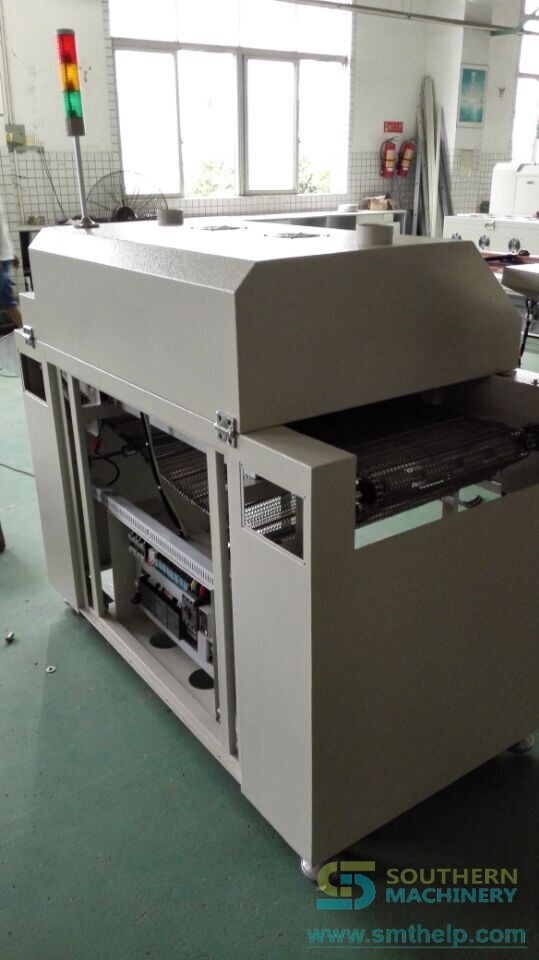
High-Performance EMS Curing Oven Solution for Smart PCB Assembly
A coated or glued board isn’t finished when it leaves the dispenser — it’s finished when the coating or adhesive is cured. Until then, the protection against moisture, dust, and vibration exists only on paper. An uncontrolled cure drifts from board to board, and the failure shows up months later in the field, not at final test.
The hidden cost: the uncured process step
Curing is the most underestimated step in electronics manufacturing. Skipping it or guessing at it quietly ships risk.
- Coating delamination risk. A conformal coating that didn’t reach its specified cure can flake or lose adhesion, exposing the board to the environment it was meant to shield.
- Adhesive failure on double-sided boards. SMT red glue that is under-cured lets bottom-side components shift or lift during wave soldering, creating defects that surface only after the fact.
- Field returns, not line scrap. An inconsistent cure rarely fails on the test bench; it fails in the customer’s product, where the warranty cost dwarfs the board cost.
- No audit evidence. Automotive, industrial, and medical customers expect documented temperature profiles; a manual oven without logging cannot provide that record.
The Four-Step Cure-Profile Control
Treat the oven as a partner to your dispensing and coating equipment, not an afterthought. Think of it as the Four-Step Cure-Profile Control.
1. Match the profile to the chemistry. Read the coating or adhesive datasheet and define the required temperature and dwell time. The goal is to cure to spec, not to “heat it until it looks dry.”
2. Hold the zone uniform. Keep temperature uniform across the working width so every board — front, back, edge — receives the same cure, not a gradient that leaves some boards under-cured.
3. Log every run. Store the recipe and the actual temperature profile for each material and board family, so each cure is repeatable and auditable rather than recreated from memory.
4. Set the acceptance band. Define the acceptable profile window and over-temperature limit, and treat any deviation as a stop condition. That band becomes your acceptance test at commissioning.
The vehicle: Southern Machinery EMS curing oven
This framework maps directly onto how the curing oven fits the “process support” segment of a complete line.
- Match the profile to the chemistry → material coverage. The oven cures conformal coatings (acrylic, silicone, polyurethane), SMT red glue, underfill for BGA/CSP/flip-chip, and potting or encapsulation compounds, applied after or alongside soldering.
- Hold the zone uniform → controlled heating. Configurable heating zones with ramp and soak control hold boards at the specified temperature, supporting glue-on-wave flows where the oven sits between SMT placement and the wave machine.
- Log every run → recipe and data control. Recipe storage for different materials, real-time temperature profiling, and data logging give you the traceability that automotive and medical audits require.
- Set the acceptance band → safe operation. Over-temperature protection, interlocks, and exhaust/venting controls keep the process within the agreed band and protect the line and operators.
Specification note: the number of heating zones, temperature uniformity, maximum process temperature, conveyor format, board limits, installed power, and footprint should be confirmed at quotation, because they depend on your coating chemistry, board mix, and volume.
Specifications
| Parameter | Value |
|-----------|-------|
| Process | Curing of conformal coating, SMT adhesive, underfill, potting |
| Heating zones | Configurable 1–4 zones (model-dependent) |
| Temperature control | Ramp / soak profile with zone uniformity |
| Max process temperature | Per material datasheet (confirm at quotation) |
| Throughput format | Inline conveyor or offline batch oven |
| Conveyor | Belt / mesh; max board width and height confirmed at quotation |
| Control | Recipe storage, real-time profiling, data logging, MES option |
| Safety | Over-temperature protection, interlocks, exhaust/venting |
| Footprint / power | Floor space and installed power confirmed at quotation |
The loop: re-profile at every material change
Cure quality drifts the moment a new coating or adhesive enters the line. Build a loop: whenever a material changes, re-load its datasheet profile, run a qualification board, and compare the logged temperature curve against the accepted band before production. Review cure-related field or AOI trends with your process lead each quarter, and retire any recipe that no longer matches the current chemistry. Treat the profile as a living record — the loop is what keeps the oven protecting the investment made upstream instead of quietly weakening it.
Your next step
Send us your coating or adhesive type, board mix, and daily volume. We’ll return a configuration review outlining whether a batch or inline curing oven fits your Smart EMS factory, what zone count and logging to specify, and what to confirm at quotation. Reach Jason at jasonwu@smthelp.com or on WhatsApp +86 13602562576.
FAQ
What is an EMS curing oven used for?
It cures process materials applied to PCBs — conformal coating, SMT adhesive (red glue), underfill, and potting — with controlled, uniform heat so they reach their specified mechanical and electrical properties.
How is it different from a reflow oven?
A reflow oven melts solder paste at peak temperature for a short time to form joints. A curing oven holds boards at a lower, controlled temperature longer to polymerize or harden coatings and adhesives. They serve different steps.
How long does conformal coating take to cure?
It depends entirely on the coating chemistry and its datasheet — a specified temperature and dwell time. The oven’s job is to hold that profile accurately and repeatably across the whole board.
Can it handle double-sided boards with SMT adhesive?
Yes. In glue-on-wave flows, the oven cures the adhesive holding bottom-side SMD components before the board passes through wave soldering.
Should I choose a batch or inline oven?
Batch ovens suit high-mix, low-volume production and flexible scheduling; inline ovens suit continuous, higher-volume flows. Your coating volume, board mix, and floor space decide the format.
Jason Wu
Founder & CEO, Southern Machinery (Shenzhen Southern Machinery Sales and Service Co., Ltd.)
Email: jasonwu@smthelp.com / info@smthelp.com
WhatsApp: +86 13602562576
Catalog & manuals: file.autoinsertion.com | Machine photos: ph.smthelp.com
LinkedIn: linkedin.com/in/smtsupplier | YouTube: youtube.com/c/Smthelping
Comments
Comments appear after approval.