
Your THT Line Is The Reason You Cannot Run A Night Shift
The SMT side can run unattended. Then boards reach the through-hole benches, and the shift ends when the operators do.
Aug 4, 2026 · Updated Aug 29, 2026 · Jason Wu
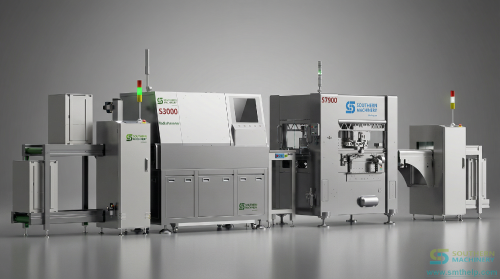
Your SMT line will run a third shift. It does not need anyone to agree to it.
Then a board arrives at the through-hole section and meets the constraint nobody can schedule around: a row of people. Capacitors, relays, transformers, terminals and odd-form parts go in by hand, and the line's capacity becomes the number of trained operators who showed up.
Automation does not start with a machine purchase. It starts with four numbers, and most factories have never written them down.
The four things manual DIP assembly actually costs
Labour you cannot plan around. Manual insertion depends on skilled, stable operators. As our S-70LD documentation notes, DIP lines staffed by young, mobile operators carry high training costs and unpredictable output.
Defects with a human signature. Floating components, missed insertions, misinsertion and reverse-polarity insertion. Each has a person-shaped cause, and each survives to ICT or to the customer.
A ceiling on throughput. Manual output is capped by operator speed and shift length. An automatic inserter runs at rated speed on the night shift too.
Scaling that means hiring. Manual output grows linearly with headcount. That is not a scaling strategy, it is a recruiting strategy.
The Four-Number THT Audit
Write these down before you request a single quotation.
Number 1 — Component mix. What percentage of your through-hole parts are radial, axial, odd-form, and pin/eyelet/terminal? This number alone determines the machine set. Radial covers capacitors, transistors, diodes, LEDs, connectors, tact switches, coils, potentiometers, lamps and fuses. Axial covers leaded resistors, diodes and fuses. Odd-form covers relays, transformers, connectors and anything that will not sit in radial or axial tape. Pins, eyelets and terminals need their own machine.
Number 2 — Boards per hour, sustained. Not the peak. The number you hold across a shift after changeovers and stoppages. Published speeds are a starting point for feasibility — our S-3000 series radial inserter is documented at 18,000 CPH and the S-7020 series pin/eyelet/terminal machine at 12,000 CPH — but your sustained rate is what the line has to deliver.
Number 3 — Changeovers per shift. This is the number that decides whether a line is genuinely flexible, and it is the one most often skipped. High changeover frequency makes programming method more important than raw speed: offline programming, Excel-based programs, USB data import and online visual teaching matter more than another 2,000 CPH.
Number 4 — Hole-to-lead tolerance on your current board designs. Auto insertion needs boards designed for it. The insertion hole is typically about 0.5 mm larger than the component lead. If your existing Gerbers predate automation, this is the number that will stop the project — or the first thing you fix.
What a lights-out THT section looks like
Once the four numbers are in hand, the configuration follows from the component mix:
- Radial components → S-3000 series radial insertion machines. Documented at 18,000 CPH, with 360° insertion in 1° increments and inward or outward clinching.
- Axial components → S-4000 series axial insertion machines.
- Odd-form parts — relays, transformers, connectors — → S-70LD and the S-7000/S-7900 series. These exist precisely because those parts will never run in radial or axial tape.
- Pins, eyelets and terminals → S-7020 series, inserting from bulk or reel packaging with 360° orientation control and inward or outward clinching, on boards up to 380 × 280 mm (larger sizes customisable).
- Soldering → lead-free wave soldering. The S-WS350B dual-wave documents 300–1800 mm/min conveyor speed, 50–350 mm PCB width, three PID preheating zones and ±1–2 °C temperature control accuracy. The S-WS450 covers larger-format requirements.
- The links → board handling: loaders, unloaders, conveyors and turn conveyors. This is what makes "lights-out" physically possible. Nobody carries boards, so the line does not stop when a shift ends.
Utilities matter more than they look on a datasheet. Insertion machines are typically single-phase 220 V (S-7020: 2 KVA); wave soldering is typically three-phase 380 V, 415 V compatible. Check floor loading and power before you finalise a layout.
Where we would tell you not to do this
If your number 1 is dominated by odd-form parts in low volume, a full lights-out line is the wrong answer — start with a single odd-form machine and manual soldering. If your number 4 fails across most of your board portfolio, fix the designs first; buying insertion machines to fight bad hole tolerances is an expensive way to manufacture scrap.
And if your number 3 is very high with short runs, prioritise programming and changeover tooling over rated speed. A fast machine that takes forty minutes to change over is slower than a modest one that changes in five.
Close the loop
Re-run the Four-Number Audit every time your product mix materially changes, and at least annually. Component mix drifts as designs mature — a board that was 80% manual three years ago may now be a clean automation candidate. The audit is what tells you when the payback has arrived.
On the business case: buyers justify these lines on labour replacement, quality cost avoidance, and capacity without headcount. Our published THT material references ROI windows as short as one year for wave-soldered THT assembly — treat that as a planning benchmark from our materials and validate it against your own labour rate, shift pattern and board mix.
Your next step
Send your component mix, board sizes, volumes and changeover frequency. We will return a line layout, the machine configuration, and a straight answer on which of your board designs need a revision before automation will work on them.
Catalog and documentation: file.autoinsertion.com. Installed lines and machine photos: ph.smthelp.com. Line walkthroughs: youtube.com/c/Smthelping.
Jason Wu
Founder & CEO, Southern Machinery (Shenzhen Southern Machinery Sales and Service Co., Ltd.)
Email: jasonwu@smthelp.com / info@smthelp.com
WhatsApp: +86 13602562576
Catalog & manuals: file.autoinsertion.com | Machine photos: ph.smthelp.com
LinkedIn: linkedin.com/in/smtsupplier | YouTube: youtube.com/c/Smthelping
Comments
Comments appear after approval.