
How the SME800 Auto Stencil Cleaning Machine Optimizes a Smart EMS Factory's PCB Assembly Workflow
A process-improvement walkthrough of how automated wash-rinse-dry stencil cleaning is scheduled inside a changeover cycle instead of competing with it.
Aug 8, 2026 · Updated Aug 31, 2026 · Jason Wu
How the SME800 Auto Stencil Cleaning Machine Optimizes a Smart EMS Factory's PCB Assembly Workflow
Stand at the printer during a changeover and watch what the line is actually waiting for. Often it is not the program, the paste or the squeegee — it is a stencil that came off the previous job and still needs cleaning, plus the operator who has to do it. This is a workflow article, not a product page: where automated stencil cleaning belongs in a changeover cycle, and what it removes from the critical path when scheduled deliberately.
The cost you haven't named: cleaning on the critical path
Most SMT floors own a stencil cleaner. Fewer have decided when cleaning happens relative to the changeover — and that scheduling decision is where the time goes.
- Cleaning competes with setup. If the stencil is cleaned during the changeover rather than before it, wash and dry time sit directly inside line downtime.
- Wet stencils force a wait. A stencil not dry enough to mount or store creates an unplanned queue at the printer — which is why "quick wipes" get substituted and apertures stay partly blocked.
- Manual results are unrepeatable. Wiping quality depends on the operator and the moment. On fine-pitch and micro-BGA apertures, hand cleaning cannot reach the aperture walls that matter.
- The defect cost is invisible. Bridging, insufficient fill and tombstoning are logged as print defects, rarely as stencil-hygiene defects, so the root cause never reaches the improvement list.
The Four-Step Stencil Hygiene Workflow Audit
Treat stencil cleaning as a scheduling problem before you treat it as an equipment problem. Call it the Four-Step Stencil Hygiene Workflow Audit.
1. Map the stencil park against the schedule. List every stencil in rotation, which products use it, and how many changeovers per shift each line runs. That tells you how many cleaning cycles the workflow must absorb — the real capacity question.
2. Time the current cycle and locate it. Measure how long cleaning takes today and, more importantly, whether it happens before, during or after the changeover. Anything happening during it is time you can move off the critical path.
3. Tie print defects back to apertures. Pull your SPI and AOI data for insufficient solder, bridging and tombstoning, and separate boards printed with a freshly cleaned stencil from the rest. That gap is the yield case in your own numbers.
4. Define the return condition. Write down what "print-ready" means here: apertures clear, foil underside free of flux residue, dry enough to mount or store immediately. That sentence becomes your acceptance test.
The vehicle: SME800 auto stencil cleaning machine
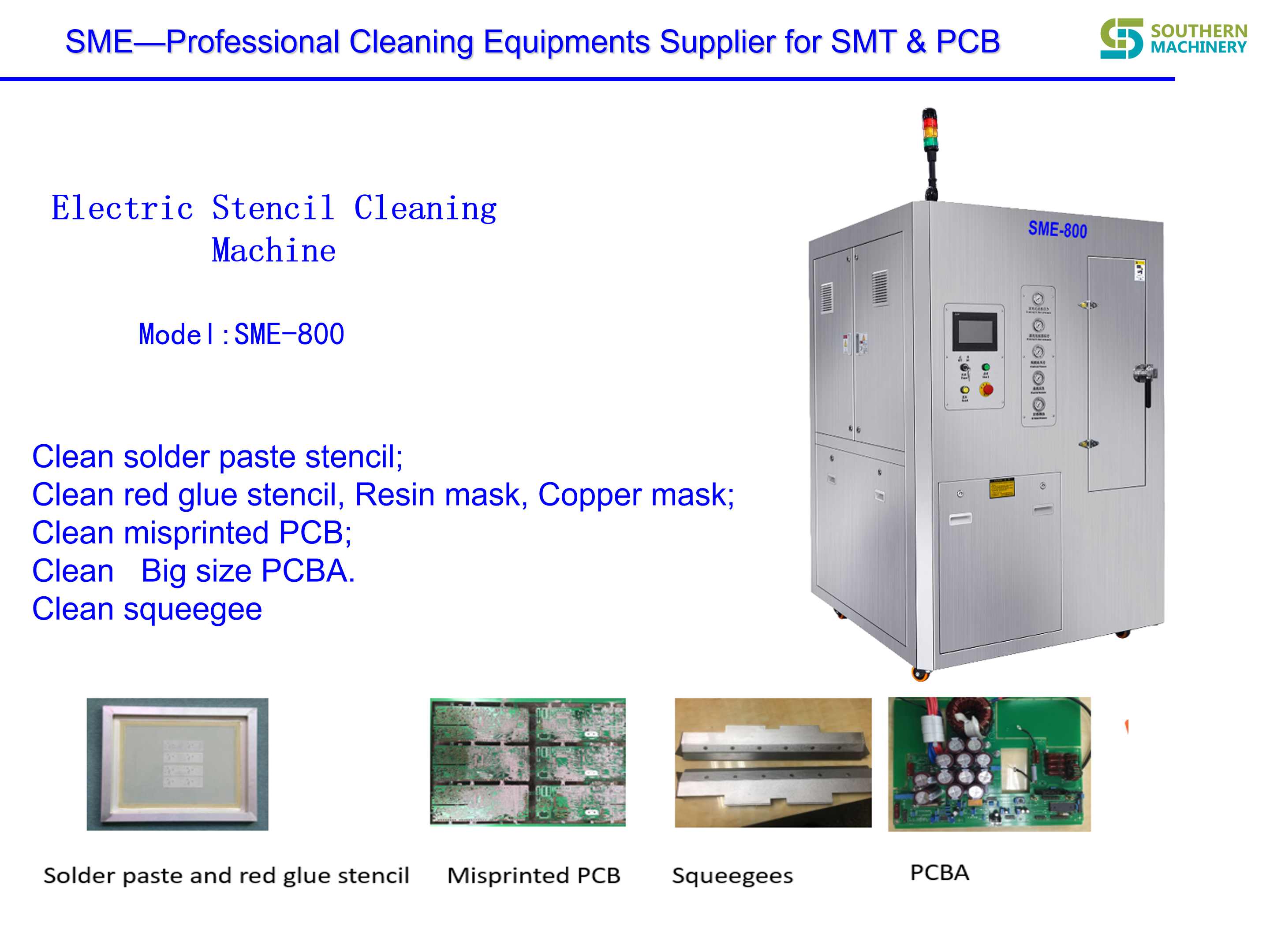
The SME800 runs a full wash–rinse–dry cycle on stencils, squeegees, frameless stencils and misprinted boards. What matters for workflow is how each audit step maps onto a capability.
- Map the stencil park → programmable recipes on PLC control. Wash and rinse time, liquid and DI water temperature, and hot-air dry time and temperature are set through a touch-panel English interface, so each stencil class gets a stored recipe instead of an operator judgement call.
- Time the cycle and locate it → a known, bounded cycle. Wash 3–5 minutes, rinse 1–2 minutes, dry 3–5 minutes gives a 7–12 minute total. A cycle with a known duration can be scheduled to run during the previous job, so the stencil waits for the changeover rather than the reverse.
- Tie defects to apertures → bottom ultrasonic plus side spray. Spray, ultrasonic wash, DI rinse and hot-air dry, with an X-Y-Z structure driving the head across the foil, reach the aperture walls hand wiping does not.
- Define the return condition → hot-air drying to specification. Hot air up to around 100 °C decides whether a stencil leaves the cabinet ready to mount or ready to wait. Twin cabinets keep wash and DI rinse separate so rinse water stays clean.
Two extensions matter as much as the main cycle. The misprinted-PCB fixture turns a scrap line item into a recovery step. Squeegee and frameless fixtures let one machine absorb several cleaning jobs that each otherwise need their own bench and chemistry.
Specification note: throughput per shift, recipe settings, chemistry consumption and fixture selection are confirmed at quotation, since they depend on your stencil park, aperture mix and changeover frequency.
Specifications
| Parameter | Value |
|---|---|
| Maximum stencil / mask size | 750 × 750 × 40 mm |
| Cleaning method | Bottom ultrasonic + side spray, X-Y-Z moving structure |
| Process sequence | Spray clean → ultrasonic wash → DI rinse → hot air dry |
| Cabinet layout | Twin cabinet: wash + separate DI rinse |
| Cycle time | Wash 3–5 min / rinse 1–2 min / dry 3–5 min |
| Drying temperature | Hot air up to approx. 100 °C |
| Tank capacity | 60 L cleaning liquid / 60 L DI water |
| Spray pressure | 4–5 kg/cm² |
| Filtration | 1 µm / 1 µm with filter-replacement alarm |
| Construction | SUS304 stainless steel, acid/alkali protection |
Placed next to the paste printer, the machine sits beside the one tool that touches every board. Nothing else in the line changes, but the print input becomes repeatable. Where three-phase power is unavailable, the pneumatic S-1688 is the alternative; the S-6200 covers nozzle cleaning. PLC recipes and filter alarms let cycle and consumable data feed MES process control rather than a clipboard.
The loop: schedule, measure, re-schedule
The gain here is a scheduling habit, not a purchase. Build a loop: every month, re-time cleaning against the changeover and confirm cycles still start before the line stops. Re-pull the SPI and AOI split from step three and check whether the gap between freshly cleaned and carried-over stencils is narrowing. Review recipe settings per stencil class with your process engineer, and check consumable records against the alarm history. When a new fine-pitch product family arrives, re-run the audit before ramping. The loop keeps cleaning off the critical path once the initial discipline fades.
Your next step
Send us your stencil sizes, changeover count per shift and your current print-defect breakdown. We will return a workflow review showing where the SME800 sits in your changeover cycle, what recipe and fixture set to specify, and which figures to confirm at quotation — with a written spec sheet and a demonstration before you commit. Reach Jason at jasonwu@smthelp.com or on WhatsApp +86 13602562576.
FAQ
Where should stencil cleaning sit in the changeover cycle?
Before the line stops, not during. Because the cycle is a bounded 7–12 minutes, the outgoing stencil can be cleaned while the previous job still runs, so the printer never waits on a wet or dirty foil.
How long is the cleaning cycle?
Per the SME800-series specification: wash 3–5 minutes, rinse 1–2 minutes, dry 3–5 minutes — roughly 7–12 minutes depending on the stored recipe.
Can it clean red-glue stencils and plastic masks?
Yes. The product documentation confirms cleaning of red-glue-printed copper stencils and plastic masks up to 3 mm thick, because the cleaning pressure penetrates very small holes to wash the adhesive out.
Does it use solvent or water?
Water-based cleaning liquid with DI or DM water rinsing and hot-air drying, which cuts solvent consumption and disposal cost.
How does stencil hygiene show up in yield?
Dried paste and flux inside apertures restrict paste transfer, producing insufficient solder, bridging and rework. Restoring aperture geometry stabilises print volume — the input first-pass yield is most sensitive to.
Jason Wu
Founder & CEO, Southern Machinery (Shenzhen Southern Machinery Sales and Service Co., Ltd.)
Email: jasonwu@smthelp.com / info@smthelp.com
WhatsApp: +86 13602562576
Catalog & manuals: file.autoinsertion.com | Machine photos: ph.smthelp.com
LinkedIn: linkedin.com/in/smtsupplier | YouTube: youtube.com/c/Smthelping
Comments
Comments appear after approval.