
Lead trimming after wave soldering: the THT step your line chart forgot
After the wave, the pliers come out: manual THT lead trimming is the step most line charts leave out, and it is where yield quietly leaks away. Here is how an inline auto lead cutter closes the gap.
Aug 28, 2026 · Updated Aug 28, 2026 · Jason Wu
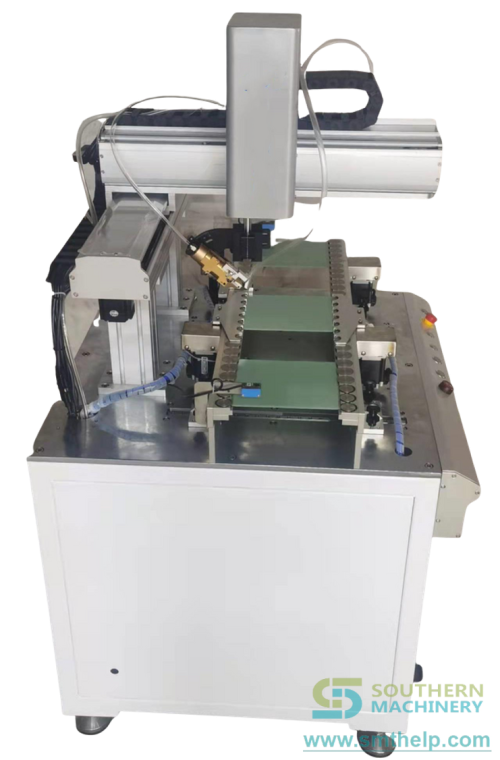
Lead trimming after wave soldering is the THT step your line chart forgot. After the wave, the pliers come out: manual THT lead trimming is the step most line charts leave out, and it is where yield quietly leaks away. Here is how an inline auto lead cutter closes the gap.
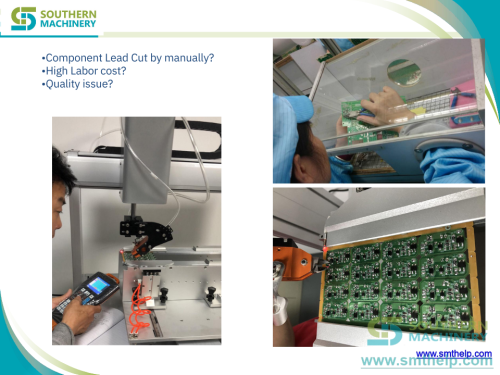
I have stood at the end of more wave soldering machines than I can count, and the view is almost always the same: boards come off the conveyor, still warm, and disappear into a row of operators with pliers. Nobody puts that station on the line chart. It is not in the capacity calculation, not in the yield discussion, not in the headcount plan. It is simply there — eating minutes, fingers, and occasionally a good board.
Manual lead trimming is the last hand-operated step on most THT lines. And it is the one step that touches every through-hole board you ship.
The three bills the trimming station sends
The labor bill. Trimming a connector-heavy board by hand takes an operator per board every minute or two — and the station scales linearly with volume. Peak season means renting hands. Quiet season means paying them anyway.
The quality bill. Pliers are fast until they slip. A cut that lands too close to the solder joint can crack the joint or lift the pad. A lead cut at the wrong angle can scrape the adjacent trace. And because trimming happens after wave soldering, a mistake here is a finished board going to scrap — not a component you can rework at the insertion station.
The containment bill. Cut leads go everywhere. On a busy line, loose leads on the floor, in pallets, and on boards are an ESD and short-circuit risk that never shows up in the defect log — until a board fails at final test with a trimmed lead sitting across two pads.
What is this machine used for?
The SF320AT is an inline automatic selective lead cutter that sits directly after wave soldering and before AOI. It cuts the excess leads of through-hole components on the PCB automatically — at any angle, at up to 7,200 CPH — collects the cut lead scraps by vacuum, and hands the board to the next process with a consistent, repeatable trim length. For lines that are too small or too mixed for an inline machine, the S-430AC standalone auto lead cutter covers the same job at a manual cell.
The SF320AT, by the numbers
| Parameter | Value |
| --- | --- |
| Machine type | Inline auto selective lead cutter |
| Cutting speed | up to 7,200 CPH |
| Positioning accuracy | ±0.1 mm |
| PCB size | up to 320 × 250 mm |
| Minimum PCB edge | 3 mm |
| Lead length | 0.5 – 6 mm |
| Lead diameter | < 1.6 mm |
| Max component height | < 110 mm |
| Scrap handling | High-vacuum lead collection |
| Programming | PLC & PC-based |
| Cutting angle | Any angle |
| Interface | SMEMA |
| Machine dimension | 790 × 798 × 1443.5 mm |
Where it sits in the line
The intended position is simple — and the line diagram is short:
PCB loading → Wave soldering → SF320AT lead cutting → AOI → PCB unloadingBecause the SF320AT talks SMEMA to the wave solderer and the AOI, no operator has to babysit the handshake. The board arrives, is trimmed, and moves on. The machine dimension is 790 × 798 × 1443.5 mm, so it fits a normal conveyor line without a dedicated room.
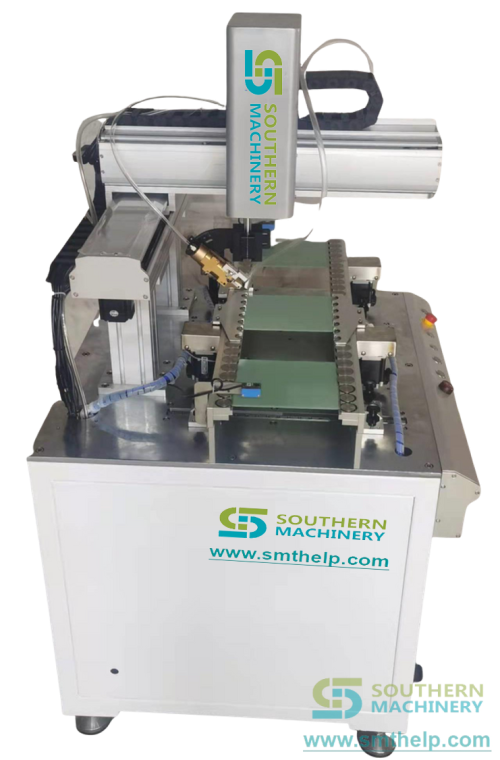
For plants that trim only some batches — prototypes, low-volume boards, or products with unusual lead forms — the S-430AC is the same idea in a standalone cabinet: 7,200 CPH, X/Y/Z/R axes for any-angle cutting, vacuum aspiration into a pin collection cup, and an optional MES connection. You keep the manual station for the odd jobs and let the machine own the volume.
The ROI math, honestly
The S-430AC solution material works one example out in full. Treat it as an illustration, not a promise: 6–8 operators trimming by hand, monthly salary around USD 300 each, machine price about USD 18,000. At 7,200 CPH × 25% utilization, running 20 hours a day, machine output is roughly 36,000 boards/day versus about 10,000 boards/day by hand:
| Utilization | Machine output/day (example) | Manual output/day (example) | Approx. payback |
| --- | --- | --- | --- |
| 25% | 36,000 boards | 10,000 boards | ~17 months |
| 50% | 72,000 boards | 10,000 boards | ~9 months |
| 75% | 108,000 boards | 10,000 boards | ~6 months |
That math depends entirely on your board volume, your labor cost, and your shift pattern. It is an example from company material — subject to final technical and commercial confirmation — not a guarantee. The part the example never captures is quality: a machine does not have a bad day, does not cut into a joint after lunch, and does not leave leads on the floor.
Selection checklist for a THT lead cutter
- PCB size and edge clearance — confirm your boards fit the working window (SF320AT handles up to 320 × 250 mm with a 3 mm minimum edge).
- Lead length and diameter — standard range is 0.5–6 mm lead length and < 1.6 mm lead diameter.
- Component height — up to 110 mm.
- Throughput — 7,200 CPH machine speed versus your line target and shift pattern.
- Inline or standalone — SMEMA inline between wave soldering and AOI, or a standalone S-430AC at a manual cell.
- Scrap handling — vacuum collection, non-negotiable for ESD and short-circuit protection.
- Programming — PLC & PC-based programming; the S-430AC software calculates compensation points automatically so the operator only specifies the plane-to-space distance.
- Service — per company policy: 7×24 worldwide support, free installation and training, 1-day spare-parts lead time, and 1-month customization solutions.
FAQ
Q: Is lead trimming really necessary after wave soldering?
A: If component leads protrude beyond the limit required by the next process — connector mating, potting, coating, or final assembly clearance — yes. Industry acceptance criteria and your customer drawing define the exact limit; the machine trims to a consistent length so the board matches the drawing every time.
Q: What is the difference between the SF320AT and the S-430AC?
A: The SF320AT is inline: it sits between wave soldering and AOI with a SMEMA interface. The S-430AC is a standalone cabinet machine for manual cells or low-volume lines. Both run at up to 7,200 CPH.
Q: Can it cut leads at any angle?
A: Yes. The SF320AT cuts at any angle with a positioning accuracy of ±0.1 mm, and the S-430AC pliers head can be adjusted at any angle and direction across X/Y/Z/R axes.
Q: What happens to the cut leads?
A: They are collected by vacuum — the SF320AT has a high-vacuum lead collection system, and the S-430AC uses vacuum aspiration into a pin collection cup that is easy to empty.
Q: Will it handle tall components?
A: Component height up to 110 mm is supported on both machines.
Q: Can we test our boards before buying?
A: Yes. Send PCB samples and component details — we run a live cutting test, record it, and hand you the evaluation so you can verify the result instead of trusting a datasheet.
If your line chart does not include the trimming station
That is exactly the point: the cost is invisible until you look. Send us a photo of the station, your PCB size, lead specifications, and daily volume, and we will tell you which machine fits, where it goes in the line, and what the changeover looks like.
WhatsApp: +86 136 0256 2576 · Email: info@smthelp.com · www.smthelp.com
_— Jason Wu, Southern Machinery. Your Trusted Partner for SMT & THT Solutions — from the first inserted lead to the last trimmed one._
Comments
Comments appear after approval.