
NBHZ Series Soldering Robot: Programmed THT Soldering for High-Mix Lines
The hand-solder bench is usually the least controlled process in an otherwise automated line — the NBHZ Series replaces it with a programmed iron-tip path.
Aug 16, 2026 · Updated Aug 31, 2026 · Jason Wu
Your SMT line is instrumented end to end: paste height measured, placement logged, reflow profiled, AOI judging every joint. Then the board reaches the through-hole bench, and the process becomes a person with an iron. Dwell time is whatever their wrist decides. Solder volume is whatever the wire feed happens to give. Quality drifts across the shift, and the first objective measurement anyone takes is at functional test — or at the customer.
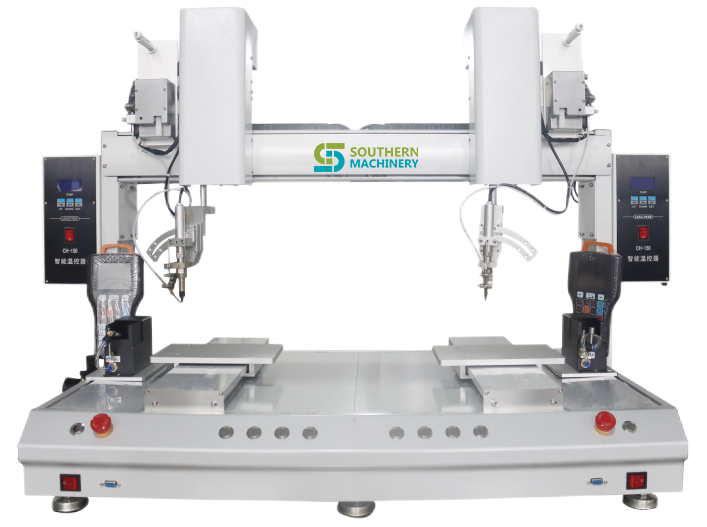
Southern Machinery's NBHZ Series soldering robot replaces that bench with a programmed iron-tip path and automatic wire feed, built for high-mix, low-to-medium volume work.
Why manual iron-tip soldering breaks quality, capacity or cost
Hand soldering is not a bad process. It is an unmeasured one, which is a different problem.
- Three variables drift at once. Tip temperature, dwell time and solder volume all change with operator, fatigue and hour of the shift. Nothing records them, so nothing corrects them.
- Cold joints and oxidation escape inspection. A dull, insufficiently wetted joint often passes visual check and fails months later in the field, where the cost of the failure has nothing to do with the cost of the joint.
- The skill is scarce and slow to build. A capable through-hole operator takes months to train, and that investment leaves with them.
- Capacity only scales with benches. More volume means another station, another iron and another person — so unit cost never improves as the order grows.
- Selective wave is often the wrong answer. It brings throughput but also fixture cost and capital that a mixed, mid-volume THT workload cannot absorb.
The Hand-Solder Bench Test
Run this at your existing bench before you compare machines. It needs a stopwatch and your last quarter of test data.
1. Count the joints, not the boards. Tally solder points per board and per shift by product. Joint count is what drives robot cycle time, and it is the only input that makes a throughput comparison against manual work meaningful.
2. Measure the drift, not the average. Sample the same joint from the first hour and the last hour of a shift, across two operators. Compare wetting, fillet shape and volume. The spread you find is the quality variance a programmed path removes.
3. Locate where solder defects are caught. Split your cold joint, bridge and oxidation failures by detection point — in-process, functional test, or customer return. Cost rises by an order of magnitude at each step, and that gradient is where the payback sits.
4. Check access and geometry per joint. For each joint, confirm the tip can reach it: pad size, adjacent component height, connector shrouds, board orientation. Joints a tip cannot reach cleanly stay manual, and knowing that fraction upfront keeps the business case honest.
The Vehicle: how the NBHZ Series works
The NBHZ Series is an automatic iron-tip soldering machine — a desktop or cabinet robot that carries a soldering iron along a taught path and feeds solder wire to each joint. Because the process is programmed rather than tooled, a product changeover is a program recall, not a fixture rebuild, which is what makes it suitable for high-mix production where a dedicated special-purpose machine cannot pay back. Southern Machinery documents three configurations: the NBHZ-5331 double-head, double-station build for higher throughput; the NBHZ-331-2 double-splicing configuration for multi-point or multi-station work; and the NBHZ-331-3 cabinet-type machine with vision-assisted positioning for boards that need optical correction before the tip lands.
| Parameter | Specification |
|---|---|
| Model family | NBHZ-5331 / NBHZ-331-2 / NBHZ-331-3 |
| Configuration | Double-head double-station / double-splicing / cabinet-type visual |
| Process | Programmed iron-tip soldering with automatic solder wire feed |
| Programming | Teach-mode path entry with program storage for changeover |
| Positioning | Mechanical fixture; vision-assisted on the NBHZ-331-3 |
| Consumables | Tin wire only — no flux bath, gas or bulk solder pot |
| Solder wire diameter | Typically 0.6–1.2 mm, selected per joint (confirm per configuration) |
| Tip temperature | Programmable per joint profile (typical iron-tip range) |
| Working area | Configured to your largest PCB and fixture (confirm on order) |
| Duty cycle | Continuous operation across shifts |
| Utilities | AC power, compressed air and fume extraction per layout |
| Throughput | Validated against your joint count and board layout at quotation |
Southern Machinery does not publish a generic CPH figure for the NBHZ Series. Rows marked as typical are category-normal values confirmed against your configuration; cycle time is measured on your actual board.
Where it fits
The robot sits at the soldering stage of a mixed-technology line: SMT printing, placement, reflow and AOI, then axial, radial and odd-form insertion, then the NBHZ cell, then cleaning, inspection, depaneling, test and pack. Three placements are common. As a replacement for a bank of manual benches, running boards from a tray with a fixture. As a touch-up cell beside a wave solder line, handling the joints the wave cannot reach. Or as a flexible cell paired with loaders, unloaders and conveyors so it runs with minimal operator attention — the arrangement that makes one-operator-several-machines practical rather than theoretical.
The ROI case
Build the case on four separate lines. Quality: a programmed path applies the same temperature, dwell and wire length to every joint, which removes the human variables behind oxidation and cold joints and moves your defect data from anecdote to trend. Labour: operators do not need advanced soldering skill, so one person can supervise several machines — the change is in the skill grade required, not only the headcount. Capacity: the cell runs continuously across shifts without the quality drift that limits how long a manual bench can be pushed. Scrap and returns: each cold joint prevented removes a rework cycle, and the escapes prevented at functional test remove the far larger cost of a field return.
Then re-run the Hand-Solder Bench Test after the first month of production. That audit-and-improvement loop closes the gap between the quoted cycle time and what the cell actually delivers on your joint mix. Any payback figure is a planning benchmark built from your labour rate and defect history.
Your next step
Send your PCB data, the through-hole section of your BOM, and clear photos of the joints you solder by hand. Our engineers confirm the configuration, iron tip geometry, fixture approach and a realistic cycle time for your joint count before any quotation. Email jasonwu@smthelp.com or info@smthelp.com, or WhatsApp +86 13602562576.
FAQ
Is the NBHZ Series a wave soldering machine? No. It solders joints one at a time along a programmed path. It replaces manual benches, or complements a wave line by handling touch-up joints the wave cannot reach.
What can it solder? Through-hole and odd-form joints normally done by hand: connectors, relays, transformers, terminal blocks, coils and wire-to-board joints. Suitability depends on joint geometry, access and tip selection.
Do we still need skilled solder operators? No. Programming is done in teach mode, and the stated benefit is that one person can operate several machines without advanced soldering skill.
How fast is it? There is no universal figure. Cycle time depends on joint count, board layout and whether the build is single-head, double-head or cabinet-type, so it is validated against your board during quotation.
Jason Wu
Founder & CEO, Southern Machinery (Shenzhen Southern Machinery Sales and Service Co., Ltd.)
Email: jasonwu@smthelp.com / info@smthelp.com
WhatsApp: +86 13602562576
Catalog & manuals: file.autoinsertion.com | Machine photos: ph.smthelp.com
LinkedIn: linkedin.com/in/smtsupplier | YouTube: youtube.com/c/Smthelping
Comments
Comments appear after approval.