
Odd-form components: the four-level upgrade path from bowl to inline
Connectors, transformers and relays do not have to mean hand insertion. Bowl, belt, tube, tray, reel — each feeding level buys you speed and polarity control.
Aug 20, 2026 · Updated Aug 28, 2026 · Jason Wu
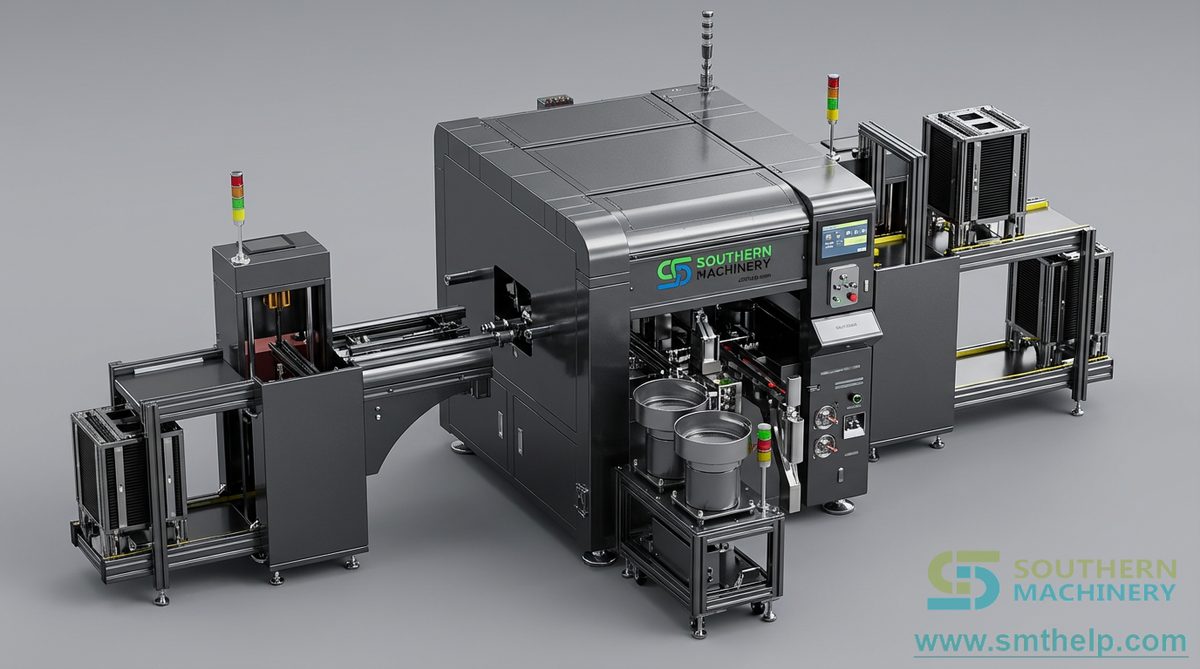
Every automation project dies at the same sentence: _"but my component is special."_ A connector with bent pins, a transformer that tumbles wrong in a bowl, a relay nobody wants to feed by tube. I have heard it in four languages. Here is the secret from thirty years on through-hole lines: the component is never as special as it looks. There is a feeding method for it. You just have to know which level it lives at.
Level 1 — Bulk, with vision as the referee
Loose parts in a vibratory bowl or belt feeder, orientation and polarity checked by camera before insertion. Fast to start, honest for simple geometries — and the right answer more often than engineers expect. The S-7020 mixed demo shows what bulk feeding can already do when the vision system refuses bad parts instead of trusting hands.
Level 2 — Re-tape the "un-tapeable"
This is where my team earns its keep. Terminals, tact switches, big capacitors, even parts nobody has ever taped can be re-packaged onto tape and reel — then fed at pick-and-place-grade speed with polarity guaranteed by the pocket. We design the taping tooling and the reel feeder ourselves; see the S7020T running reel terminals and radial taped parts. The economics are brutal in your favor: radial feeder automation cuts insertion cost by an order of magnitude versus hand placement on high-mix boards.
Level 3 — Tube, tray, and magazine feeding
For transformers, sockets, and pinned parts that would bruise in a bowl: stick and tube feeders like the STF1003 family, or tray feeders that keep every lead untouched. Damage rate drops toward zero because the part never fights gravity.
Level 4 — The dedicated inline cell
When several feeding levels must work in sequence — eyelet, then terminal, then odd-form, then clinch — a machine like the S7900 combines them in one inline cell with polarity verification and clinching built in. This is the level your IE manager dreams about and your CFO will approve after Level 2 pays for itself.
The framework in practice
Do not start by buying a machine. Start by sending samples. The classification takes one afternoon: which parts go to a bowl, which get taped, which live in tubes, and which finally justify the inline cell. The customized feeder and nozzle catalog lists the feeding hardware we have built for each case — most of it designed because a customer's "special" component said otherwise.
Your move: pick your three most annoying through-hole parts, ship them to Shenzhen, and let the camera decide their level. You will get a written classification and a demo video of your own parts — free, and yours to keep. Start on WhatsApp or info@smthelp.com.
_— Jason Wu, Southern Machinery. If a part can be fed, it can be inserted. If it cannot be fed yet, we design the feeder._
Comments
Comments appear after approval.