
Compact SMT Lines Turn Corners With a 90-Degree Conveyor
When a line can't run straight, operators carry boards between machines. Run the Line-Layout Audit, then automate turns with the S-460.
Aug 18, 2026 · Updated Aug 31, 2026 · Jason Wu
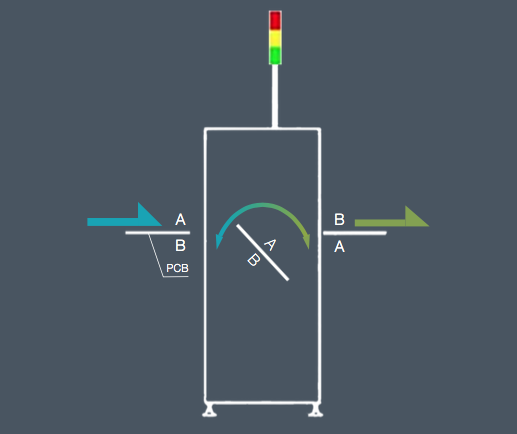
When an SMT line can't run in a straight line, someone has to carry the boards. L-shaped or U-shaped floor plans, an oven that must sit perpendicular to the placement line, or a process step added after the line was drawn up all force an operator to lift PCBs and walk them to the next machine. That walk is a handling cost and a damage risk hiding in plain sight.
Southern Machinery designs and manufactures PCB turn conveyors for exactly this job — dependable direction change inside SMT, THT and mixed-technology lines. The S-460 series and the SCN250/SCN330 series rotate boards 90 or 180 degrees and pass them to the next station without a human touch.
Why manual board turning breaks quality
Carrying boards between machines is a quiet source of defects:
- Dropped boards — a slip during a hand-carry can ruin a populated assembly.
- Scratched solder mask — contact and misalignment mar surfaces before inspection.
- Misalignment — boards entering the next machine off-angle cause placement and soldering errors.
- Labor cost — each turn is an operator and a hand-off point that scales with volume.
The Line-Layout Audit
Decide where a turn conveyor pays off before you reconfigure the floor. The audit uses your layout:
1. Sketch the flow. Mark every point where the line changes direction or an operator moves boards.
2. Measure the board envelope. List maximum panel width and minimum thickness across your product mix.
3. Confirm the transport height. Record the line's transport height and left-to-right or right-to-left direction.
4. Check the takt time. Verify a turn cycle fits your line's cycle time without a bubble.
How the S-460 Works
A turn conveyor receives a PCB from one conveyor and delivers it to a conveyor at a right angle, rotating the board on the machine then transferring it onward. Southern Machinery's family uses standard SMEMA interface signals and standard transport height, so the module connects to existing loaders, placement machines, ovens and unloaders with minimal changeover. The S-460 series, SCN250 (250 mm-class) and SCN330 (330 mm-class) cover a range of board sizes, with customizable heights and flow directions to match the line.
Verified specification from the Southern Machinery product scope:
| Parameter | Specification |
|---|---|
| Models | S-460 series; SCN250 (250 mm-class); SCN330 (330 mm-class) |
| Max board size | S-460A up to 530 × 460 mm |
| Min board thickness | 0.6 mm (S-460 series) |
| Rotation angle | 90° standard; 180° U-turn optional |
| Turn cycle time | ~5 seconds (S-460 series) |
| Transport height | 900 ± 20 mm, L→R or R→L (customizable) |
| Power & air | 100–230 VAC 1-phase, max 250 VA; 4–6 bar air, max 10 L/min |
| Interface | SMEMA-standard signaling |
Confirm exact dimensions, utilities and flow direction with Southern Machinery's engineers before ordering.
Where it fits in a complete line
A turn conveyor slots into the board-handling chain like any conveyor module. A typical mixed line runs: stencil printer → pick-and-place → reflow → turn conveyor (90°) → auto-insertion → wave soldering → lead cutting/cleaning → AOI/SPI. Because it uses SMEMA signaling and standard height, it installs into an existing line with minimal changeover. The U-turn option also lets a compact line fold back on itself, fitting more process steps into a small footprint.
The ROI case
The business case for a turn conveyor is usually labor and floor space, not raw speed. Each manual transfer means an operator, a hand-off and a chance of damage. Automating the turn removes that person and lets the line run leaner; on an L-shaped line one conveyor can replace a full-time material handler. Edge-guided transport reduces damage on larger or heavier boards, and as a low-power passive module it adds almost no energy cost while keeping the line balanced. For an EMS factory quoting new work, a compact line that turns back on itself can mean more capability in the same footprint. Model it with your labor rate and floor plan — this audit-and-improvement loop keeps layout decisions tied to real jobs.
Make it a recurring check
Re-run the Line-Layout Audit when you add a process step, change board formats, or re-plan the floor. Southern Machinery's engineers can advise on transport height and flow direction.
Your next step
Your next step is to send Southern Machinery your line layout, board sizes and transport height. Our engineers will recommend a practical S-460 or SCN-series configuration — part of a full SMT and THT portfolio (since 2011, 237+ global customers) with installation, training and spare parts.
FAQ
What is a PCB turn conveyor used for? It rotates PCBs 90 or 180 degrees and transfers them between inline machines, letting a line change direction without manual handling.
Can it be added to an existing SMT line? Yes — standard SMEMA signaling and transport height let it connect to loaders, placers, ovens and unloaders with minimal changeover.
What board sizes does the S-460 handle? The S-460A accepts PCBs up to 530 × 460 mm, with a minimum thickness of about 0.6 mm. Other sizes are available on request.
Does a 90-degree conveyor need compressed air? The S-460 series uses 4–6 bar compressed air at low consumption (max 10 L/min) and 100–230 VAC single-phase power at max 250 VA. Confirm exact needs for your configuration.
Jason Wu
Founder & CEO, Southern Machinery (Shenzhen Southern Machinery Sales and Service Co., Ltd.)
Email: jasonwu@smthelp.com / info@smthelp.com
WhatsApp: +86 13602562576
Catalog & manuals: file.autoinsertion.com | Machine photos: ph.smthelp.com
LinkedIn: linkedin.com/in/smtsupplier | YouTube: youtube.com/c/Smthelping
Comments
Comments appear after approval.