
PCB Conveyor Selection: S-460C Rail, S-350C Buffer & Dual-Link
Between the printer and the wave solder sits the part of the line easiest to overlook: board transport. Choose the right conveyor and operators stop being couriers.
Aug 27, 2026 · Updated Aug 31, 2026 · Jason Wu
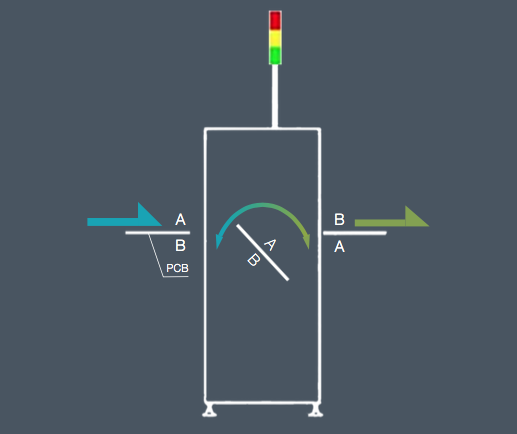
Between the printer, the placement machine, the reflow oven, the auto inserter and the wave soldering machine sits the part of the line that is easiest to overlook: board transport. When PCBs are walked between machines by hand, operators become couriers, boards get dropped or scratched, and every hand-off is a potential line stoppage.
A conveyorized board handling system changes that math by carrying boards automatically — and it connects into your existing line through the same SMEMA handshake your machines already use.
The real cost of carrying boards by hand
Manual transfer between machines leaks in ways the OEE report never shows:
- Operators become couriers. A person lifting a board and walking it to the next station is not adding value — they are bridging a gap the line should close.
- Dropped and scratched boards. Manual handling is the most common source of transfer damage, and a scratched board can fail at ICT or at the customer.
- Cycle-time mismatch. When one machine runs faster than the next, boards pile up or starve the line — and a human cannot smooth that out.
- No OK/NG discipline. After AOI, good and rejected boards land in the same stack and rework sneaks back into the flow.
- Lost time. Reference EMS lines recover about 2.5 hours per shift once operators stop walking boards between machines.
The Conveyor Fit Map
Map your line before buying a single module — it costs one afternoon and no capital:
- List the hand-offs, not the machines. Every point where a board changes custody is a conveyor candidate. Most lines find two or three arrows nobody owns.
- Flag the speed mismatch. Wherever two machines run at different cycle times, you need buffer capacity, not just transport.
- Mark the inspection exits. Post-AOI, do good and rejected boards have separate physical destinations? If not, that is a dual-link job.
- Check the working height. Your conveyor must align to 900 ± 20 mm (the S-460C reference) or your upstream/downstream equipment — mismatch breaks the SMEMA handoff.
Complete those four and the conveyor type selects itself.
The Vehicle: four jobs, four modules
S-460C reference rail conveyor. The workhorse between two machines: single or double rail, belt or roller transport, lengths from 0.5 to 2 m. It carries boards from 50 × 50 to 460 × 460 mm at 0.5–12 m/min, with SMEMA front/rear board-present signals so boards transfer without collisions.
S-350C buffer conveyor. When one machine runs faster than the next, a buffer adds queue capacity between different cycle times, storing boards until the next machine is ready. This is the cheapest way to absorb a mismatch without slowing your fastest station.
Dual-link conveyor. Two parallel lanes serve double-track lines or separate OK and NG boards after inspection — keeping rework out of the main flow instead of at a rework bench.
SFBC flat belt conveyor (SFBC05 / SFBC10 / SFBC20). Gentle, high-volume transfer for boards and carriers, with an ESD belt to DIN EN 61340-5-1. Lengths of 0.5 m, 1 m and 2 m suit delicate boards or carrier-based transport.
Specifications come from the Southern Machinery S-460C user manual and conveyor brochures; final configuration is confirmed against your board set and line layout.
Where each earns its place
- S-460C fits EMS/ODM high-mix lines where rail width and working height must adapt to board sizes quickly.
- S-350C fits any line with a speed mismatch between adjacent machines.
- Dual-link fits parallel-track lines and post-inspection OK/NG separation.
- SFBC flat belt fits medical and sensitive boards where shock and contamination control matter.
An unloader such as the SUL-250 completes the flow by stacking boards automatically at the exit — removing the last manual handling step.
Re-run the map as the line grows
Lines change: new machines arrive, board sizes shift, volumes rise. Re-run the Conveyor Fit Map at each line change — a gap that was fine by hand last quarter becomes a bottleneck the moment throughput climbs. Reviewing it whenever you add or move a machine keeps transport from silently capping the line.
Your next step
Send your board sizes, line layout and the machines the conveyor must connect to info@smthelp.com or WhatsApp +86 136 0256 2576. Southern Machinery returns a type recommendation, configuration, quotation and delivery schedule — typically the same working day, with installation, operator training and spare-part support included.
Jason Wu
Founder & CEO, Southern Machinery (Shenzhen Southern Machinery Sales and Service Co., Ltd.)
Email: jasonwu@smthelp.com / info@smthelp.com
WhatsApp: +86 13602562576
Catalog & manuals: file.autoinsertion.com | Machine photos: ph.smthelp.com
LinkedIn: linkedin.com/in/smtsupplier | YouTube: youtube.com/c/Smthelping
Comments
Comments appear after approval.