
Radial Insertion Machine S3000 vs S3010A — Which One Fits Your THT Line
Two radial inserters, two automation levels. Use the five-parameter check to decide between the S3000 entry model and the S3010A inline cell before you ask for a configuration.
Aug 27, 2026 · Updated Aug 31, 2026 · Jason Wu

Your radial bench looks busy. It is also the slowest, least-documented station on the line — and the one your customer's auditor will question first.
Radial-lead capacitors, transistors, LEDs and key switches are still placed by hand on many THT lines. That bench quietly caps throughput, re-introduces polarity errors, and makes every traceability audit harder than it needs to be. Southern Machinery's S3000 and S3010A replace hand placement with tape-fed, machine-paced insertion at 10,000–12,000 CPH, scaling from a single entry inserter to a high-mix inline cell with automatic PCB load and unload.
The quiet cost of hand radial insertion
Before comparing models, name what manual placement actually costs you:
- Throughput scales with headcount, not demand. A skilled operator places a few hundred radial parts per hour; a machine places ten thousand. You cannot win a volume spike by hiring faster.
- Polarity errors surface at test. A reversed capacitor can clear visual inspection and fail only at ICT — the most expensive place to find a mistake.
- Turnover erodes discipline. Night shifts and new hires reintroduce the errors automation was meant to remove.
- Tape and parts chaos. Half-used reels and loose components undermine 5S and ESD control on the bench.
- Audit exposure. Manual insertion cannot document what it cannot verify — and automotive or medical customers ask exactly that.
The Five-Parameter Check
Run this before you request a quote. It decides the model, not the brochure:
- Board envelope. What is your actual PCB size and thickness range? Both machines accept 50×50 mm to 400 mm on the long edge, but the S3010A reaches 400×400 mm.
- Component mix. Lead spans from 2.5 to 10.0 mm (single, dual, triple, quad tooling). Taller parts? The S3000 tops out at 20 mm; the S3010A handles 22 mm without derating.
- Target output. 10,000 CPH actual (S3000) versus 12,000 CPH real throughput (S3010A).
- Changeover speed. How often does the radial mix change? Fast mix favors camera-visual programming.
- Inline vs standalone. Do you need automatic load/unload and magazine racks, or a single bench replacement?
If you can answer those five, you already know which machine to shortlist.

The Vehicle: two machines, two automation levels
Both insert the same radial-lead, tape-packaged family. Board size, mix and volume pick the fit.
S3000 — the cost-efficient entry model. 10,000 CPH actual insertion, 10 recommended feeder stations, servo motor + lead-screw drive with 8 servo axes, and 100% Universal-compatible wearing parts. It accepts PCBs from 50×50 to 400×300 mm, spans 2.5–10.0 mm, components up to 20 mm tall, and supports optional inline load/unload. A documented payback reference runs under one year depending on volume — confirm against your own headcount and shift pattern.
S3010A — the high-performance inline model. It adds full Fuji servo drive (1.5 kW head, 400 W X-Y), 12,000 CPH real throughput, camera-visual programming of a new PCB in under five minutes, machine-vision coordinate correction, quad-span tooling, and 0°–360° insertion in 1° steps. Automatic PCB load/unload with 50-board magazine racks comes standard. It takes UIC-compatible heads, clinch bases, CTA carriers and feeders.
All values come from the official Southern Machinery datasheets and support initial evaluation; final configuration is confirmed after technical review of your boards.
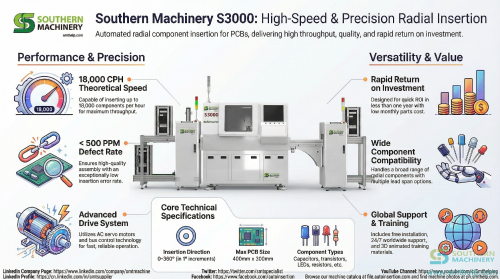
Where each model earns its place
- S3000 fits EMS/ODM mixed lines, lighting, power and appliance boards dominated by radial parts that never justified a manual bench — and factories replacing one bench affordably.
- S3010A fits automotive, medical and industrial-control assemblies where documented polarity control, fast changeover and a conveyorized cell matter more than the entry price.
Both slot between SMT placement and wave or selective soldering on a SMEMA-style handoff, and run alongside axial, terminal and odd-form inserters in one Southern Machinery THT cell.
Make it a recurring check, not a one-off
Component mixes drift. Re-run the Five-Parameter Check every quarter: board sizes change, new radial parts appear, and volume shifts. The answer that pointed to an S3000 this year may point to an S3010A next year — and catching that early protects both throughput and capital.
Your next step
Send your board sizes, radial component mix, monthly volume and line layout to info@smthelp.com or WhatsApp +86 136 0256 2576. The engineering team returns a model recommendation, configuration and quotation — typically the same working day.
Jason Wu
Founder & CEO, Southern Machinery (Shenzhen Southern Machinery Sales and Service Co., Ltd.)
Email: jasonwu@smthelp.com / info@smthelp.com
WhatsApp: +86 13602562576
Catalog & manuals: file.autoinsertion.com | Machine photos: ph.smthelp.com
LinkedIn: linkedin.com/in/smtsupplier | YouTube: youtube.com/c/Smthelping
Comments
Comments appear after approval.