
Radial Lead Molding & Taping Machine S-300B by Southern Machinery
The S-300B radial lead molding and taping machine takes loose radial components out of a bulk bowl and delivers a sealed paper-tape pack — boxed or coiled — at a published 180 ± 20 components per minute, with lead forming, polarity checking, re-orientation, value testing and reject ejection in one pass before the tape reaches your inserter. For EMS and ODM plants running through-hole lines, it moves the tape specification — pitch, hole diameter, taping height and polarity direction — inside your own process, where a reversed electrolytic is turned instead of shipped. Published figures are reproduced from the supplied documents and open points are printed rather than averaged; every throughput and payback number is example arithmetic on your own inputs.
Oct 6, 2026 · Updated Oct 6, 2026 · Jason Wu

Radial Lead Taping Machine S-300B by Southern Machinery
What is the S-300B used for? The S-300B is a radial lead molding and taping machine: it takes loose radial components out of a bulk bowl, forms the leads to the lead pitch your inserter is set for, checks polarity and electrical value, ejects what fails, and delivers a sealed paper-tape pack — boxed or coiled — at a published rate of 180 ± 20 components per minute. It runs one step before the radial inserter, so the tape your through-hole line depends on stays under your own control.
Hook: Is your THT line actually slow at insertion?
Ask a production manager for the cycle time of a through-hole line and you will get a competent answer about insertion, wave soldering and test. Ask for the time spent hand-forming and hand-taping the radial parts that feed it, and the conversation changes shape. Nobody measured it, because it never appeared as a station on the line layout — it appeared as headcount.
A radial inserter does not care how careful your operators are. It cares that every part arrives the right way up, at the right lead pitch, in the right pocket of the tape, every time. Hand taping turns that into a human judgement repeated thousands of times a shift — and a judgement repeated that often is a defect rate, not a skill.
Diagnosis: Which failure never reaches your tester?
Two costs hide at that bench, and only one of them is wages.
The first is the polarity error. Insert a radial electrolytic capacitor the wrong way round and it passes a simple continuity check — the path is perfect right up until the electrolyte vents. It fails weeks later, in the field, with the case split, and by then it is a warranty claim instead of scrap.
The second is the tape you did not control. Pre-taped components are convenient right up to the moment your inserter starts mis-picking, and then the argument is between your line and a supplier you cannot audit. Lead pitch, hole diameter, taping height and polarity direction are process parameters, not consumables.
Framework: What are the nine stations between the bin and the sealed tape?
- Bulk feed — a vibratory bowl lifts loose components onto a linear track; a bowl eye stops the bowl when the track is full, a track eye slows it when short.
- Lead spread — a spreader opens the leads before anything touches the body, so the die cannot close on a crossed lead.
- Lead forming — an integrated moulding die presses the leads to the formed pitch; it is one piece and comes off with four screws.
- Polarity test — measured before the part is committed to the tape, which is the difference between a board that works and a board that comes back.
- Re-orientation — a wrongly oriented part is turned rather than rejected; both directions are selectable to match your inserter.
- Value test — with the matching tester fitted, capacitance and resistance are compared against the window you set.
- Lead trim — long-lead parts are trimmed so the finished tape height is uniform.
- Reject ejection — a gate holds open for a good part and drops a failed part into a scrap tube.
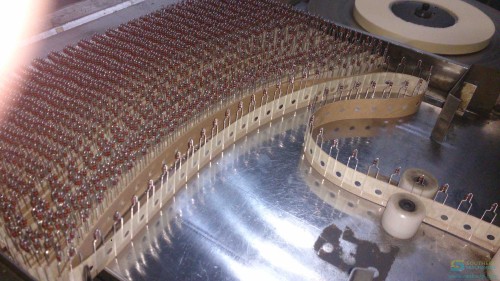
- Tape and pack — good parts are sealed into paper tape, boxed or coiled, ready for the feeder.
Vehicle: What should you specify before you order?
A taping machine is only useful if the die, the fixtures and the tape all match the component you actually run. Settle these before the order:
- Taping speed (published): 180 ± 20 components per minute — a band from 160 to 200. Plan from the bottom of the band; treat 200 as a best case, not a rate.
- Formed lead pitch: 2.5 mm, 3.5 mm and 5.0 mm dies are standard; 7.5 mm, 10 mm, 15 mm and above are ordered separately.
- Component diameter: Ф6 – Ф10 mm standard fixture configuration; across the conventional Ф4 – Ф10 range, Ф4 – Ф6 and Ф8 – Ф10 each use their own fixture set.
- Component length: 5 – 30 mm. Tape hole: 12.7 mm pitch, 4.1 mm diameter, others customised on request. Taping height: 17 – 21 mm.
- Output: boxed (ammo pack) or coiled on a reel — tell us which your inserter takes.
- Drive and cams: servo control replacing the traditional clutch, imported cams ground to 0.01 mm.
- Site: 220 V / 50 Hz / 1.6 kW, clean dry air at 4 – 5 kg/cm², footprint 2200 × 1200 × 1500 mm, weight 700 – 900 kg, access on all four sides for the bowl, reject tube and output end.
- Tester (optional): polarity is checked on every part; with the capacitance and resistance tester fitted, out-of-window parts are ejected too. Without it the machine still forms and tapes, but stops rejecting on value.
Consumables from the supplier documentation for this machine class, to confirm against your own tape specification before ordering in volume: paper tape 18 mm wide at 0.38 or 0.47 mm, top tape of 6, 10, 12 or 15 mm, a 12.7 mm sprocket hole pitch and a 4.1 mm hole.
What the documents do not agree on
A specification table that quietly picks one of two numbers is worth less than one that shows both. Six points in the supplied S-300B documents disagree or are stated in only one of them, and they are printed rather than averaged: the model naming (S-300B, S300B, S-300BSTD, and a DT-300BSTD manual for this machine class); the control system and interface; the speed framing (a 160 – 200 band, speaker notes quoting up to 200, and 120 – 180 in the supplier manual); the component diameter range; a 1 mm difference at the top of the taping height range; and whether coiled output and a 2.0 mm pitch are standard or to order. Confirm each against the current drawing for your configuration.
How does it connect to the rest of a PCB assembly line?
The S-300B is the preparation stage of a through-hole line, not a standalone machine: component prep feeds radial insertion, radial insertion hands over to odd-form insertion, and assembled boards move on to wave soldering and inspection. Everything downstream inherits the tape — an inserter cannot be more accurate than the pocket it picks from.
Loop: What changes in year two?
The inputs move: component counts per board rise as designs add bulk capacitance, and volumes swing with demand. Every time either changes, a bench absorbs it by hiring and a machine absorbs it by running.
Example only — depends on configuration; subject to final technical confirmation.

Parts to tape per month = radial parts per board × boards per month
Person-months released = (parts per month × 12) ÷ (hand rate/min × 60 × productive min/shift × hours × days)

Illustrative inputs, chosen by the reader:
  40 radial parts per board × 5,000 boards per month = 200,000 parts per month
  Hand taping at 8 parts/min, 60% productive time, 8 h shift, 21 days = 48,384 parts/month per operator
  Operators needed by hand ............................................ 4.1
  S-300B at the bottom of the published band, same 60% availability ... 967,680 parts/month
Nothing above is a measured result. It counts taping labour only: floor space, consumables, maintenance, reduced rework and the warranty failures a reversed electrolytic causes are real, and they are yours to add.
FAQ: Radial lead molding and taping questions buyers ask
Does it test the components or only tape them? Both, if the matching tester is fitted: polarity on every part, plus capacitance and resistance compared against your window, with out-of-window parts ejected into a scrap tube instead of being taped.
Can it run both boxed and reeled output? The product sheet lists boxed and coiled as equal alternatives and the deck says both are supported; the supplier manual for the class describes boxed as standard with coiled optional. Because the documents differ it stays an open point — tell us which output your inserter takes.
Can it handle my component diameter? The standard fixture configuration covers Ф6 – Ф10 mm; within the conventional Ф4 – Ф10 range the Ф4 – Ф6 and Ф8 – Ф10 bands each use their own fixture set. Send the drawing if your part sits outside that, because the bowl and fixture are tooled to the body.
How long does a lead pitch change take? The die is integrated and comes off with four screws, so a pitch change is a die change rather than a re-setup. What takes longer is first-article validation: measure the first tape against your tape specification before releasing the machine.
How fast is it, really? 180 ± 20 components per minute, so 160 to 200. Plan on the bottom of the band and multiply by your own availability after bowl refills, box or reel changes, die changes and stops.

CTA: Send one component and one tape drawing
The useful enquiry is short: what the part is, what tape your inserter takes, and how many you run a month. Email info@smthelp.com with a component sample and your tape specification and we will confirm the die, the fixture sets and the output configuration in writing before you commit to anything.
Next in this series: the S4000 axial insertion machine and how the axial half of a through-hole line is specified — same component list, different feeder bank.
Comments
Comments appear after approval.