
S-300B Molding & Taping Machine — Form, Test, and Tape Radial Parts in One Pass
Radial components only become useful to an insertion line after leads are formed, values verified, and parts taped. The S-300B does all three in one pass at 180 parts/min.
Aug 27, 2026 · Updated Aug 31, 2026 · Jason Wu
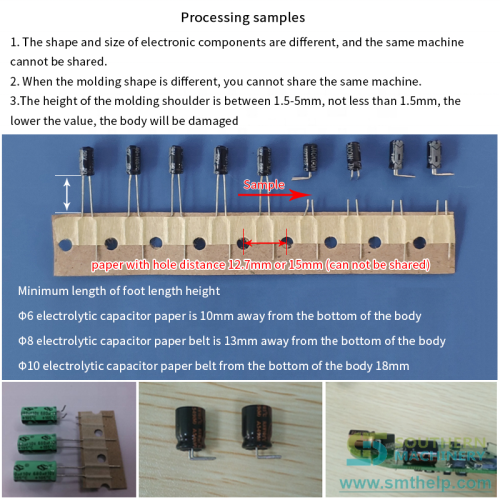
Radial-lead components are the workhorse of THT boards — LEDs, capacitors, resistors — but they only become useful to an automated insertion line after their leads are formed, their values verified, and their bodies packed into tape. Done by hand, that chain is slow, inconsistent, and invisible to your quality system.
The S-300B Fully Automatic Molding & Taping Machine from Southern Machinery compresses the whole job into one machine: form, test, and tape radial components at 180 ± 20 parts per minute, with servo control, imported precision cams, and an optional in-line capacitance/resistance tester that sorts good from defective chips before they ever enter a reel.
The hidden cost of manual forming and taping
Forming, testing, and taping by hand is a bottleneck wearing a disguise:
- Forming is inconsistent. Lead pitch and bend accuracy vary operator to operator, and the insertion line downstream pays for every deviation.
- Sorting is manual. Capacitance and resistance checked by hand are slow and error-prone; defective chips slip into good reels.
- Taping caps the line. A manual bench cannot keep pace with an automatic insertion machine; the reel runs out and the line stops.
- Clamping damage. Hand-held components get scratched or bent before they are ever placed.
- No yield record. Without integrated testing, there is no per-lot yield data to improve against.
The Reel-Readiness Audit
Run this before you buy any taping equipment — it works without spending a cent:
- Where do defective chips enter today? If wrong-value parts reach your insertion line, you need in-line testing and sorting, not just taping.
- What is your real throughput? Your taping rate must stay ahead of the insertion machine, not set its schedule.
- Which pitches do you run? Standard formed lead pitches of 2.5 / 3.5 / 5.0 mm cover most families; 7.5 / 10 / 15 mm are available on request.
- What packing fits your feeder? Box or reel — matched to downstream feeding, no extra repacking step.
Answer those four and you know whether a plain taper or a test-and-sort machine is the right buy.
The Machine: one pass, three jobs
The S-300B forms component leads (LEDs, capacitors, resistors), optionally tests capacitance and resistance with automatic good/defective sorting, and tapes parts into carrier tape at 180 ± 20 parts per minute, in box or reel packaging. It sits upstream of THT insertion: the reels it produces feed radial insertion machines with components already formed to a consistent pitch, value-tested, and packed complete.
- Feed — components enter from upstream feeders; the machine pairs with lead cutting/forming machines for a full forming-to-taping cell.
- Form — servo control drives imported precision cams (grinding accuracy up to 0.01 mm) to form leads to the selected pitch.
- Test (option) — the in-line tester measures capacitance and resistance of each chip.
- Sort — good and defective products are separated during the taping pass; defective chips never enter the reel.
- Tape and pack — 12.7 mm standard hole pitch (4.1 mm hole diameter), box or reel.

Conventional component diameter is Φ6–Φ10 mm (Φ4–Φ10 mm overall); product length 5–30 mm, taping height 17–21 mm. Utilities: 220 V / 50 Hz at 1.6 kW and compressed air 4–5 kg/cm²; footprint 2200 × 1200 × 1500 mm, 700–900 kg. All values are from the official Southern Machinery datasheet and confirmed after technical review of your component drawings.
Where it earns its place
- EMS and ODM factories with high-mix radial components feeding THT insertion.
- LED lighting and display plants molding and taping Φ4–Φ10 mm radial-lead LEDs.
- Capacitor and resistor lines converting bulk or tube components into insertion-ready radial tape.
- Automotive, medical, and industrial lines where one defective chip in a reel means a failed board at wave soldering.
Make reel-readiness a standing check
Component drawings and volumes change. Re-run the Reel-Readiness Audit whenever a new radial family enters production: the pitch, test requirement, and packing that fit last quarter may not fit the next. Reviewing it at each new product introduction keeps defective chips out upstream instead of at wave solder.
Your next step
Send your component drawings, product range, and monthly volume to info@smthelp.com or WhatsApp +86 136 0256 2576. Southern Machinery returns the tooling set, tester configuration, and quotation within 24 hours — plus free installation, operator training, 24/7 worldwide support, and a 1-day spare-part lead time.
Jason Wu
Founder & CEO, Southern Machinery (Shenzhen Southern Machinery Sales and Service Co., Ltd.)
Email: jasonwu@smthelp.com / info@smthelp.com
WhatsApp: +86 13602562576
Catalog & manuals: file.autoinsertion.com | Machine photos: ph.smthelp.com
LinkedIn: linkedin.com/in/smtsupplier | YouTube: youtube.com/c/Smthelping
Comments
Comments appear after approval.