
S-D600 Moveable V-Cut PCB Separator: Clean Depaneling for LED, SMT and Aluminum Boards
A guillotine-style V-cut separator that splits assembled panels cleanly along pre-scored grooves, protecting joints on LED, SMT and aluminum boards.
Aug 9, 2026 · Updated Aug 31, 2026 · Jason Wu
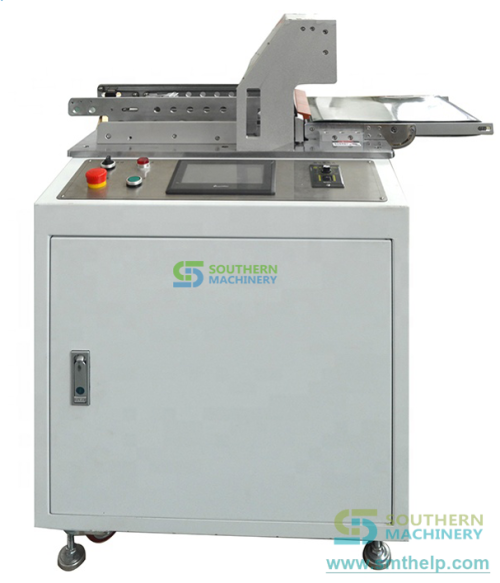
S-D600 Moveable V-Cut PCB Separator: Clean Depaneling for LED, SMT and Aluminum Boards
A finished panel that cracks a solder joint at the last station is the most expensive scrap on the floor — it carries the full value of paste, placement and reflow, then fails at depaneling. Hand-breaking and manual bending are still how many lines split multi-up boards, and both bend the panel enough to micro-crack joints you cannot see. The S-D600 moveable V-cut separator replaces that gamble with a guided, low-stress cut.
The cost you haven't named: depaneling stress
Depaneling is the step right before packing, so its defects ship. The damage is usually invisible until the board is in the field.
- Micro-cracking from hand break. Bending the panel to snap the V-groove flexes every joint on the board, not just the score line.
- Component damage. Tall capacitors and connectors near the edge take the impact when an operator forces a break.
- Inconsistent quality. Manual force varies operator to operator, so the same panel yields different results across a shift.
- Aluminum and thick boards. LED and SMT aluminum substrates resist hand-breaking entirely and need a real blade.
- Throughput ceiling. Hand depaneling is a bottleneck right before packing, throttling the whole line's output.
The Four-Point Clean-Depaneling Method
Frame separation as a method, not a guess. Call it the Four-Point Clean-Depaneling Method.
1. Map the score lines. Identify every V-groove on the panel and the components sitting close to each groove, because those are the joints most at risk during separation.
2. Score the board stack-up. Note board thickness and material — 0.2–3.0 mm FR-4, aluminum, or mixed — since each needs a matched blade gap and feed speed.
3. Quantify the separation force. Decide how much stress the joints can tolerate, then set the cut so separation energy stays far below the fracture point of the solder.
4. Set the cut acceptance test. Define a clean edge with no copper tear and no micro-crack as the pass criterion, and make it the same for every operator and every shift.
The vehicle: S-D600 Moveable V-Cut PCB Separator
The method above maps directly onto how the S-D600 is run on the floor.
- Map the score lines → aligned blade bed. The operator places the panel and aligns the V-groove under the blade; a foot switch triggers the cut, so the groove — not the operator's eye — sets the path.
- Score the board stack-up → 0.2–3.0 mm range. The S-D600 handles thin FR-4 through thick aluminum substrates across its rated thickness, with feed speed selectable at 300–500 mm/s for the material.
- Quantify the separation force → low-stress circular blade. A stepper-motor upper circular blade presses a lower straight blade to break the panel cleanly, keeping separation stress small enough to avoid the micro-cracking that hand methods cause.
- Set the cut acceptance test → repeatable travel stops. Pre-set cutting travel at 0/150/300/450/600 mm gives consistent passes, so the clean-edge standard holds whether the operator is new or experienced.
Specification note: exact blade material grade, separation length beyond 600 mm, and machine configuration should be confirmed at quotation, because they depend on your panel size, board material and daily volume rather than one default build.
Specifications
| Parameter | Value |
| --- | --- |
| Machine size | 950 × 340 × 430 mm (L×W×H) |
| PCB thickness | 0.2 – 3.0 mm |
| Feed speed | 300 – 500 mm/s (switchable) |
| Blade material | SKD61 high-speed steel (SKH-9) |
| Working temperature | 10 – 35 °C |
| Power supply | 230/110 V, 50/60 Hz, 40 W |
| Machine weight | 40 kg |
| Standard separation length | up to 600 mm (customizable) |
| Pre-set cutting travel | 0 / 150 / 300 / 450 / 600 mm |
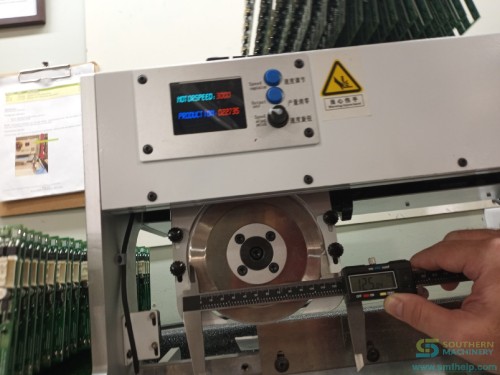
The loop: re-check the blade gap every two weeks
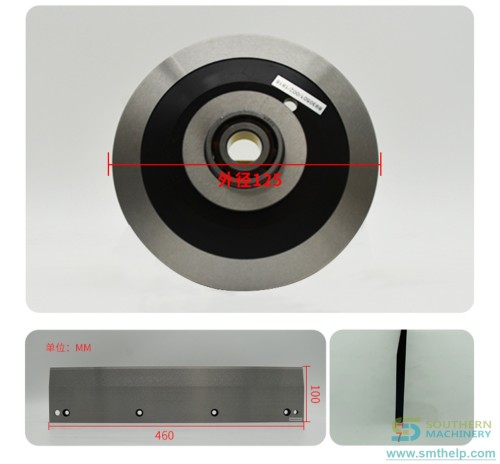
Depaneling quality fades as the blade wears, and nobody notices until the tear-out returns. Build a loop: every two weeks, inspect the upper and lower blade for wear, compare sample edge quality against the acceptance test, and re-time the cut if a new board thickness entered production. If a panel with tighter component spacing arrives, re-map the score lines before running it. The loop is what keeps the S-D600 cutting clean long after the hone loses its edge.
Your next step
Send us a sample panel and its board thickness. We will return a depaneling review showing where the S-D600 Moveable V-Cut PCB Separator fits, what feed speed and blade to specify, and what to confirm at quotation. Reach Jason at jasonwu@smthelp.com or on WhatsApp +86 13602562576.
FAQ
What boards can the S-D600 separate?
It handles FR-4 and aluminum SMT/LED panels from 0.2 to 3.0 mm thick along pre-scored V-grooves, after placement, reflow, THT and wave soldering.
How does it avoid micro-cracking joints?
A stepper-driven upper circular blade meets a lower straight blade to break the panel with intentionally small separation stress, unlike hand-bending which flexes every joint.
Is it manual or automatic?
It is operator-loaded: the panel is placed, aligned and cut via foot switch, giving guided, repeatable separation without a fully automated line.
What is the longest board it cuts?
Standard separation length is up to 600 mm, customizable beyond that. Exact length is confirmed at quotation.
Does it suit aluminum LED boards?
Yes. Thick aluminum substrates that resist hand-breaking are cut by the blade within the rated thickness range.
Jason Wu
Founder & CEO, Southern Machinery (Shenzhen Southern Machinery Sales and Service Co., Ltd.)
Email: jasonwu@smthelp.com / info@smthelp.com
WhatsApp: +86 13602562576
Catalog & manuals: file.autoinsertion.com | Machine photos: ph.smthelp.com
LinkedIn: linkedin.com/in/smtsupplier | YouTube: youtube.com/c/Smthelping
Comments
Comments appear after approval.