
S-MVF01 Belt Bulk Feeder: Selection and Integration Guide
A practical guide to selecting and integrating the S-MVF01 belt bulk feeder: how to present loose odd-form components with a stable pick position on your existing mounter.
Aug 3, 2026 · Updated Aug 31, 2026 · Jason Wu
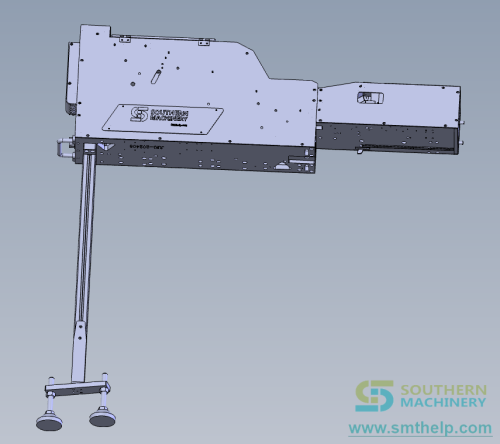
S-MVF01 Belt Bulk Feeder: Selection and Integration Guide
A loose terminal that needs tape or tray packaging ties up inventory, labor, and floor space before it ever reaches the mounter. The S-MVF01 Belt Bulk Feeder is built to present suitable loose odd-form parts at a stable pick point without that packaging — but selecting and integrating it is an engineering step, not a plug-in. Southern Machinery walks you through the fit, interface, and validation with your actual component and target mounter, so the feeder earns its place on the line.
The cost you haven't named: bulk packaging overhead
Most teams price a feeder by its sticker and forget the recurring cost of forcing loose parts into tape or trays. The overhead shows up long before the placement head moves.
- Tape and tray prep labor. Repackaging loose terminals and connectors into tape or trays adds a manual step that scales with every new part number and quietly consumes operator time each shift.
- Inventory and floor space. Packaging consumes storage and reel real estate that could stay as bulk stock closer to the line, where it is actually consumed.
- Mismatched feeder interfaces. A bulk component that is not screened against the mounter's feeder rail and orientation rules will not present consistently at the pick point, no matter how good the feeder is.
- Unverified throughput. Assuming a feeder is plug-and-play hides the return-and-reselect tuning, vibration timing, and fiber-optic positioning that actually drive a stable cycle and a believable capacity number.
The Bulk Feeder Fit & Integration Audit
Before committing the S-MVF01 to a line, frame the decision as a repeatable audit rather than a catalog pick. Call it the Bulk Feeder Fit & Integration Audit.
1. Screen the component. Confirm the part has distinguishable physical characteristics for selection, with no easily deformed pins and a length-to-height ratio at or above 1:1.2. This screening step decides whether bulk feeding is even viable for the part.
2. Define the pick orientation. State the required orientation at the mounter pick location and the marking or pin reference the feeder must respect. A clear orientation target keeps the downstream placement program simple and the reject rate low.
3. Match the mounter interface. Capture the placement machine brand, exact model, feeder rail or interface space, and any current feeder reference. The S-MVF01 uses a positioning key and clamping block, with alternative fixing matched during the engineering review.
4. Validate the flow. Run the actual component through belt selection, return flow, direct-vibration timing, and fiber-optic positioning, then confirm controls and line handoff before production release. Sign-off on a sample run is the acceptance test.
The vehicle: S-MVF01 Belt Bulk Feeder
The framework above maps directly onto how the S-MVF01 is selected and installed on a real production line.
- Screen the component → application-specific feeding. The S-MVF01 uses a motor-driven belt plus direct vibration: loose parts enter, components with distinguishable characteristics are selected on the belt, non-selected material returns for another pass, and fiber-optic induction supports pick-point positioning.
- Define the pick orientation → stable pick position. By returning and re-selecting non-conforming parts, the feeder targets a repeatable orientation at the pick point rather than relying on ideal bulk presentation from the start of the run.
- Match the mounter interface → standard mounting kit. A positioning key and clamping block are provided as standard, with alternative fixing structures engineered to the specific mounter rail or interface space you confirm during review.
- Validate the flow → PLC-controlled operation. PLC control can include optional I/O connection to the line, so the feeder hands off cleanly to the surrounding placement and inspection process instead of running as an island.
Specification note: exact cycle time, feeding accuracy, air and power configuration, and interface fixing should be confirmed at quotation, because they depend on your validated component, mounter model, and local utility setup rather than a single default.
| Parameter | Value |
| --- | --- |
| Envelope (L × W × H) | 850 × 140 × 260 mm |
| Component size range | 3 × 3 × 3 to 20 × 20 × 20 mm |
| Feed method | Single-channel belt + direct vibration |
| Typical feeding time | 1.5–2 s per part (validated component) |
| Feeding accuracy | ±1 mm (catalog value) |
| Power supply | 220 V / 50 Hz |
| Air supply | 0.4–0.6 MPa |
| Control | PLC with optional I/O connection |
The loop: re-review on every part change
Component mixes shift faster than line layouts, and a feeder tuned for this quarter's terminal may drift on next quarter's connector. Build a loop: every time a new bulk part is added or an existing one changes geometry, repeat the Bulk Feeder Fit & Integration Audit on that part, re-check the screening boundaries, and re-validate the belt and vibration tuning on the target mounter before ramping. Keep the original audit as the baseline and compare feeding stability across part changes, so a creeping reject rate is caught at the feeder review rather than on a downstream placement head. The loop is what keeps the S-MVF01 integrated and useful instead of a one-part experiment that never scaled.
Your next step
Send your component list with actual part photos, dimensions, pin and orientation notes, target mounter model, interface photos, and cycle requirement. We will review S-MVF01 fit, confirm the closest configuration or recommend a more suitable feeding method, and list what to confirm at quotation. Reach Jason at jasonwu@smthelp.com or on WhatsApp +86 13602562576.
FAQ
Can the S-MVF01 feed any loose component?
No. Components need distinguishable physical characteristics, and the source flags restrictions around easily deformed pins and a length-to-height ratio below 1:1.2. Send samples and drawings for confirmation before assuming fit.
Does the feeder eliminate tape or tray packaging?
It is designed to present suitable loose components without tape or tray packaging. Whether that fits your process depends on part geometry, orientation requirement, and placement equipment.
What placement equipment information is needed?
Provide the mounter brand and exact model, available feeder rail or interface details, mounting-area photos, and any current feeder reference so the interface can be matched.
How fast is the S-MVF01?
The catalog source lists a typical feeding value of 1.5–2 seconds. Actual performance depends on the validated component, setup, and mounter integration rather than the headline number.
Jason Wu
Founder & CEO, Southern Machinery (Shenzhen Southern Machinery Sales and Service Co., Ltd.)
Email: jasonwu@smthelp.com / info@smthelp.com
WhatsApp: +86 13602562576
Catalog & manuals: file.autoinsertion.com | Machine photos: ph.smthelp.com
LinkedIn: linkedin.com/in/smtsupplier | YouTube: youtube.com/c/Smthelping
Comments
Comments appear after approval.