
You Are Buying Pallets For Boards You Will Never Build Again
Every pallet in your store is a bet that a board will come back in volume. In HMLV work, most of those bets lose — and the pallet is still on the shelf.
Aug 3, 2026 · Updated Aug 29, 2026 · Jason Wu
Open the pallet store and count how many fixtures have not moved in a year.
Each one was a reasonable purchase at the time. Each one assumed a board would come back in volume. In high-mix, low-volume work most of those assumptions are wrong, and the evidence is sitting on a shelf costing you floor space and capital.
Palletised wave soldering is a superb process for volume. It is a poor process for uncertainty — because the fixture cost lands before you know whether the board will ever justify it.
What HMLV actually costs you
The pain in high-mix through-hole work is not the soldering. It is everything around it:
Fixture lead time before first article. A new board waits on a pallet design, a machined fixture and a qualification run before you can ship a single unit.
Changeover between small batches. Loading, unloading, preheating and stabilising a wave pot for thirty boards costs the same setup as for three thousand.
Thermal exposure you did not choose. Palletised wave soldering heats the whole board. Dense SMD areas, connectors and heat-sensitive parts see a thermal profile selected for the through-hole joints.
Dross and material you cannot scale down. A full pot oxidises whether you run fifty boards or five thousand.
The Batch-Size Crossover: four questions
This is the test that decides selective versus wave. It takes an hour with your own production data.
1. What is your median batch size? Not the average — the median. A few large orders distort an average and hide the fact that most of your work is short runs. Below roughly 5–50 boards per batch with frequent changeovers, fixture-based economics start to break.
2. How many active part numbers share the line? Count distinct boards run in the last twelve months. Each one is a potential pallet. Multiply by fixture cost and you have your real capital exposure.
3. Where is the thermal risk on the board? List through-hole parts next to heat-sensitive SMD. If the two are adjacent — transformers and bus bars beside dense SMD is the classic case — you need localised heat, not a bath.
4. What is your changeover frequency per shift? This is usually the deciding number. If you change boards several times a shift, fixture handling dominates your available production time.
Read the result together: small median batches, many part numbers, adjacent thermal risk and frequent changeovers all point the same way. When three of four do, selective soldering is worth a serious look.
Where the S100B fits
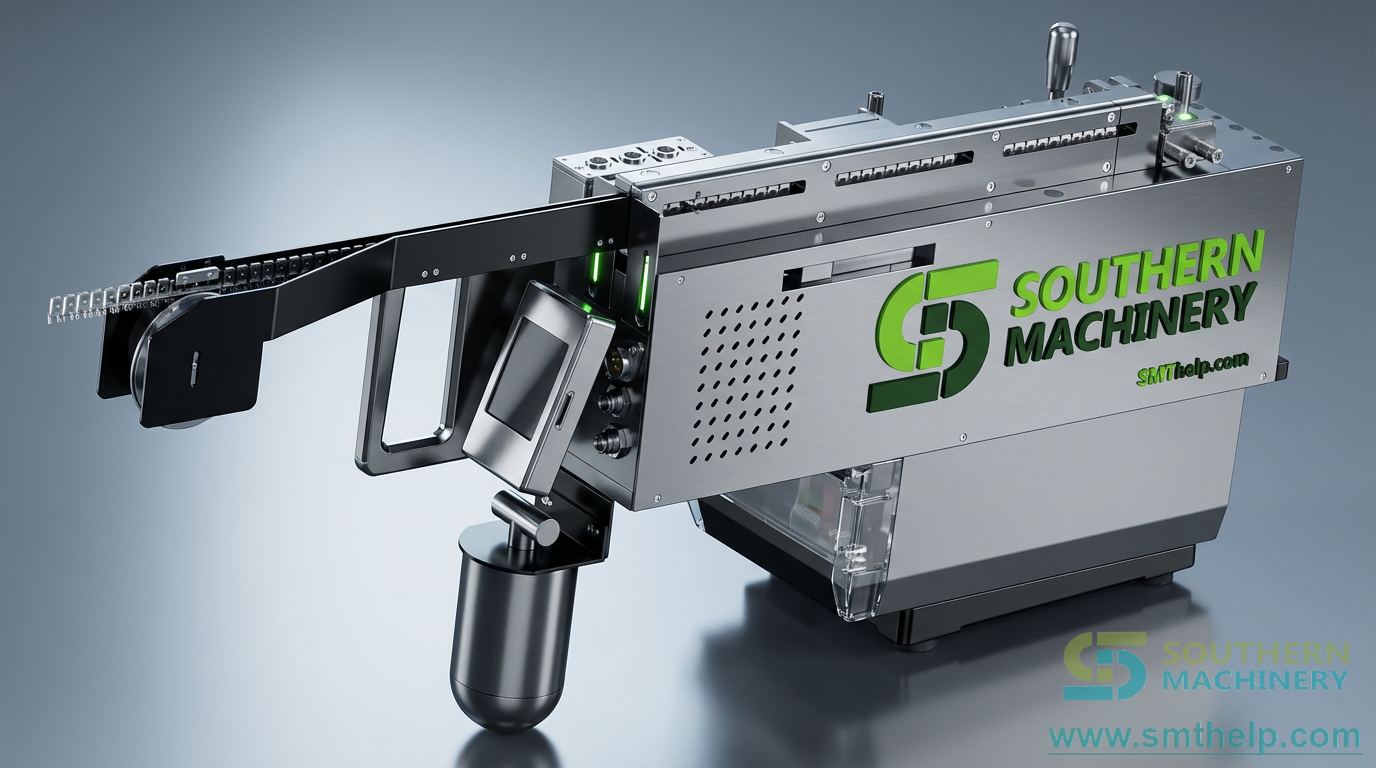
Southern Machinery's S100B is a desktop selective soldering system built for exactly this profile. Its rapid-change design lets operators switch between board types without dedicated pallets or wave solder fixtures: boards load directly onto the work surface and a programmable nozzle path solders each joint individually.
Mapped onto the four questions:
- Median batch size — fixtureless operation removes the pallet from the economics entirely. No fixture cost, no fixture lead time, no fixture store.
- Part number count — a new board type is a new program, not a new machined fixture.
- Thermal risk — the nozzle solders the joints that need soldering. Adjacent SMD sees far less thermal exposure than it would in a wave.
- Changeover frequency — program recall replaces pallet handling.
The S100B handles standard through-hole components including connectors, relays, transformers, electrolytic capacitors, terminal blocks and pin headers. For lead-free work it is compatible with SAC305 and other lead-free alloys; confirm the machine's temperature range and pot metallurgy (titanium or stainless steel) are rated for sustained lead-free operation at your required temperatures, typically 260–280 °C.
On the business case, our product material cites break-even against palletised wave soldering within roughly the first three to six months for HMLV operations running 5–50 board batches with frequent changeovers. Treat that as a planning reference from our documentation, not a commitment — your payback depends on your fixture costs, changeover frequency and labour rate.
Where it sits in the line
In a mixed-technology flow the S100B slots in after SMT reflow and before final inspection: printing → placement → reflow → AOI → THT selective soldering on the S100B → final inspection and test. For low-volume work it also runs as a standalone cell — an operator loads a board, the machine executes the pre-programmed solder path, and the board exits ready.
Close the loop
Recalculate your median batch size every quarter. Mix drifts: a line that justified wave soldering two years ago can quietly become an HMLV line as customers shift to smaller, more frequent orders. The crossover point is not a one-time decision.
Your next step
Send one representative board — the one with the awkward mix of through-hole connectors and dense SMD — plus your median batch size and changeovers per shift. We will run it on the S100B and send you the soldered board back with the program. You will know whether selective soldering fits before you spend anything.
See it running: youtube.com/c/Smthelping. Catalog and documentation: file.autoinsertion.com. Machine photos: ph.smthelp.com.
Jason Wu
Founder & CEO, Southern Machinery (Shenzhen Southern Machinery Sales and Service Co., Ltd.)
Email: jasonwu@smthelp.com / info@smthelp.com
WhatsApp: +86 13602562576
Catalog & manuals: file.autoinsertion.com | Machine photos: ph.smthelp.com
LinkedIn: linkedin.com/in/smtsupplier | YouTube: youtube.com/c/Smthelping
Comments
Comments appear after approval.