
S300AS Desktop PCB Router: Repeatable Depaneling for Small-Batch SMT/THT Lines
An offline desktop PCB router that replaces hand tools and V-cut stress with programmed, ±0.02 mm repeatable cutting for small-to-medium SMT/THT batches.
Jul 23, 2026 · Updated Aug 31, 2026 · Jason Wu
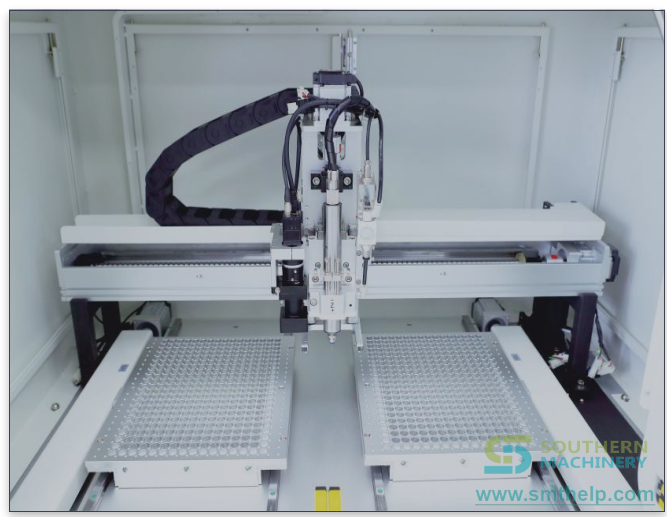
S300AS Desktop PCB Router: Repeatable Depaneling for Small-Batch SMT/THT Lines
A rough depaneling edge rarely gets noticed until a field return arrives three weeks later. In small-to-medium SMT/THT batches, routing paths change often, and operators still reach for hand tools or V-cut breakers that flex the board and stress nearby components. These stresses don't show up on the first-pass yield chart, but they quietly add rework and scrap. The S300AS Desktop PCB Router is an offline, high-precision station designed to replace that variability with programmed, repeatable cuts.
The cost you haven't named: depaneling stress and variation
Most lines track placement and reflow carefully, then leave the final separation step as a manual afterthought that nobody audits.
- Edge damage from hand tools. Knives, pliers, and manual breakers leave uneven surfaces, burrs, and over-cut tabs that downstream inspection has to catch—or the customer has to find.
- V-cut micro-stress on components. Score-and-snap methods flex the whole panel, transferring bending force to components and solder joints near the break line.
- Inconsistent results across operators. Two people separating the same panel rarely produce the same edge, so quality drifts with whoever is on the bench that shift.
- Changeover drag in high-mix runs. When routing paths change often, manual prep slows every new job and ties experienced operators to a low-value, repetitive task.
The Depaneling Quality Audit
Before specifying any router, frame the purchase as a repeatable audit of your separation process rather than a one-off tool buy. Call it the Depaneling Quality Audit.
1. Map the routing path. List the routed tab locations, remaining material, and cutter access for each panel you run, then confirm the machine can import that outline instead of re-teaching it by hand for every revision.
2. Protect the board edge and nearby components. Define the acceptable burr level and edge quality, and check that the cut keeps force localized to the tab so components and solder joints near the path are not stressed.
3. Close the takt with dual-table cycling. Measure how many panels per hour you need versus how long one fixture load takes, and confirm the station can keep cutting while the next board is being loaded.
4. Lock repeatability with verification. Set the acceptance test as consistent edge quality across shifts—alignment marks, stored programs, and fixed accuracy—so the result does not depend on who is operating the machine.
The vehicle: S300AS Desktop PCB Router
The four audit steps map directly onto how the S300AS is deployed as an offline depaneling station.
- Map the routing path → programmed cutting paths. The router follows taught cutting paths with DXF/PLT import, automatic path optimization, and breakpoint execution. It supports points, lines, arcs, full circles, curves, polylines, helices, and ellipses—so a changed outline is re-imported, not re-learned.
- Protect the board edge and nearby components → 800W precision spindle. An 800W high-speed precision milling cutter runs under ±0.02 mm cutting accuracy and repeatability. A sheet-metal environmental cover and aluminum die-cast frame add rigidity, keeping the cut localized at the tab.
- Close the takt with dual-table cycling → continuous operation. Dual-table alternating cycle lets one table route while the operator loads or unloads the other, keeping the spindle working instead of waiting on manual handling.
- Lock repeatability with verification → dual MARK alignment and program storage. Dual MARK alignment plus 1,000 stored programs keep the cut consistent across shifts and changeovers, backed by a Shinano Electric motor, YAKO driver, HIWIN linear guide, and TBI lead screw or synchronous-belt transmission.
Specification note: spindle speed, exact cutting range interpretation, fixture approach, and throughput should be confirmed at quotation. They depend on your panel size, routing path length, component clearance, and line layout rather than a single factory-wide default.
Specifications
| Parameter | Value |
| --- | --- |
| Spindle power | 800W high-speed precision milling cutter |
| Cutting accuracy / repeatability | ±0.02 mm |
| Movement speed | 0–500 mm/sec |
| Maximum load | 10 kg |
| Cutting range (source-stated) | 600 × 400 × 400 × 100 mm (notation to confirm) |
| Equipment dimensions | 1350 × 800 × 1900 mm |
| Program storage | 1000 sets |
| Control method | Microcontroller + handheld programmer |
| Motion components | Shinano Electric motor, YAKO driver, HIWIN guide, TBI screw/belt |
| Power input | Full-voltage AC110–220V |
| External interface | RS232 |
| Example throughput | ~30 sec/panel, ~120 boards/hour |
The loop: re-verify every program change
Depaneling quality drifts once a panel revision ships without anyone re-checking the cut. Build a loop: every time a routed outline, tab design, or component near the path changes, re-import the DXF/PLT, run a sample board, and compare the edge against the last accepted sample. On a set cadence—monthly for a stable mix, immediately for any revision—review stored programs against the live panel list with your process engineer and retire programs no longer in production. Treat the audit as a living document: the loop is what keeps the S300AS producing the same edge on Monday and Friday, not just on the day it was installed.
Your next step
Send us your PCB panel drawing, routed tab design, target takt time, and component clearance constraints near the routing path. We will review whether the S300AS Desktop PCB Router fits, what fixture approach and cutting range interpretation apply, and what to confirm at quotation. Reach Jason at jasonwu@smthelp.com or on WhatsApp +86 13602562576.
FAQ
Is the S300AS an inline router or an offline station?
The source positions it as a desktop/offline PCB router. It supports production workflows with dual-table cycling, but it is not described as a fully inline cell with automatic loading, unloading, MES connection, or advanced CCD vision.
What is the main advantage over manual or V-cut separation?
The main advantage is repeatability. The machine cuts to a programmed path at ±0.02 mm accuracy, reducing rough edges, over-cutting, missed cuts, and the board flex that hand and V-cut methods introduce.
What panel volumes does it suit?
The example figures are about 30 seconds per panel and roughly 120 boards per hour, but actual output depends on board size, routing path length, fixture design, and loading behavior. It suits EMS, ODM pilot, automotive, medical, and industrial-control batches that need controlled, small-to-medium depaneling.
Can it handle complex board outlines?
Programming supports points, lines, arcs, circles, curves, polylines, helices, and ellipses, plus DXF/PLT import and automatic path optimization. Final suitability depends on the PCB design and cutter access at the tab.
What should be confirmed before purchase?
Confirm panel size, routing path, component clearance, fixture design, expected throughput, dust and safety requirements, program import workflow, power input, and the exact interpretation of the listed cutting range with our engineering team.
Jason Wu
Founder & CEO, Southern Machinery (Shenzhen Southern Machinery Sales And Service Co., Ltd.)
Email: jasonwu@smthelp.com / info@smthelp.com
WhatsApp: +86 13602562576
Catalog & manuals: file.autoinsertion.com | Machine photos: ph.smthelp.com
LinkedIn: linkedin.com/in/smtsupplier | YouTube: youtube.com/c/Smthelping
Comments
Comments appear after approval.