
The Last Machine On The Line Breaks The Most Boards
Placement holds tolerance, reflow holds profile — and then the panel gets snapped by hand. The cheapest station on the line is quietly the most expensive one.
Jul 20, 2026 · Updated Aug 29, 2026 · Jason Wu
Ask where boards fail and most people point at the reflow oven. Ask where boards break and the honest answer is usually the last station — the one with a person and a pair of hands snapping a panel along a V-groove.
It is the cheapest station on the line and it carries the most risk, because the stress goes somewhere. Into the solder joints. Into a ceramic capacitor three millimetres from the edge. Into a BGA underneath a connector nobody thought about.
The four places depaneling stress hides
Cracked solder joints. Board flex during breaking loads every joint near the separation line. The joint does not always fail immediately — it fails in the field, which is the worst possible place.
Edge-near components. Ceramic capacitors and small-outline parts close to the board edge have no margin. Hand breaking does not know they are there.
Complex panel geometry. Stamp holes, V-slots, cut-outs and non-rectangular outlines do not break predictably along a straight line. Manual force follows the path of least resistance, which is not the path you designed.
Inconsistent results between operators. Manual depaneling is a skill, which means yield varies by shift. That variance is invisible in your SMT data and obvious in your field returns.
The Stress Audit: four questions before you choose a method
1. How close is the nearest component to the separation line? Under about three millimetres, mechanical breaking is a risk you are taking on every board.
2. What is the panel outline? Straight lines with clean V-grooves are one problem. Curves, cut-outs and stamp holes are a different problem that a straight break cannot solve.
3. What is under the board? BGAs, large QFNs and heavy inductors near the edge turn flex into cracked intermetallics.
4. What is your mix? High-mix work needs a depaneling method that reprograms in minutes, because you will be doing it all day.
If questions 1 and 2 come back unfavourable, V-cut and hand breaking are out. If 3 is unfavourable too, you need low-stress routing, not a faster break.
Where the S380A fits
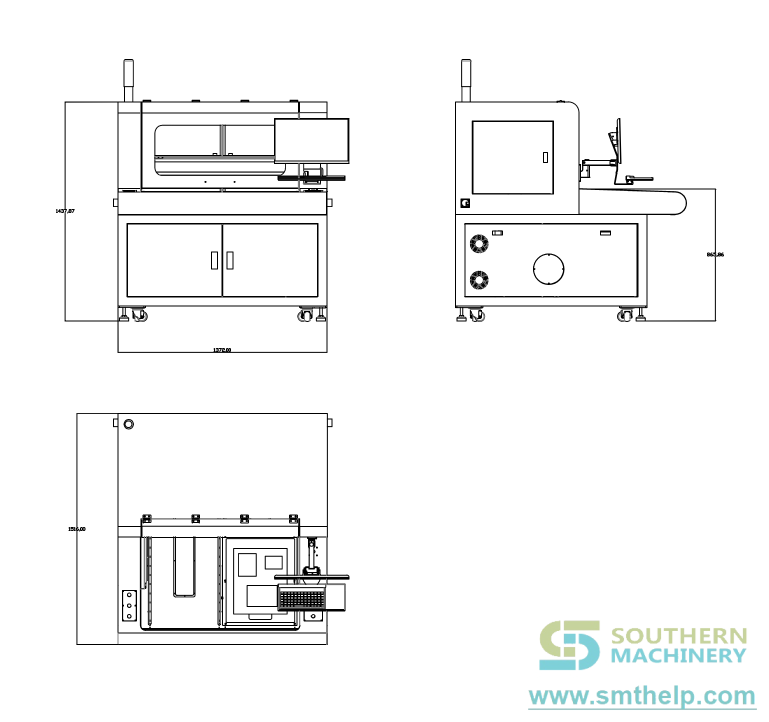
The S380A is a full-vision curve splitter built for panels with complex shapes, dense components, stamp holes, V-slots and outlines that straight-breaking handles badly.
Vision programming. A CCD camera captures the board image and the technician draws the cutting path directly on it — straight lines and arcs. For high-mix work this is the difference between a new program and a new fixture.
Low-stress high-speed routing. The spindle runs at 20,000–60,000 rpm, cutting rather than snapping. Mechanical stress on the board and its joints drops sharply compared with manual breaking, which is what protects edge-near parts and BGA joints.
Double Y-axis table. While one table routes, the other loads. Operator and machine time overlap instead of alternating.
Tool management. Cutter wear and breakage are monitored, so a worn bit stops being a silent quality drift.
Documented specification values from the product source:
| Item | Value |
|---|---|
| Machine repetition accuracy | ±0.01 mm |
| Cutting accuracy | ±0.02 mm |
| Cutting speed | 5–100 mm/s adjustable |
| Effective cutting size | 350 × 550 mm |
| PCB thickness range | 0.3–3 mm |
| Milling cutter size | 0.8–3.0 mm |
| Separator power supply | AC220V 50/60 Hz, 1 HP, 5 kW |
| Dust collector power supply | AC380V 50/60 Hz, 3 HP, 3 kW |
| Host size / weight | L1230 × W1180 × H1350 mm / 800 kg |
Confirm final configuration and options for your panel sizes at quotation.
Fit it into the line, including the dust
Routing generates dust, and dust collection is not an accessory — plan it. In an SMT flow the router sits after reflow and AOI; in a THT flow it usually sits after wave soldering and lead cutting. Either way, extraction and fixture design have to be in the layout from the start, not added when the machine arrives.
Close the loop
Add depaneling to your failure review. Any field return with cracked joints near a board edge should trace back to the separation method, and the fix is usually a program change rather than a new machine. Track one number: edge-related defects per thousand boards.
Your next step
Send a panel drawing or a sample panel — ideally the one with the tightest edge clearance and the awkward outline. We will program it on an S380A and return the separated boards so you can inspect the edge quality and check the joints under X-ray.
Catalog and documentation: file.autoinsertion.com. Machine photos: ph.smthelp.com. Cutting videos: youtube.com/c/Smthelping.
Jason Wu
Founder & CEO, Southern Machinery (Shenzhen Southern Machinery Sales and Service Co., Ltd.)
Email: jasonwu@smthelp.com / info@smthelp.com
WhatsApp: +86 13602562576
Catalog & manuals: file.autoinsertion.com | Machine photos: ph.smthelp.com
LinkedIn: linkedin.com/in/smtsupplier | YouTube: youtube.com/c/Smthelping
Comments
Comments appear after approval.