
S4000 Axial Auto Insertion Machine — Component Compatibility and Feeder Setup Guide by Southern Machinery
The S4000 axial inserter accepts tape-packed resistors, diodes and jumper wires within defined lead diameter and span limits.
Aug 15, 2026 · Updated Aug 31, 2026 · Jason Wu
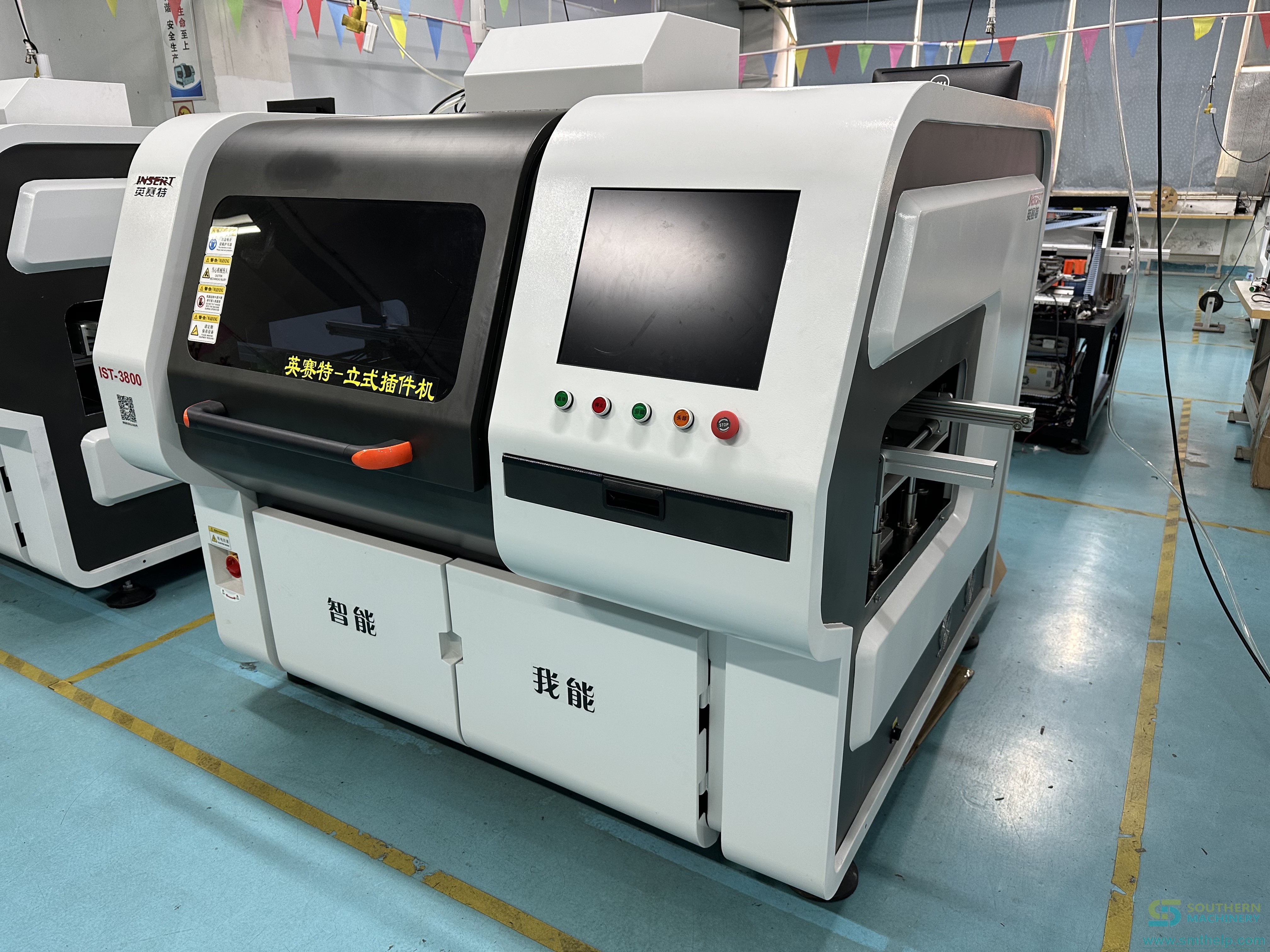
S4000 Axial Auto Insertion Machine — Component Compatibility and Feeder Setup Guide by Southern Machinery
Which axial components can the S4000 insert, and how should you plan the feeder setup before quoting a THT line? The S4000 is the axial workhorse of a through-hole line, but it earns its place only when your BOM fits within its component and geometry limits. Get those limits wrong, and you may quote a machine that cannot run your board.
The S4000 is an automatic axial component insertion machine that places tape-packed axial-lead components — resistors, diodes, jumper wires, and other compatible parts — into a PCB, replacing manual THT insertion. It is not a radial inserter or an odd-form inserter; it is normally paired with radial and odd-form machines to cover the full through-hole mix.
Why axial compatibility affects quality, capacity, and cost
- Wrong component format stops the line. Loose, bulk, or tube parts are not axial-tape parts, and forcing them onto an axial inserter wastes the quotation.
- Out-of-range lead diameter jams heads. Leads outside the supported diameter require custom tooling before the machine can run them.
- Out-of-range lead span misfeeds. A span wider than the head geometry accepts will not present correctly, causing missed or skewed insertion.
- Under-planned stations cap throughput. Too few feeder stations force changeovers that stall a board with many unique axial part numbers.
- Assuming rated speed. Rated CPH is not actual production; planning labor savings on rated speed alone overstates the return.
The Component Compatibility Triage
1. Confirm tape packaging. Verify every candidate part is available in axial tape; if not, plan a custom feeding solution or a different machine before quoting.
2. Check lead diameter. Measure the axial lead diameter and confirm it falls within the supported range; out-of-range parts need evaluation and possible tooling.
3. Check lead span. Measure the span between the two bends and confirm it fits the head geometry; wider spans belong on other platforms.
4. Count unique part numbers. Map unique axial part numbers to feeder stations so the modular station count matches your BOM and changeover plan.
The Vehicle: how the S4000 handles components
The S4000 is designed for tape-packed axial components, and three mainstream groups are documented: resistors in standard tape packaging, axial-lead diodes in tape format, and jumper wires used to bridge traces on single- or double-sided PCBs. The machine is a full servo-driven system with an EtherCAT motion-control bus and a Windows-based industrial computer, so program and station data are managed in software. It supports automatic PCB loading and is compatible with MES production management systems for traceability and line-level data collection. Operator training material, including a software editing video, helps teams learn board programming before the machine arrives.
| Parameter | Documented value |
| --- | --- |
| Component packaging | Axial tape only |
| Lead diameter | 0.3 – 0.8 mm |
| Lead span | 5 – 20 mm |
| Feeder stations | Modular, 5 – 60 stations |
| Rated speed | Up to 20,000 CPH (typical actual approx. 10,000 CPH) |
| Motion control | Full servo + EtherCAT bus |
| Control system | Windows-based industrial computer |
| MES integration | Compatible with MES production management systems |
| PCB loading | Automatic PCB loading for inline operation |
Where it fits
The S4000 is built for production-line integration. Upstream, a PCB loader feeds boards from an upstream conveyor, with SMT placement first if the board is mixed; the S4000 then runs axial insertion. Downstream, radial and odd-form insertion stations follow, then wave soldering, AOI or inspection, and lead cutting or depaneling. As a full-line solution provider, Southern Machinery can source SMT, THT, wave soldering, board handling, and inspection from one supplier, which simplifies line engineering, training, and after-sales support across the whole through-hole cell.
The ROI case
The ROI argument for the S4000 is straightforward on paper and needs validation in practice. Capacity is rated up to 20,000 CPH, with roughly 10,000 CPH typical in real production — far beyond manual insertion. Automatic insertion removes the human variability of hand placement, reducing polarity errors and missed insertions, while consistent lead clinching reduces rework downstream. One machine replaces several manual insertion stations, which matters where labor cost or operator recruitment is the constraint. Treat these figures as a planning benchmark to validate against your own line; payback is driven by your labor cost and defect reduction, and Southern Machinery can help configure the machine to your actual mix before you commit. Revisit station count as your BOM changes. That audit-and-improvement loop closes the gap between quote and reality.
Your next step
Contact Southern Machinery with your BOM, board size, and target volume, and get a configuration recommendation for the S4000 — or a complete SMT/THT line including wave soldering, board handling, and inspection.
FAQ
Can the S4000 insert radial components like capacitors or LEDs?
No. The S4000 is an axial inserter for tape-packed axial components. Radial components are handled by radial insertion machines, and non-standard parts by odd-form inserters.
What is the real production speed of the S4000?
Southern Machinery documents a rated speed up to 20,000 CPH, with typical actual production around 10,000 CPH depending on board layout and component mix.
Does the S4000 work with a MES system?
Yes. The machine uses an EtherCAT motion-control bus and is compatible with MES production management systems, supporting traceability and line-level data collection.
Is the S4000 suitable for high-mix EMS production?
Yes, within its axial scope. The modular 5–60 station feeder configuration and software-based programming support multiple part numbers, and the Windows-based control system simplifies changeovers.
Jason Wu
Founder & CEO, Southern Machinery (Shenzhen Southern Machinery Sales and Service Co., Ltd.)
Email: jasonwu@smthelp.com / info@smthelp.com
WhatsApp: +86 13602562576
Catalog & manuals: file.autoinsertion.com | Machine photos: ph.smthelp.com
LinkedIn: linkedin.com/in/smtsupplier | YouTube: youtube.com/c/Smthelping
Comments
Comments appear after approval.