
S-4000 Axial Insertion Machine: Smart Factory THT Automation
A high-speed axial insertion machine that turns the THT bottleneck into a repeatable, data-ready station with IPC-A-610 clinching and up to 60 feeders.
Aug 11, 2026 · Updated Aug 31, 2026 · Jason Wu

S-4000 Axial Insertion Machine: Smart Factory THT Automation
Manual axial insertion is one of the last labor-heavy steps on a PCB line — slow, inconsistent, and exposed to polarity and clinch errors that surface only at test. For EMS, ODM, automotive, medical and industrial-control builders, that bottleneck caps throughput no matter how fast the SMT stage runs. The S-4000 axial insertion machine is built to replace repetitive hand insertion with high-speed, repeatable automation, turning a variable manual station into a stable, data-ready part of the line.
The cost you haven't named: the THT insertion bottleneck
Manual axial insertion looks cheap until you price what it costs per board.
- Labor intensity. Each lead is placed and clinched by hand, so output scales with headcount, not with machine time.
- Quality drift. Insertion errors, wrong polarity and uneven clinch drive rework and inspection failures that compound at test.
- Throughput cap. A slow THT stage starves every downstream process, no matter how fast placement upstream runs.
- Traceability gaps. Hand work is hard to log, so escapes are difficult to reconstruct during an audit.
- Setup scatter. Fixtures, pre-formers and jigs for hand insertion are scattered across benches, so a board change means hunting tools before the first lead is placed.
The Axial Insertion Automation Readiness Check
Before buying, confirm the machine fits your product and line. Call it the Axial Insertion Automation Readiness Check.
1. Profile the axial mix. List the axial components on your boards — resistors, diodes, capacitors — and their lead forms, so the feeder and clinch setup matches reality.
2. Confirm the board handling. Define board size, thickness and fiducial or indexing method, so the machine positions and clamps consistently.
3. Set the quality bar. Agree the insertion accuracy and clinch style (full or half clinch) to IPC-A-610, so acceptance is measurable at delivery.
4. Plan the data connection. Decide what the machine should report — counts, faults, cycle status — so the station feeds your MES instead of running blind.

The vehicle: S-4000 axial insertion machine
The framework maps onto the machine's capabilities.
- Profile the axial mix → expandable feeders. Up to 60 axial feeders let the S-4000 hold a wide component set on one machine, reducing changeover between product families.
- Confirm the board handling → automatic positioning. The machine positions each board automatically, holding it for stable insertion across the run.
- Set the quality bar → IPC clinching. Leads are inserted and clinched to IPC-A-610 full or half clinch, giving a consistent, inspectable joint.
- Plan the data connection → data-ready station. Cycle and fault data support line visibility, so the THT stage is no longer a blind spot.
Specification note: exact CPH, feeder count, board-size limits and clinch options should be confirmed at quotation, because they depend on your component mix, board layout and line configuration.
Into an existing THT stage, the S-4000 mounts inline after the SMT reflow and before wave or selective soldering, passing boards through its own conveyor. Its program files load from the same line PC used for adjacent stations, and the clinch and fault data post to the MES alongside SMT placement records, so the axial step stops being a separate, unlogged bench.
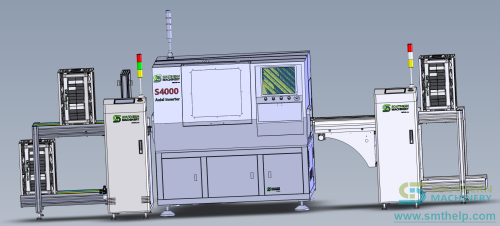
Specifications
| Parameter | Typical value / range |
| --- | --- |
| Insertion speed | Up to 20,000 CPH |
| Placement accuracy | ±0.1 mm |
| Axial feeders | Up to 60 (expandable) |
| Component types | Axial resistors, diodes, capacitors |
| Clinch style | Full / half clinch, IPC-A-610 |
| Board handling | Automatic positioning and clamping |
| Typical use | Power supplies, lighting drivers, control boards, automotive modules |
| Data output | Cycle counts, fault and status reporting |
The loop: tune the program every product change
A THT station drifts when programs are copied rather than verified. Build a loop: every time a new board enters the S-4000, re-run the Axial Insertion Automation Readiness Check, compare insertion accuracy and clinch quality to the last accepted baseline, and update the feeder map with your process engineers. Review fault logs monthly with the line lead. Treat the program as a living asset — the loop is what keeps the machine in specification instead of slowly degrading between audits.
Your next step
Send us your axial component list and a sample board. We will return a configuration outline showing feeder count, throughput estimate and what to confirm at quotation for the S-4000 axial insertion machine. Reach Jason at jasonwu@smthelp.com or on WhatsApp +86 13602562576.
FAQ
What components does the S-4000 insert?
Axial-lead parts such as resistors, diodes and capacitors used in through-hole boards.
How fast is it?
Up to 20,000 components per hour; actual throughput depends on board layout and component mix.
Does it clinch to standard?
Yes — full or half clinch to IPC-A-610, confirmed per your acceptance criteria.
Can it feed my MES?
Cycle and fault data are available; the exact interface is confirmed at quotation.
Do I need to replace my whole line?
No. The S-4000 slots into a THT stage as a single automated station or part of a line.
Jason Wu
Founder & CEO, Southern Machinery (Shenzhen Southern Machinery Sales and Service Co., Ltd.)
Email: jasonwu@smthelp.com / info@smthelp.com
WhatsApp: +86 13602562576
Catalog & manuals: file.autoinsertion.com | Machine photos: ph.smthelp.com
LinkedIn: linkedin.com/in/smtsupplier | YouTube: youtube.com/c/Smthelping
Comments
Comments appear after approval.