
Forty Hand Touches Per Board Is Capping Your Power Supply Output
Axial resistors and diodes are the backbone of power supply and LED driver boards — and the last step still done by hand.
Aug 19, 2026 · Updated Aug 31, 2026 · Jason Wu
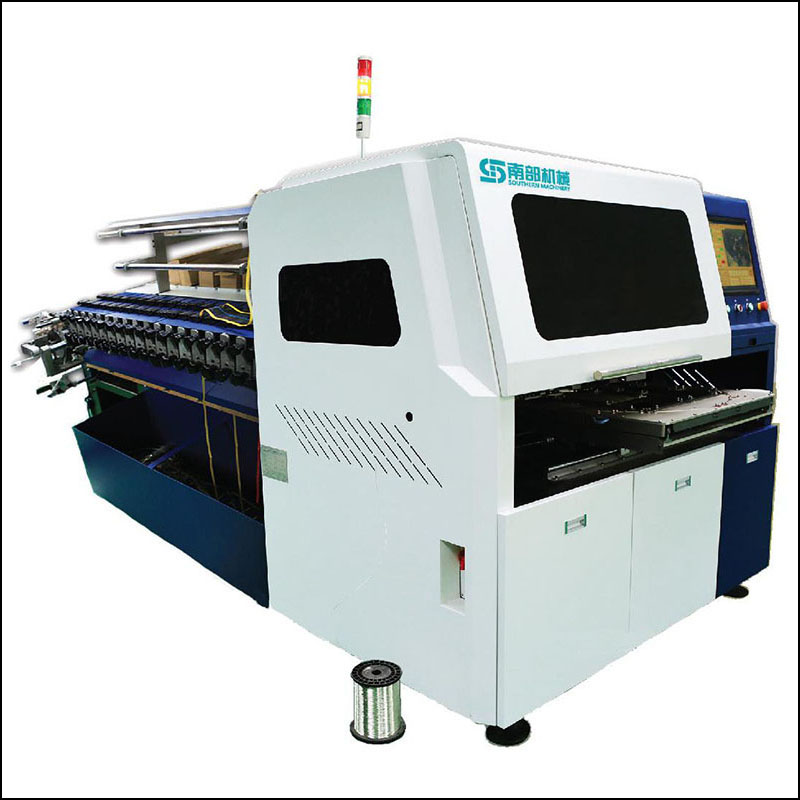
A 40-component power supply board means 40 hand operations per unit: pick, bend, push, clinch. Multiply by shift volume and the arithmetic stops being about labor cost alone — it becomes a ceiling on how much output the factory can promise. When orders climb, the manual insertion cell is the constraint that cannot be scaled by adding overtime, because every additional touch also adds a chance of a shallow insertion or a poor clinch that surfaces only after wave soldering.
Southern Machinery's S4000 Axial Insertion Machine automates that cell end to end. It feeds taped axial parts, forms the leads, inserts them into the board and clinches them on the far side, under programmable control — rated up to 20,000 CPH, with a typical actual production speed of approximately 10,000 CPH on a mixed board in real line conditions.
Why manual axial insertion breaks throughput and quality
Adapters, chargers, ballasts, LED drivers and street-lamp power supplies carry a high density of axial resistors and diodes. Hand insertion at volume fails in predictable ways:
- Depth variance. Insertion depth is set by the operator's wrist, so lead length below the board varies from part to part.
- Inconsistent lead forming. Manually bent leads enter the barrel at varying angles, which changes wetting during wave soldering.
- Clinch quality drift. A weak clinch lets the part shift before the wave; an over-tight clinch stresses the pad.
- Vibration-driven field failures. LED drivers mounted inside luminaires are exposed to heat and vibration, where a marginal joint becomes a warranty claim.
- Skill and turnover sensitivity. Any staff change lowers output and raises defect rate on the same board program.
The Axial Automation Audit
Score the manual cell before you specify feeder count. Four steps, using your own board set:
1. Count the touches. Axial parts per board × boards per shift. That number, not the wage rate, is what tells you whether automation is overdue.
2. Check the component envelope. Confirm every axial part is tape-packed, with lead diameter inside 0.3–0.8 mm and lead span inside 5–20 mm. Anything outside that range belongs on a radial or odd-form station instead.
3. Count distinct values, not just parts. The number of different axial values per board — plus how often you change over — decides where you land in the 5-to-60 feeder station range.
4. Fix the downstream requirement first. Wave soldering parameters depend on lead length after clinch, so agree clinch style and residual lead length before commissioning, not after the first production run.
The Vehicle: how the S4000 works
The S4000 performs a single mechanical sequence — feed, form, insert, clinch — for every axial part in the program. Because that sequence is executed under servo control rather than by hand, the same board program produces the same result shift after shift. Motion is full servo, driven by a Windows-based industrial PC over an EtherCAT bus, and the machine supports automatic PCB loading so it can run inline.
Published specification from Southern Machinery:
| Parameter | Specification |
|---|---|
| Component types | tape-packed axial resistors, diodes, jumper wires |
| Axial lead diameter | 0.3–0.8 mm |
| Component lead span | 5–20 mm |
| Rated insertion speed | up to 20,000 CPH |
| Typical actual speed | approx. 10,000 CPH in production |
| Feeder stations | 5 to 60 (modular) |
| Motion control | full servo drive |
| Bus / controller | EtherCAT bus, Windows-based industrial PC |
| PCB loading | automatic |
| Factory systems | MES compatible |
Confirm the final configuration against your actual board list and component range before ordering.
Where it fits in a complete line
The S4000 sits at the head of the THT block. A typical line runs: magazine or PCB loader → S4000 axial insertion (resistors, diodes, jumpers) → radial and odd-form insertion for capacitors, connectors and relays → wave soldering (lead-free dual wave) → inline lead cutter and post-solder handling → board handling and inspection with AOI, counters and conveyors. Southern Machinery supplies the whole chain — radial inserters S-3010B and S3000, odd-form inserters S7040 and S7000, wave soldering S-WS450 and S-WS350B, plus board handling, cleaning and inspection — so the line can be engineered as one system rather than assembled from mismatched brands. EtherCAT control and MES compatibility mean the S4000 joins an existing SMT/THT line without a separate control island.
The ROI case
Model the return in five parts and use your own numbers. Labor: one S4000 replaces a manual insertion work cell, and Southern Machinery's application data shows a single axial inserter covering the output of many hand-insertion operators per shift. Rework and scrap: precise forming, insertion and clinching cut missed insertions and bent leads, which reduces post-wave rework and scrapped boards. Reliability: repeatable clinch quality matters most on LED drivers and power supplies facing warranty pressure. Capacity: when volume grows, adding shift hours on an automated machine costs less than recruiting and training more operators. Traceability: MES-compatible data capture supports the production records EMS and ODM customers increasingly request.
None of this is a promised saving. Treat it as a planning benchmark: measure your current defect rate and insertion hours, project the change, then re-measure after commissioning and feed the delta back into the Axial Automation Audit. That measure-adjust-measure loop is what keeps line balance correct as your board mix shifts, and it also tells you when a second machine is cheaper than a second shift.
Your next step
Every power supply and LED lighting board set is different — feeder count, line layout and downstream soldering parameters all change the correct configuration. Send your board list and target output for an engineering review, and Southern Machinery will return a concrete machine and line proposal. Southern Machinery (Shenzhen, China, since 2011, 237+ global customers) supplies SMT and THT automation with spare parts, training and worldwide support; contact details are below.
FAQ
Which components can the S4000 insert? Tape-packed axial-lead components — resistors, diodes and jumper wires — with lead diameters from 0.3 to 0.8 mm and lead spans from 5 to 20 mm.
How fast is it? Southern Machinery rates the S4000 at up to 20,000 CPH, with a typical actual production speed of approximately 10,000 CPH.
How many feeder stations can it have? The platform is modular, from 5 to 60 feeder stations, chosen according to how many different axial values your boards carry and how often you change over.
Can it run inline? Yes. It supports automatic PCB loading, EtherCAT motion control and MES compatibility, so it can be placed between a PCB loader and a wave soldering machine in a full THT line.
Jason Wu
Founder & CEO, Southern Machinery (Shenzhen Southern Machinery Sales and Service Co., Ltd.)
Email: jasonwu@smthelp.com / info@smthelp.com
WhatsApp: +86 13602562576
Catalog & manuals: file.autoinsertion.com | Machine photos: ph.smthelp.com
LinkedIn: linkedin.com/in/smtsupplier | YouTube: youtube.com/c/Smthelping
Comments
Comments appear after approval.