
S7040 Odd-Form Insertion — Cut THT Cycle Time by Removing the Manual Bottleneck
On a mixed SMT/THT line, the bottleneck is usually the manual odd-form station. Run the Odd-Form Bottleneck Audit, then see how the S7040 automates transformers, relays and connectors.
Aug 25, 2026 · Updated Aug 31, 2026 · Jason Wu
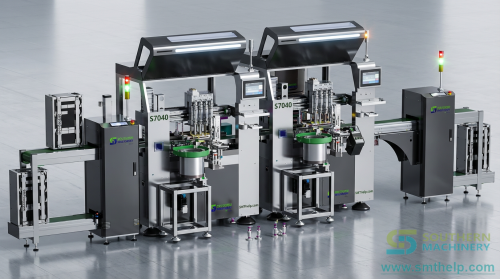
When an EMS factory measures its PCB assembly line, the bottleneck is usually not the pick-and-place machine. It's the manual odd-form station — the operators who still insert transformers, relays, large electrolytic capacitors, and connectors by hand before wave soldering. Southern Machinery's S7040 odd-form insertion machine is engineered for exactly that problem: it automates the non-standard THT components that slow the line, reduces cycle time, and lets the SMT side run at its real capacity.
The cost of a manual odd-form station
Odd-form components are the most labor-intensive part of THT assembly. Every part differs in shape, weight, and lead geometry, so manual insertion is slow, quality depends on operator skill, and the station becomes the capacity gate for the whole line.
The math is the classic hidden bottleneck:
- Line capacity is set by the slowest step. If the SMT line can output 20 boards per hour but the manual odd-form station only clears 12, real output is 12. The remaining SMT capacity is idle.
- Quality varies by operator. Bent leads, mis-inserted parts, and clinch inconsistencies enter the build with every hand load.
- Scaling headcount is hard. THT labor is difficult to add linearly; more boards means more hands, not more throughput per hand.
- Changeover is a retraining task. Switching product families means retraining operators on new component geometries.
The Odd-Form Bottleneck Audit
Score the THT stage before you automate. The audit works from your own line data:
- Measure real output. Count boards cleared per hour at the odd-form station versus the SMT stage. The lower number is your true line rate.
- List the odd-form parts. Transformers, relays, connectors, large electrolytic capacitors, MOS devices, coils — the three-dimensional THT components a radial or axial inserter cannot place.
- Count manual touches. How many operators stand at the insertion bench per shift, and what do they cost in direct labor?
- Check changeover frequency. How often product families switch, and how long retraining takes.
- Confirm feasibility. Southern Machinery runs component and board feasibility checks so the S7040 configuration matches your mix rather than a generic spec.
The audit does not tell you to buy. It quantifies how much SMT capacity you are leaving on the table.
The Vehicle: how the S7040 inserts
The S7040 automatically inserts odd-form through-hole components — parts with unusual shapes or lead configurations that standard radial or axial inserters cannot handle efficiently.
- New-design bulk feeder simplifies feeding of bulk-packed odd-form components; tube, tray, and tape formats are also supported depending on configuration.
- Programmable cycle time — feeding (bulk, tube, tray, or tape), insertion, and clinching become a programming and tooling task instead of an operator task.
- Repeatable force and position — programmable insertion and clinching reduce the rework and scrap caused by manual handling, bent leads, and mis-inserted parts.
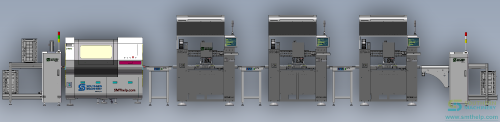
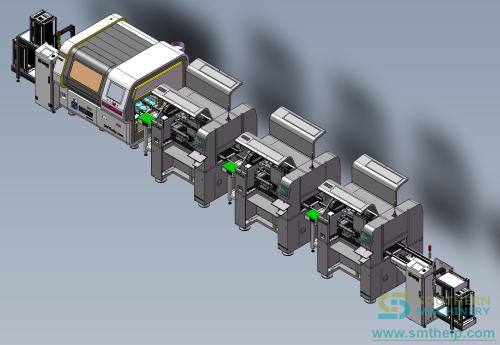
- Multi-machine cells — Southern Machinery deploys the S7040 in cells with S7020T terminal inserters and PCB loading systems, or paired with an SLD250 magazine loader/unloader.
Where it fits in a mixed SMT/THT line
A typical mixed-technology line flows from SMT to THT:
- SMT side — stencil printing, pick-and-place, reflow oven, optional SPI and AOI.
- THT side — axial insertion (S4000), radial insertion (S3010A / S3000), odd-form insertion (S7040), then wave or selective soldering.
- Post-soldering — inline lead cutting, PCBA cleaning, depaneling.
The S7040 sits on the THT side, typically fed by a magazine loader and linked to downstream soldering with SMEMA-style conveyor handshakes. Because odd-form parts are usually the last inserted before soldering, automating this step removes the final manual dependency — so the line runs with fewer operators and fewer defects.
Make it a recurring check, not a one-off
Product mixes shift, and odd-form content grows as boards add power and connectivity. Re-run the Odd-Form Bottleneck Audit when you add a transformer, relay, or connector-heavy board, or when SMT capacity outpaces the THT stage after a placement upgrade. The bottleneck you removed last quarter can reappear with a new product family.
Your next step
Send your BOM, PCB files, and target volume to info@smthelp.com or WhatsApp +86 136 0256 2576. The engineering team returns a station count, feeder configuration, and expected cycle time for your mix. Southern Machinery (Shenzhen, China, founded 2011) serves 237+ customers worldwide with complete SMT + THT + wave soldering + board handling + inspection solutions.
FAQ
What is an odd-form insertion machine used for? It automatically places non-standard THT components — transformers, relays, connectors, large electrolytic capacitors, and other parts with unusual shapes or lead configurations — onto PCBs, replacing manual insertion and improving consistency and throughput.
What components can the S7040 handle? Odd-form components that standard radial or axial inserters cannot place efficiently: transformers, relays, connectors, MOS devices, and large electrolytic capacitors. Exact capability depends on component geometry and lead configuration, so feasibility should be confirmed with your component list.
How does the S7040 reduce cycle time? By automating the manual odd-form station, it removes the typical THT bottleneck so line output is no longer limited by operator speed; the SMT side can finally run at its real capacity.
Can the S7040 integrate with an existing SMT/THT line? Yes. It is designed for the THT side of a full line, typically fed by a magazine loader and linked to wave soldering downstream. Southern Machinery builds multi-machine cells combining odd-form, terminal, axial, and radial insertion with board handling.
Does the S7040 support bulk feeding? Yes. It is demonstrated with a new-design bulk feeder for bulk-packed odd-form components, and also supports tube, tray, and tape feeding depending on configuration.
Is the S7040 suitable for high-mix, low-volume production? It suits higher-mix environments because changeover is driven by programming and tooling rather than operator retraining. Southern Machinery can tailor feeder and tooling to your changeover frequency.
Jason Wu
Founder & CEO, Southern Machinery (Shenzhen Southern Machinery Sales and Service Co., Ltd.)
Email: jasonwu@smthelp.com / info@smthelp.com
WhatsApp: +86 13602562576
Catalog & manuals: file.autoinsertion.com | Machine photos: ph.smthelp.com
LinkedIn: linkedin.com/in/smtsupplier | YouTube: youtube.com/c/Smthelping
Comments
Comments appear after approval.