
S7900VI 6-Head Odd-Shape Insertion Machine: Automated Placement for Non-Standard THT
Six parallel heads and up to eight bowl feeders let the S7900VI place non-standard THT parts that manual stations cannot hold consistent.
Aug 7, 2026 · Updated Aug 31, 2026 · Jason Wu
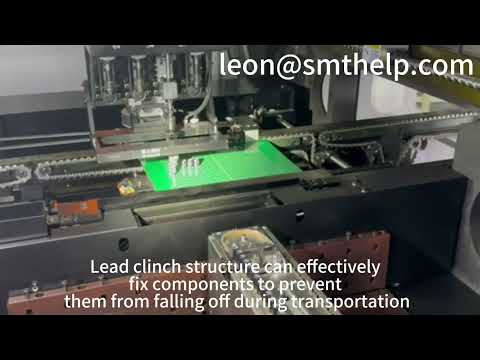
S7900VI 6-Head Odd-Shape Insertion Machine: Automated Placement for Non-Standard THT
Through-hole boards keep a stubborn slice of manual labor alive: the connectors, relays, transformers and electrolytic capacitors that standard axial and radial inserters refuse to touch. On a line placing a few hundred of these odd-form parts per panel, hand work becomes the bottleneck and the quality risk at once — one mis-seated connector or bent pin can scrap a populated board. The S7900VI 6-head odd-shape insertion machine targets exactly this gap, automating non-standard THT parts that manual stations cannot place consistently.
The cost you haven't named: manual odd-form insertion
Most factories automate axial and radial parts, then leave the genuinely awkward components to a hand station at the end of the line.
- A bottleneck that hides at the line tail. Odd-form parts are low in count but high in handling time. Operators pause to orient each connector or relay by eye, and that pause scales with every new product family.
- Orientation and pin defects surface late. A component inserted at a wrong angle or with a bent lead often passes visual check, only to fail during wave soldering or final test — after value has already been added.
- Operator-dependent consistency. Manual placement quality swings between shifts and between temporary workers, so first-pass yield on through-hole content becomes a moving target.
- Weak traceability on the awkward parts. The components most likely to be mishandled are the ones least likely to be logged, leaving audit gaps when a field return traces back to a connector.
The Odd-Form Coverage Framework
Before specifying any odd-shape insertion machine, frame the purchase as a coverage problem rather than a single machine buy. Call it the Odd-Form Coverage Framework.
1. Map the odd-form parts. List every non-standard THT component on your recurring boards — connectors, relays, transformers, electrolytic capacitors, terminal blocks, fuses, heat sinks — and note its body size, lead style and placement orientation.
2. Group by feeder type. Sort those parts by how they can be presented: which need bowl feeders, which need custom orienting, and which share a common pitch so they can run from the same lane.
3. Set the placement window. Define the accuracy and orientation tolerance each part demands, plus the panel size and throughput you must hold across a mixed product range.
4. Define the acceptance test. State what "good" means at delivery: correct orientation on every part type, no bent leads, and a repeatable rate your line leads can verify on a trial board.
The vehicle: S7900VI 6-head odd-shape insertion machine
The framework maps directly onto how the S7900VI is deployed for non-standard THT work.
- Map the odd-form parts → six parallel heads. The S7900VI runs 6 independent insertion heads in parallel, so it places several odd-form components across a panel in one coordinated pass instead of one head revisiting the board.
- Group by feeder type → up to eight bowl feeders. It is fed by up to 8 bowl feeders simultaneously, letting connectors, relays, transformers and electrolytic capacitors each occupy a dedicated, correctly oriented supply lane.
- Set the placement window → vision-guided alignment. Vision-guided alignment corrects each component's orientation and pin position before insertion, which is what removes the bent-pin and mis-seat defects that manual stations cannot control.
- Define the acceptance test → verified repeatability. Because every placement is machine-controlled, the acceptance test becomes a simple trial-board count rather than a faith-based hand check.
Specification note: exact cycle time, placement accuracy and panel-size limits should be confirmed at quotation, because they depend on your specific component mix, body sizes and line layout rather than a single fixed default.
Specifications
| Parameter | Value |
| --- | --- |
| Insertion heads | 6 independent heads, parallel operation |
| Simultaneous component families | Up to 8 bowl feeders |
| Component types | Connectors, relays, transformers, electrolytic capacitors, terminal blocks, fuses, heat sinks |
| Alignment method | Vision-guided orientation and pin correction |
| Placement accuracy | ±0.1 mm typical (confirmed at quotation) |
| Throughput | Up to ~3,600 placements/hr typical (mix-dependent) |
| Target sectors | EMS, automotive electronics, industrial control |
The loop: re-audit the part mix every quarter
Product mixes drift, and the odd-form list grows every time a new customer board arrives. Build a loop: every quarter, repeat the Odd-Form Coverage Framework, compare the current part list against last quarter's, and check which new components fall outside the S7900VI's current feeder setup. When a new product family adds a part the machine has not handled, qualify it on a trial board before the production ramp. The loop is what keeps the 6-head configuration earning its floor space instead of slowly falling behind the boards you actually build.
Your next step
Send us your recurring board list and the odd-form parts you still place by hand. We will return a part-mix review showing where the S7900VI 6-head odd-shape insertion machine fits, which feeder setup to specify, and what to confirm at quotation. Reach Jason at jasonwu@smthelp.com or on WhatsApp +86 13602562576.
FAQ
What components can the S7900VI place?
It handles non-standard THT parts — connectors, relays, transformers, electrolytic capacitors, terminal blocks, fuses and heat sinks — that axial and radial inserters cannot process.
How is it different from a generic odd-form inserter?
This variant uses 6 independent parallel heads fed by up to 8 bowl feeders, so it places several odd-form parts across a panel in one pass rather than serially revisiting the board.
Does it need vision guidance?
Yes. Vision-guided alignment corrects orientation and pin position before insertion, which is the main control against bent leads and mis-seated parts.
Can it run mixed product types?
It is built for high-mix THT work; exact head assignment, feeder count and throughput for your mix are confirmed at quotation.
Jason Wu
Founder & CEO, Southern Machinery (Shenzhen Southern Machinery Sales and Service Co., Ltd.)
Email: jasonwu@smthelp.com / info@smthelp.com
WhatsApp: +86 13602562576
Catalog & manuals: file.autoinsertion.com | Machine photos: ph.smthelp.com
LinkedIn: linkedin.com/in/smtsupplier | YouTube: youtube.com/c/Smthelping
Comments
Comments appear after approval.