
Samsung Hanwha Label Feeder LFSUMSUNG
The LFSUMSUNG label feeder brings automatic label peeling and feeding into the Samsung SM/SME placement cycle, up to 100 labels per minute.
Aug 15, 2026 · Updated Aug 31, 2026 · Jason Wu
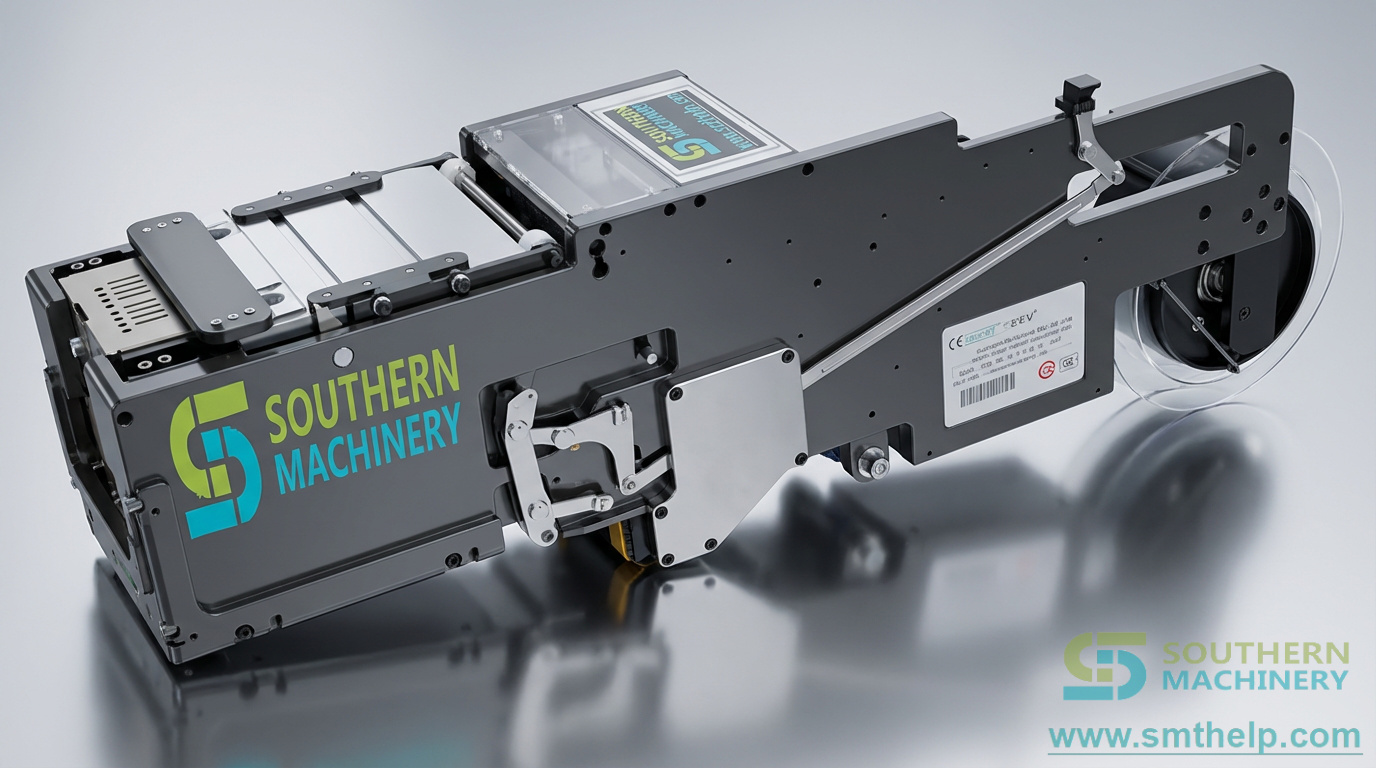
Samsung Hanwha Label Feeder LFSUMSUNG: Automatic Label Peeling & Feeding for Samsung SM/SME Mounters by Southern Machinery
A separate manual labeling station looks harmless until it becomes the slowest step on an otherwise fast line. Every serial, barcode and safety label placed by hand costs a few seconds and a chance to misalign — and at volume those seconds and misses add up to a rework cycle the customer rejects. The LFSUMSUNG label feeder removes that step by mounting on Samsung SM/SME pick-and-place machines, peeling each label and presenting it at a fixed pickup point so the mounter head places it automatically, at up to 100 pieces per minute.
The cost you haven't named: manual labeling as a bottleneck
Labeling rarely gets engineered. It gets handed to an operator, and the cost hides there.
- Manual placement is slow. Hand-placing serial, barcode and safety labels ties up operators and caps throughput at the labeling station, throttling a line that is otherwise automated.
- Misplaced labels mean rework. Labels landing off-position are rejected by customers, and every miss adds a rework cycle plus a traceability gap.
- Generic feeders do not fit Samsung machines. Off-the-shelf label units ignore the SM/SME mounter interface, creating integration work nobody budgeted for.
- Film waste tangles the line. Peeled liner that is not managed properly snags, breaks and stops production, often at the worst moment.
The Four-Point In-Line Labeling Audit
Before adding a feeder, qualify the labeling step with a repeatable audit. Call it the Four-Point In-Line Labeling Audit.
1. Count the label types. List every serial, barcode and safety label your boards need, and how many per board. This sets the feeder model and roll size you require.
2. Measure the manual minutes. Add up the labor time and miss rate of hand labeling today. The number usually justifies automation on its own at volume.
3. Check the mounter interface. Confirm your Samsung SM/SME model and the feeder slot it offers, because fit — not just speed — decides whether integration is clean.
4. Set the speed and quality target. Define labels per minute and placement accuracy you will accept at outgoing inspection. That becomes your acceptance test.
The vehicle: LFSUMSUNG Label Feeder
The audit maps onto how the LFSUMSUNG series is specified and used.
- Count the label types → two models. The LFSUMSUNG series covers Samsung SM/SME mounters with models LFSUMSUNG-60 and LFSUMSUNG-100, both providing fully automatic label peeling and feeding.
- Measure the manual minutes → up to 100 ppm. The feeder presents labels at a fixed pickup position at up to 100 pieces per minute, removing the manual station from the cycle.
- Check the mounter interface → matched fit. Built around the Samsung SM/SME mounter family with a matched interface, it mounts into the existing placement cycle rather than beside it.
- Set the speed and quality target → adjustable feeding. Speed adjustment lets the peeling rate match the line rhythm, so the head is neither starved nor jammed.

The mechanism view shows the peeling and feeding path: the roll feeds, the liner peels away, and the label waits at the pickup point for the mounter head — a closed loop that removes hand handling.

In the SMT workflow, labeling moves from a separate bench into the placement cycle, so the board leaves the mounter already labeled and traceable.
Specification note: exact label size range, roll capacity, interface detail for your specific SM/SME model and warranty depth should be confirmed at quotation, since they follow your label geometry and mounter revision.
The loop: re-check labels at every product change
Label types change with every customer and every revision. Build a loop: every time a new label or board enters the line, re-run the Four-Point In-Line Labeling Audit and confirm the feeder model and roll still fit. Review placement accuracy monthly from outgoing inspection, and feed any miss pattern back to the speed setting. The loop keeps labeling inside the automated cycle instead of drifting back to a manual bench, and is what protects the payback benchmark — validate it against your own label volume and shift pattern.
Your next step
Tell us your Samsung SM/SME mounter model and the labels you place by hand today. We will match the LFSUMSUNG-60 or LFSUMSUNG-100 and tell you what to confirm at quotation for label size, roll capacity and interface. Reach Jason at jasonwu@smthelp.com or on WhatsApp +86 13602562576.
FAQ
What machines does the LFSUMSUNG feeder fit?
It is built for the Samsung SM/SME pick-and-place mounter family, with a matched interface for clean integration.
How fast does it feed labels?
Both the LFSUMSUNG-60 and LFSUMSUNG-100 provide fully automatic peeling and feeding at up to 100 pieces per minute, with adjustable speed.
Does it remove the manual labeling step?
Yes. It brings labeling into the existing placement cycle, presenting each label at a fixed pickup point for the mounter head.
Which models are available?
The series includes LFSUMSUNG-60 and LFSUMSUNG-100, selected by your label size and throughput need.
What should I confirm before ordering?
Label size range, roll capacity, your specific SM/SME interface and warranty detail are confirmed at quotation against your samples.
Jason Wu
Founder & CEO, Southern Machinery (Shenzhen Southern Machinery Sales and Service Co., Ltd.)
Email: jasonwu@smthelp.com / info@smthelp.com
WhatsApp: +86 13602562576
Catalog & manuals: file.autoinsertion.com | Machine photos: ph.smthelp.com
LinkedIn: linkedin.com/in/smtsupplier | YouTube: youtube.com/c/Smthelping
Comments
Comments appear after approval.