
"SME-SC300 Selective Conformal Coating Machine: Three-Proof PCBA Protection Without Masking"
A selective conformal coating machine applies three-proof coating only where the board needs it, removing most masking labour and dosage variation.
Aug 15, 2026 · Updated Aug 31, 2026 · Jason Wu
Two operators, a roll of masking tape and a stack of boards needing three-proof protection. One tapes connectors, the other brushes coating, and both spend as long removing tape as applying material. The film ends up thin at the edges, pooled near tall parts, different on every board. Then the unit that failed humidity testing in the field turns out to have had a bare via nobody noticed. Masking is not protection — it is a workaround for a tool that cannot aim.
Why manual and blanket coating breaks quality, capacity or cost
Dip tanks, hand brushes and full-board spray share one flaw: they cannot distinguish the areas that need coating from the areas that must stay clean.
- Masking cost is the hidden cost. Tape, plugs and caps are cheap; applying and removing them on every board is not, and every piece removed can lift a component or leave adhesive residue.
- Dosage varies by operator. Brushed and dipped film thickness changes with viscosity, temperature and the person doing it — thin where you need it, heavy where it adds stress.
- Contamination gets sealed in. Coating over unremoved flux traps moisture and ionic contamination against the laminate, which is why cleaning belongs before coating.
- Keep-out areas get coated anyway. Coating creeping onto contacts, test points or heatsink faces means solvent rework, or a board failing functional test for an unexpected reason.
- Solvent exposure and waste. Open application and demasking mean operator exposure, uncontrolled emissions and consumption far above what the board requires.
The Coating Coverage Audit
Work through these four questions with your own drawings in front of you. They decide the configuration far more than the machine brand does.
1. Define the coating and keep-out zones. Mark on the drawing which areas need protection and which must stay bare: connector contacts, test points, programming headers, heatsink faces, press-fit terminals. The boundary width between them sets how tightly the spray pattern must be controlled.
2. Fix the chemistry before the hardware. Acrylic, silicone, urethane, epoxy and water-based formulations behave differently through an atomising valve, changing valve, pump and filtration choice. Confirm compatibility with your qualified material, not a generic sample.
3. Specify film thickness and how you will verify it. Agree a wet or dry thickness range and the measurement method: gauge, cross-section or UV trace inspection. A coverage requirement with no measurement is an opinion, and it will not survive a customer audit.
4. Map the geometry and the throughput. Count tall components, shadowed areas under connectors and any angled surfaces needing coating; these drive axis configuration and nozzle approach. Then state boards per hour and board size range, which decide conveyor integration and whether curing runs inline or in a batch oven.
The Vehicle: how the SME-SC300 selective conformal coating machine works
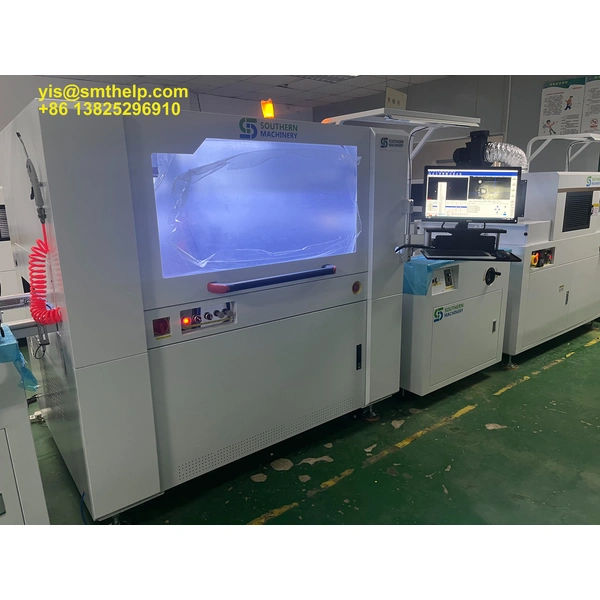
The SME-SC300 is a programmable coating and dispensing cell. A multi-axis motion system carries a precision spray valve over the board along a taught path, switching the valve on and off at coordinates you define, so material lands inside the coating zones and stops at the keep-out boundary. Fan width is adjustable, letting a wide pattern cover open areas quickly and a narrow pattern run tight along a connector edge without overspray. Because dosage is metered rather than dipped, film thickness stays within a set range across the shift.
The same platform runs dispensing work — underfill, SMT red glue, solder paste, black glue, LED and semiconductor packaging, FPC coating — useful for factories that cannot justify a dedicated machine per job. The enclosed cabinet with multi-angle exhaust recovery keeps solvent vapour contained, and the interface is built for fast recipe switching between models.
| Parameter | Specification |
| --- | --- |
| Process type | Selective spray coating and dispensing, programmable path |
| Motion configuration | Multi-axis servo/stepper platform, programmable per product recipe |
| Valve type | Precision atomising spray valve with adjustable fan width; dispensing valves optional |
| Coating materials | Acrylic, silicone, urethane, epoxy and water-based conformal coatings |
| Additional processes | Underfill, SMT red glue, solder paste, black glue, LED and semiconductor packaging |
| Keep-out control | Programmed start/stop coordinates with defined edge boundary per zone |
| Board handling | Inline conveyor integration with upstream and downstream SMT/THT equipment |
| Curing | Inline curing module or separate batch oven, depending on material |
| Enclosure | Fully enclosed structure with multi-angle exhaust gas recovery |
| Control | Touch interface with recipe storage; line control and MES linking available |
| Operation | Single operator can supervise coating and curing as one assembly-line step |
Confirm exact axis travel, board size range, valve model and throughput against the datasheet for the configuration quoted to you.
Where it fits
The coating cell sits at the back end of the line: SMT placement and reflow build the SMD side, THT insertion adds through-hole parts, wave or selective soldering completes the joints, then cleaning removes flux residue that would otherwise be sealed under the coating. Coating follows, then curing — inline or in a batch oven — then UV or AOI inspection, functional test and packing. Conveyor integration lets the cell join the existing transport system, and recipes can link to line control for traceability. On a mixed-model line the practical constraint is changeover speed between recipes.
The ROI case
Four levers carry the business case, all modelled from your own figures. Labour: masking, demasking and brushing hours per board, against one operator supervising a coating and curing line. Material: metered atomisation applies coating to the specified thickness only where needed, so compare current consumption per board against a programmed dosage. Consumables: masking tape, plugs and overspray-correcting solvent largely disappear. Quality: consistent film thickness and controlled edges reduce rework, retest and warranty exposure on boards heading into humid, dusty or corrosive service.
Run a pilot batch, measure film thickness and defect rate, adjust, then measure again — that closed loop is the honest basis for a payback figure. Treat any published saving as a planning benchmark to validate against your own board mix, chemistry and volume.
Your next step
Send your board dimensions, the areas that must stay uncoated, the coating material you have qualified, target film thickness and boards per hour. We will return a configuration recommendation and a quotation covering coating, curing and conveyor integration. Ask for a part list, a coating trial on your own boards, or a demonstration before you commit.
FAQ
How does selective coating differ from dipping or blanket spray?
Dipping and blanket spray cover everything and rely on masking to protect what must stay clean. Selective coating switches the valve on and off along a programmed path, so masking is largely unnecessary and dosage is metered rather than variable.
Which coatings can the machine apply?
Acrylic, silicone, urethane, epoxy and water-based formulations are all in scope, but valve, pump and filtration must be matched to the viscosity and cure behaviour of the specific material you have qualified.
Do we still need to clean boards before coating?
Where the process calls for it, yes. Coating applied over flux residue can trap moisture and ionic contamination against the laminate, so cleaning is placed before the coating step in the line sequence.
Can the same machine handle dispensing work?
Yes. The platform also runs underfill, SMT red glue, solder paste, black glue and LED or semiconductor packaging — a flexible cell for mixed protection and adhesive requirements.
Jason Wu
Founder & CEO, Southern Machinery (Shenzhen Southern Machinery Sales and Service Co., Ltd.)
Email: jasonwu@smthelp.com / info@smthelp.com
WhatsApp: +86 13602562576
Catalog & manuals: file.autoinsertion.com | Machine photos: ph.smthelp.com
LinkedIn: linkedin.com/in/smtsupplier | YouTube: youtube.com/c/Smthelping
Comments
Comments appear after approval.