
SH8650 3D SPI Machine for Solder Paste Inspection
The quality of your SMT line is decided at the stencil printer, not the reflow oven. Run the paste-window pre-check, then see how the SH8650 measures paste before placement instead of after reflow.
Aug 25, 2026 · Updated Aug 31, 2026 · Jason Wu
The quality of your SMT line is largely decided at the stencil printer — not at the reflow oven.
Solder paste defects that survive to reflow turn into rework, field returns or scrap. An SPI (Solder Paste Inspection) station between the stencil printer and the pick-and-place machine closes that gap, checking paste before components are placed instead of after they are baked in. This guide explains what the Southern Machinery SH8650 (also written SH-8650) 3D SPI machine does, where it fits, and what to verify before you buy.
Why paste inspection decides the line
Solder paste is the only element holding the SMT process together at the print stage. Once components are placed and the board passes reflow, paste defects are baked in.
- Paste defects drive rework. Insufficient volume, excess height, bridging and offset are leading causes of SMT rework.
- Post-reflow rework is expensive. It consumes operators, adds thermal stress to the board and risks component damage.
- SPI shifts left. It changes inspection from "find the bad board after reflow" to "prevent the bad board from being created" — at the cheapest point in the process.
- Data feeds SPC. Inspection results support statistical process control, so printing is corrected proactively instead of reactively.
SPI is not AOI. AOI inspects assembled boards after placement or reflow; SPI inspects the paste itself, before placement. A complete line typically uses both.
The Paste-Window Pre-Check
Run this against your current process — no machine required:
- Can you measure the paste, or only the joint? After reflow, you see the result, not the cause. Confirm whether you can measure volume, height, area and position before placement.
- Where do your defects originate? Of recent rework, how much traces back to paste (bridging, tombstoning, insufficient joints) rather than placement?
- Is the printer tuned by data or by feel? Without SPI, printer adjustment after a setup error is reactive and slow.
- Could you prove the paste process was in control? For automotive or medical customers, process evidence is often a contract requirement.
The pre-check shows whether you are preventing paste defects or finding them too late.
The Vehicle: what the SH8650 does
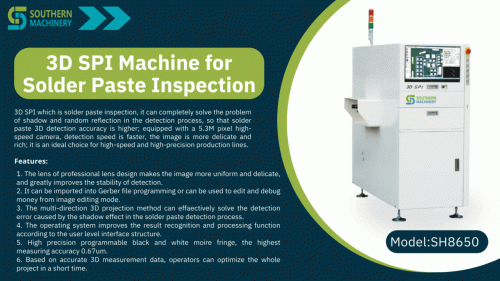
The SH8650 is a fully automatic, non-contact 3D solder paste inspection machine. It measures deposits immediately after stencil printing and before component placement, using 3D imaging to check whether paste volume, height, area and position fall within the process window. A board with wrong paste — too thin, too thick, bridged or offset — is flagged before it reaches placement and reflow.
Verified features:
- 3D imaging for accurate, repeatable solder paste measurement.
- Board size — supports PCBs up to 510 mm × 460 mm.
- Paste compatibility — works with lead-free and leaded solder paste.
- Non-contact measurement with micron-level precision; measurement based on plane camera, laser, or structured light / programmable stripes for 2D or 3D analysis.
- Software and SPC — inspection data analysis and misjudgment statistics for process control.
- Inline position — an online SPI station for SMT lines that adds no operator.
Exact cycle time, inspection accuracy and footprint are published in the Southern Machinery datasheet; confirm these against your target board and line takt when quoting. The machine is available with OEM/ODM options.
Where it fits on the line
A typical SMT line with the SH8650 runs:
- Board handling — loader, magazine loader.
- Stencil printer — solder paste printing.
- SH8650 SPI — solder paste inspection (the step covered here).
- Pick and Place — SMT component placement.
- Reflow Oven.
- AOI — assembled board inspection.
- End-of-line handling — unloader, buffer, OK/NG separation.
The SH8650 sits directly after the stencil printer and feeds defect information back to the printing process. Because it is a fully automatic inline station, it adds no operator to the line.
Make it a recurring pre-check
Printer setups drift with new stencils, pastes and board mixes. Re-run the Paste-Window Pre-Check after any printer changeover or NPI ramp — the defects you prevented last month may reappear with a new product if the process window is not monitored.
Your next step
Send your board set, line speed and quality targets to jasonwu@smthelp.com or WhatsApp +86 136 0256 2576. The engineering team returns a configuration recommendation and line-layout advice for the SH8650. Watch the SH8650 demos on the Southern Machinery YouTube channel (youtube.com/@Smthelping).
FAQ
What does SPI stand for? Solder Paste Inspection — an automated step that measures solder paste deposits on a PCB after printing and before component placement.
What is the difference between SPI and AOI? SPI inspects solder paste before placement; AOI inspects assembled boards after placement or reflow. They check different stages and are complementary.
What defects does a 3D SPI machine detect? Insufficient or excessive paste volume, paste height outside the process window, bridging between pads, and paste offset from the pad.
Can the SH8650 handle lead-free paste? Yes. It is compatible with both lead-free and leaded solder paste.
What PCB sizes can it inspect? The SH8650 supports PCBs up to 510 mm × 460 mm, covering most SMT production boards.
Is it an inline machine? It is positioned as an online SPI for SMT lines — a fully automatic, non-contact station between the stencil printer and the pick-and-place machine. Confirm conveyor height and the line interface (for example SMEMA) for your specific line.
Jason Wu
Founder & CEO, Southern Machinery (Shenzhen Southern Machinery Sales and Service Co., Ltd.)
Email: jasonwu@smthelp.com / info@smthelp.com
WhatsApp: +86 13602562576
Catalog & manuals: file.autoinsertion.com | Machine photos: ph.smthelp.com
LinkedIn: linkedin.com/in/smtsupplier | YouTube: youtube.com/c/Smthelping
Comments
Comments appear after approval.