
Flux Residue Is a Reliability Defect — Clean It Inline, Not Later
Residue you cannot see becomes leakage current, dendrite growth and coating failure months later. Clean it at line speed instead.
Aug 19, 2026 · Updated Aug 31, 2026 · Jason Wu
A board that leaves the wave looking clean is not clean. Flux residue sits under components and around through-hole joints, along with solder balls and ionic contamination that no visual inspection will catch. The damage shows up later as leakage current, electrochemical migration, dendrite growth or conformal coating that will not adhere — and by then the board is in a car, a machine or a hospital. Many factories still treat cleaning as an offline batch chore rather than a defined process step.
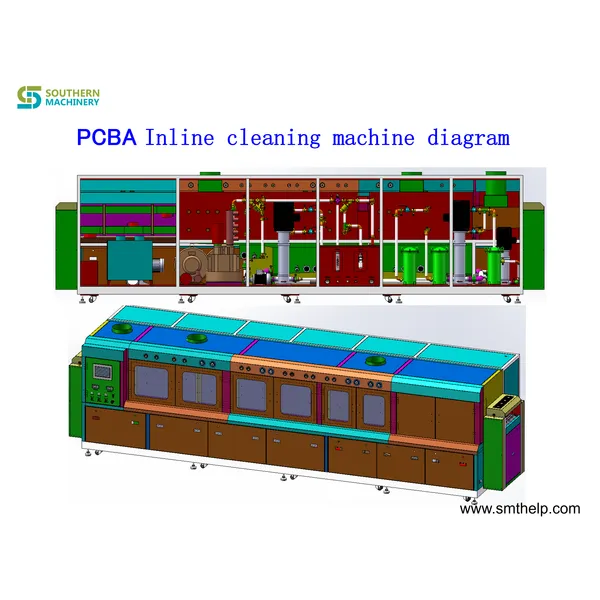
Southern Machinery's SME6200 is an inline PCBA cleaning machine that closes that gap. Boards travel on a mesh conveyor through wash, rinse and drying sections continuously, at line speed, so cleaning happens as part of production instead of in a separate cell with its own queue and its own operator judgment.
Why offline batch cleaning breaks quality and throughput
Batch cleaning is not just slower than inline cleaning; it is a different process with different failure modes:
- Judgment replaces specification. "Clean enough" is an operator opinion, not a measurable ionic cleanliness result.
- Manual brushing is uneven. Residue under low-standoff components and around dense through-hole joints is exactly where a brush cannot reach.
- Batch queuing builds WIP. Boards accumulate for a cleaning shift, so downstream coating, potting and test wait on a station that runs on its own clock.
- Extra handling adds damage risk. Every load and unload of an offline cleaner is another chance to bend a lead or contaminate a board.
- Residue distorts inspection. Flux film generates false AOI calls, so inspection time is spent on artifacts instead of defects.
The Ionic Cleanliness Audit
Before specifying a cleaner, define what "clean" has to mean for your product. Four steps:
1. Name the cleanliness requirement. IPC Class 3, an automotive tier specification, a medical biocompatibility requirement, or a coating adhesion criterion. Write down the standard you must demonstrate, because it determines rinse quality, not just wash chemistry.
2. Map your flux chemistry. Rosin, no-clean or water-soluble — the residue you are removing decides the wash configuration. On many high-reliability programs, no-clean flux is not acceptable as an excuse to skip cleaning.
3. Locate the step in the flow. After reflow, after wave soldering, before conformal coating, or before final inspection. Boards with the heaviest residue are mixed SMT/THT boards coming off the wave.
4. Confirm the physical fit. Board size range, board thickness, tall-component clearance in the wash and dry modules, conveyor width and line height at the SMEMA-style interface, plus the facility side: power, exhaust, water supply and drain.
The Vehicle: how the SME6200 works
Boards enter on the line conveyor and are carried through the machine on a mesh conveyor. The wash section applies a water-based cleaning solution to remove flux residue, solder paste balls and solder spatter. The rinse section follows — typically DI water, which is what actually brings ionic contamination down to a specified level. Air knives and hot air then dry the board before it exits onto the next station. No operator handling, no batch queuing, no separate cleaning cell.
| Capability | SME6200 configuration |
|---|---|
| Process type | inline / online, continuous at line speed |
| Board transport | mesh conveyor through wash, rinse and dry sections |
| Wash medium | water-based cleaning solution |
| Rinse | DI water for ionic contamination removal |
| Drying | air knives plus hot air |
| Contaminants removed | flux residue, solder paste balls, solder spatter, surface ionic contamination |
| Flux compatibility | rosin, no-clean and water-soluble residues (confirm chemistry) |
| Line interface | standard SMEMA-style conveyor height |
| Typical line position | after reflow, after wave soldering, or before conformal coating |
| Operator involvement | none during the cycle |
| Options | DI water system, filtration upgrades, nozzle configurations |
| Facility connections | power, exhaust, water supply, drain |
Board size range, conveyor width, drying capacity and throughput are configured per line — confirm them against your own board profile.
Where it fits in a complete line
The SME6200 has four valid positions in the flow, and high-reliability programs often use two. After the reflow oven, for boards headed to conformal coating. After wave soldering, for THT and mixed boards where residue is heaviest. Before coating or dispensing, because cleaning is a prerequisite for coating adhesion. And before AOI or final inspection, because clean boards inspect more consistently. It connects to your existing conveyor system at standard line height, so boards flow through automatically. Southern Machinery supplies the surrounding equipment as well — loaders, unloaders, conveyors and turn conveyors, wave soldering, stencil printing and cleaning, insertion machines, inspection and material management — so the cleaner slots into a line backed by one accountable partner.
The ROI case
Frame the case as four measurable effects, then model each with your own numbers. Quality: every board receives the same wash, rinse and dry cycle, which is what an ionic cleanliness or coating adhesion specification actually requires. Throughput: inline cleaning removes batch delay and cuts work-in-progress, because boards move at line speed rather than accumulating for a cleaning shift. Labor: no operator loads, brushes or judges whether a board was cleaned properly. Rework and yield: removing residue before coating and inspection reduces coating defects and false AOI calls; on high-reliability products, avoiding a single field failure can outweigh the machine cost several times over.
Then make it recurring. Sample ionic cleanliness on real production boards, compare against the requirement you wrote down in step 1 of the audit, adjust wash and rinse settings, and re-sample. That measurement loop is the difference between owning a cleaner and owning a controlled cleaning process — and it is also how you catch a flux change or a nozzle blockage before your customer does. Nothing here is a promised saving; it is a planning benchmark to test against your own data.
Your next step
Send your board profile, flux chemistry and cleanliness targets for an engineering review, and Southern Machinery will recommend a wash, rinse and drying configuration matched to them, including DI water and filtration options. Southern Machinery (Shenzhen, China, since 2011, 237+ global customers) supplies SMT and THT lines with configuration advice, spare parts, training and global service. Contact details are below.
FAQ
Is the SME6200 inline or offline? Inline. Boards enter on the line conveyor and exit washed, rinsed and dried, with no batch handling.
Which flux types can it clean? Water-based cleaning handles rosin, no-clean and water-soluble flux residues, plus solder paste balls and other organic and inorganic contaminants. Confirm your chemistry to get the right wash configuration.
Can it integrate with my existing SMT/THT line? Yes. It connects at standard SMEMA-style conveyor height and works after reflow, after wave soldering, or before conformal coating. Confirm board size, conveyor width and line height during configuration.
Which industries need inline PCBA cleaning? Automotive electronics, medical devices, industrial control, telecom and networking, LED lighting and power electronics — anywhere residual flux threatens reliability, coating adhesion or ionic cleanliness targets.
Jason Wu
Founder & CEO, Southern Machinery (Shenzhen Southern Machinery Sales and Service Co., Ltd.)
Email: jasonwu@smthelp.com / info@smthelp.com
WhatsApp: +86 13602562576
Catalog & manuals: file.autoinsertion.com | Machine photos: ph.smthelp.com
LinkedIn: linkedin.com/in/smtsupplier | YouTube: youtube.com/c/Smthelping
Comments
Comments appear after approval.