
SME800 Electric Stencil Cleaning Machine — Automate the Clean-Rinse-Dry Cycle
Blocked apertures and slow manual scrubbing quietly raise misprint and changeover time. Run the four-point stencil check, then see how the SME800 automates clean-rinse-dry for stencils up to 750 × 750 × 40 mm.
Aug 27, 2026 · Updated Aug 31, 2026 · Jason Wu
Your misprint rate has a quiet cause that never appears on the defect report: the stencil left in the cleaning room, half-scrubbed by hand, with apertures that never fully opened before the next print.
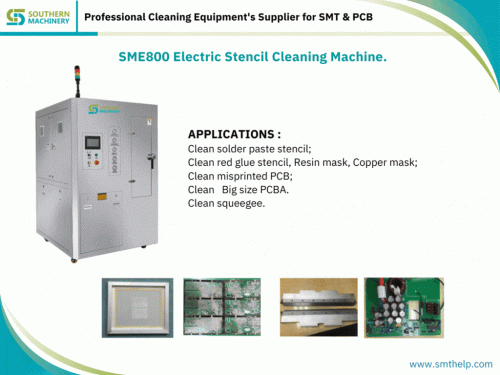
Stencil cleaning sits between every print job, and it's one of the easiest places for an SMT line to lose both quality and time. The SME800 electric stencil cleaning machine from Southern Machinery replaces manual scrubbing with a repeatable clean-rinse-dry cycle: four fixed spray rods clean while the stencil moves back and forth by motor, DI water rinses, and four hot-air blades dry it quickly. This guide gives you a framework for deciding whether your line needs one—before you ask for a quote.
The cost nobody itemizes on a stencil bench
Hand-cleaning a stencil looks free until you add up the hidden line items:
- Paste balls return. Without real-time filtration, tiny solder spheres wash back onto the stencil and re-contaminate the next board.
- Apertures stay blocked. Residue left in the openings directly causes paste misprint and the rework that follows.
- Soft hoses fail. Liquid and air hoses that bend on a moving spray head rub, leak, and stop the machine.
- Dry time gates changeover. Weak drying is what makes operators wait between jobs.
- Plastic pipes contaminate. Plastic fluid lines are a corrosion and contamination risk in cleaning chemistry.
- Results vary by shift. Manual quality depends on who is holding the brush and how long they take.
If two or three of those sound familiar, the bench—not the printer—is capping your first-pass yield.
The Four-Point Stencil Check
Run this on your current process before evaluating any machine. It works with what you already have:
- Time one full clean. From stencil-out-of-printer to dry-and-ready, how many minutes? Multiply by stencils per shift.
- Trace the paste balls. After a manual rinse, wipe a clean white cloth across the apertures. Any grey residue means contamination is returning.
- Count blocked-aperture misprints. Pull the last two weeks of print defects. How many trace back to paste transfer, not placement?
- Audit the pipe and hose material. Are your cleaning lines plastic or stainless? Plastic is the usual leak and contamination source.
The answer doesn't tell you to buy. It tells you the size of the problem—and whether automating the bench is worth a conversation.
The Vehicle: how the SME800 cleans
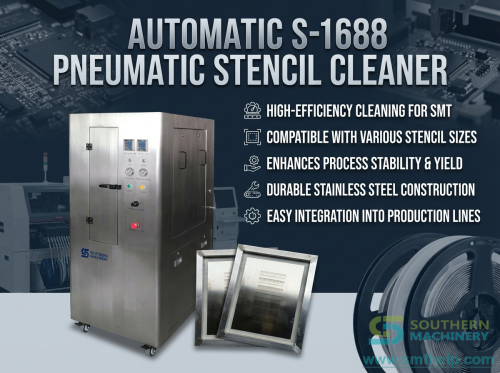
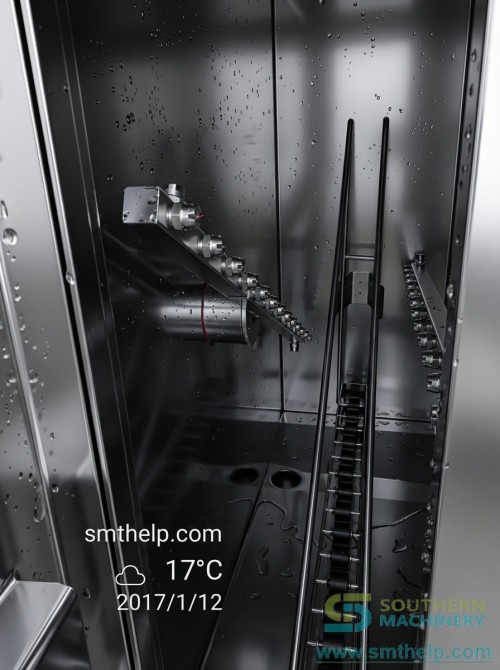
The working principle is simple: the stencil moves, the cleaning parts stay fixed. That single design choice removes the bending hoses that cause most manual-style cleaners to leak.
- Load a stencil up to 750 × 750 × 40 mm and set the cycle parameters.
- Spray clean with four fixed rods while the stencil motor moves it forwards and backwards.
- DI rinse with four fixed bars; real-time 1 µm filtration keeps paste spheres from returning to the stencil.
- Hot-air dry with four blades driven by a 5.5 HP blower that shortens dry time between jobs.
The fluid path is all SUS304 stainless steel with angle valves—no plastic hose—and the electrics use a Mitsubishi PLC, touch panel, and inverter with Schneider relays and Omron power supply. All values come from the SME800 brochure and support initial evaluation; final configuration is confirmed against your stencils and cleaning liquid.
Where it fits on the line
Stencil cleaning is a support process for printing, so the SME800 sits beside the printer rather than inline. On a full SMT + THT line—print, SPI, placement, reflow, AOI, then insertion and wave or selective soldering—a dependable clean-rinse-dry cycle protects every downstream step, because blocked apertures are one of the direct causes of paste misprint. Southern Machinery supplies the SME800 as part of a complete line: printing support, insertion, soldering, board handling, and inspection from one team.
Make it a recurring check, not a one-off
Stencil volume, paste chemistry, and liquid cost drift every quarter. Re-run the Four-Point Stencil Check when you change paste supplier, add a second shift, or see misprint drift after a product change—the numbers that looked fine in January may justify automation by Q3.
Your next step
Send your stencil types, cleaning liquid, daily volume, and quality target to info@smthelp.com or WhatsApp +86 136 0256 2576. The engineering team returns a machine recommendation, configuration, and quotation—matched to your stencils, not a generic spec sheet.
FAQ
What does the SME800 clean? Solder paste stencils, red glue stencils, resin and copper masks, and misprint PCBs—aqueous cleaning liquid followed by a DI water rinse.
What size stencils fit? Stencils up to 750 mm (L) × 750 mm (W) × 40 mm (H) are supported.
How is contamination prevented? Real-time 1 µm filtration on both the cleaning liquid and DI water keeps solder paste spheres from returning to the stencil.
Why is drying fast? A 5.5 HP hot-air blower with four air blades delivers a high air rate, reducing dry time between jobs.
How do I get a price? Email info@smthelp.com or WhatsApp +86 136 0256 2576 with your stencil details. Quotation and delivery are provided after technical confirmation—typically the same working day.
Jason Wu
Founder & CEO, Southern Machinery (Shenzhen Southern Machinery Sales and Service Co., Ltd.)
Email: jasonwu@smthelp.com / info@smthelp.com
WhatsApp: +86 13602562576
Catalog & manuals: file.autoinsertion.com | Machine photos: ph.smthelp.com
LinkedIn: linkedin.com/in/smtsupplier | YouTube: youtube.com/c/Smthelping
Comments
Comments appear after approval.