
SMT Fixture & Carrier Solutions: Custom Tooling
A custom tooling program covering printing, reflow, wave and insertion fixtures, carriers, clips and cleaning — engineered to your board from prototype to production.
Aug 15, 2026 · Updated Aug 31, 2026 · Jason Wu
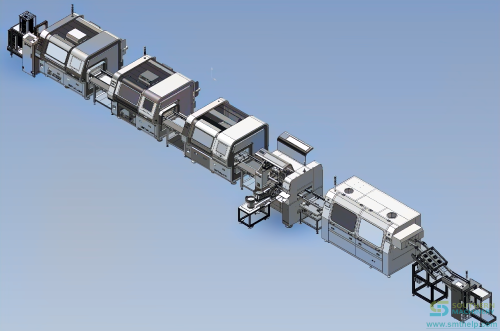
SMT Fixture & Carrier Solutions: Custom Printing, Reflow & Wave Tooling by Southern Machinery
Boards that shift in process are quietly taxing your line. Every misprint, reprint cycle, tombstone, bridge and open joint that traces back to unstable tooling costs paste, rework labor, yield and delivery time — and most factories attribute it to the machine, not the carrier that let the board move. Southern Machinery's SMT/THT fixture and carrier program replaces off-the-shelf compromises with board-specific fixtures, carriers and jigs, engineered from your sample or drawing and supported from prototype to production.
The cost you haven't named: unstable tooling across processes
Tooling problems rarely announce themselves. They show up as defects assigned to other causes.
- Boards that shift under the stencil or in the wave. Misalignment there causes misprints, tombstoning, bridges and open joints that the printer or solder pot gets blamed for.
- Off-the-shelf carriers ignore your board. Generic frames overlook your layout, edge rails and component heights, so the board is never quite held where it should be.
- Fixtures that cannot take the heat. Tooling that warps or corrodes under process temperature scraps boards and needs frequent replacement.
- Dirty pallets contaminate boards. Flux and residue on carriers transfer to the next PCB, creating intermittent defects nobody can trace.
The Four-Process Tooling Coverage Audit
Before buying piecemeal, audit your tooling as one system. Call it the Four-Process Tooling Coverage Audit.
1. Map the process chain. List every station — printing, reflow, wave, auto-insertion — and the carrier or fixture the board uses at each. Gaps are where defects enter.
2. Score the fit at each station. For each carrier, rate how well it holds your board's outline, edge rails and component heights. Generic fits score low and cost you silently.
3. Quantify the contamination and wear. Tally how often dirty or worn tooling forces a cleanup, a rework or an unplanned replacement, and what that costs per month.
4. Set the single-owner spec. Decide that one partner engineers and supports all carriers from prototype to production, so fixture problems get solved instead of handed between vendors.
The vehicle: SMT & THT Fixture and Carrier Program
The audit maps onto the program's scope.
- Map the process chain → full coverage. The program covers fixtures, carriers and jigs that hold boards through solder paste printing, reflow, wave soldering and auto-insertion.
- Score the fit → board-specific design. A high-precision spring-type printing fixture keeps the PCB aligned under the stencil; a reflow carrier supports panels that would warp; a wave pressure-plate carrier in high-hardness synthetic stone holds boards flat through the wave.
- Quantify contamination and wear → cleaning and clips. Carrier clips keep boards positioned on auto-insertion and radial insertion chains, calibration jigs keep feeders accurate, and SME5200 pallet/fixture cleaning machines remove flux and residue between runs.
- Set the single-owner spec → prototype to production. Every item is engineered from your sample or drawing and supported across the lifecycle, so one partner owns the tooling layer.
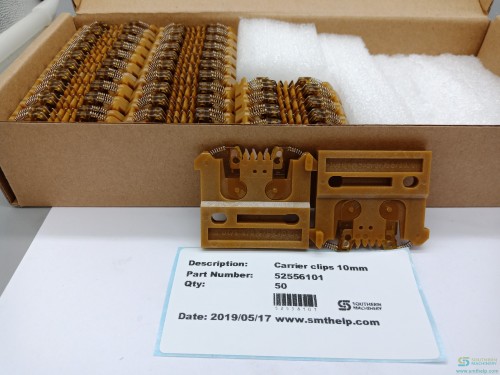
Carrier clips and pressure-plate carriers are part of the wave-side family: they keep the board positioned and flat as it crosses the solder wave, cutting bridges and open joints.
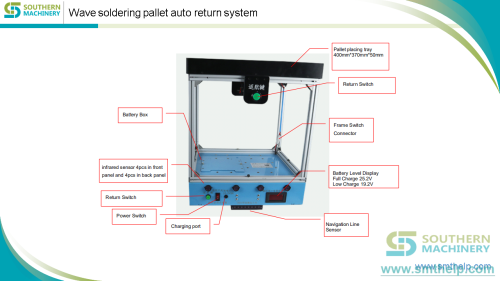
Pallet handling and return systems integrate the carriers into the line so fixtures cycle automatically rather than piling up at the wave exit.
Specification note: fixture size ranges, synthetic stone grade, cleaner capacity and turnaround times should be confirmed at quotation, since they follow your board dimensions and line layout.
The loop: re-audit tooling at every revision
Boards and lines both change, and tooling fit drifts with them. Build a loop: every time a board revision alters its layout or a line adds a station, re-run the Four-Process Tooling Coverage Audit and confirm every carrier still fits its process. Review defect data monthly by station, and feed repeat issues back to the tooling design. The loop keeps the program acting as one system instead of a drawer of mismatched fixtures, and is what protects the payback benchmark — validate it against your own scrap and rework cost per shift pattern.
Your next step
Send us your process chain and the board samples or drawings where tooling fits poorly today. We will map a carrier program from printing to wave and tell you what to confirm at quotation for size, material grade and cleaning capacity. Reach Jason at jasonwu@smthelp.com or on WhatsApp +86 13602562576.
FAQ
What does the fixture and carrier program include?
It covers printing, reflow, wave and auto-insertion fixtures, carriers, carrier clips, calibration jigs and SME5200 cleaning machines.
Is everything built for my board?
Yes. Fixtures and carriers are engineered from your sample or drawing to match board outline, edge rails and component heights.
How does it handle contamination?
Carrier clips and SME5200 pallet/fixture cleaning machines remove flux and residue between runs to stop cross-contamination.
Can it support both SMT and THT?
Yes. The program spans SMT printing and reflow as well as THT wave soldering and auto-insertion tooling.
What should I confirm before ordering?
Fixture size ranges, synthetic stone grade, cleaner capacity and turnaround times are confirmed at quotation against your boards and line.
Jason Wu
Founder & CEO, Southern Machinery (Shenzhen Southern Machinery Sales and Service Co., Ltd.)
Email: jasonwu@smthelp.com / info@smthelp.com
WhatsApp: +86 13602562576
Catalog & manuals: file.autoinsertion.com | Machine photos: ph.smthelp.com
LinkedIn: linkedin.com/in/smtsupplier | YouTube: youtube.com/c/Smthelping
Comments
Comments appear after approval.