
How the SMT Intelligent Reel Storage Rack Works: Step-by-Step
A step-by-step operational walkthrough of the SMT Intelligent Reel Storage Rack: barcode-registered receiving, LED-guided storage, BOM picking and sensor-confirmed line feeding.
Aug 11, 2026 · Updated Aug 31, 2026 · Jason Wu

How the SMT Intelligent Reel Storage Rack Works: Step-by-Step
On a high-speed SMT line, material flow determines whether you hit full OEE or stop for a missing reel. Most factories automate placement and soldering but leave reel storage manual — and then wonder why boards wait. Southern Machinery's SMT Intelligent Reel Storage Rack replaces shelf-hunting with a barcode-registered, LED-guided, sensor-confirmed workflow that turns reel storage into a predictable, traceable part of production.
The cost you haven't named: manual reel storage
Manual storage creates the same failures repeatedly.
- Time spent searching. Reels that should be in stock cannot be located quickly, so operators walk and re-scan.
- Picking errors. Mispicks cause rework, scrap and quality escapes that surface far downstream.
- Line starvation. When inventory data lags physical stock, the line stops for a reel that "exists."
- Kitting labor. Building kits by hand consumes operator hours that could support changeovers.
- Receive-and-forget. Reels accepted at goods-in are not logged until someone finds time, so the system shows stock that has not actually entered the racks — a gap that surfaces as a line stop hours later.
The Reel-to-Kit Operating Loop
Understand the system as a repeatable operating sequence. Call it the Reel-to-Kit Operating Loop.
1. Register reels at receiving. Every reel is barcode-registered on arrival, so the system knows exactly which part entered, in what quantity, and where it should live.
2. Store with LED guidance. The system directs the operator to the correct storage position with LED cues, and a sensor confirms the reel is placed — removing guesswork and mis-shelving.
3. Pick against the BOM. When a kit is needed, the system calls the exact reels for the production BOM and guides the pick, so wrong-part pulls drop sharply.
4. Confirm and feed the line. Each picked reel is sensor-confirmed before it leaves storage, then delivered line-side so placement machines are fed without manual hunting.
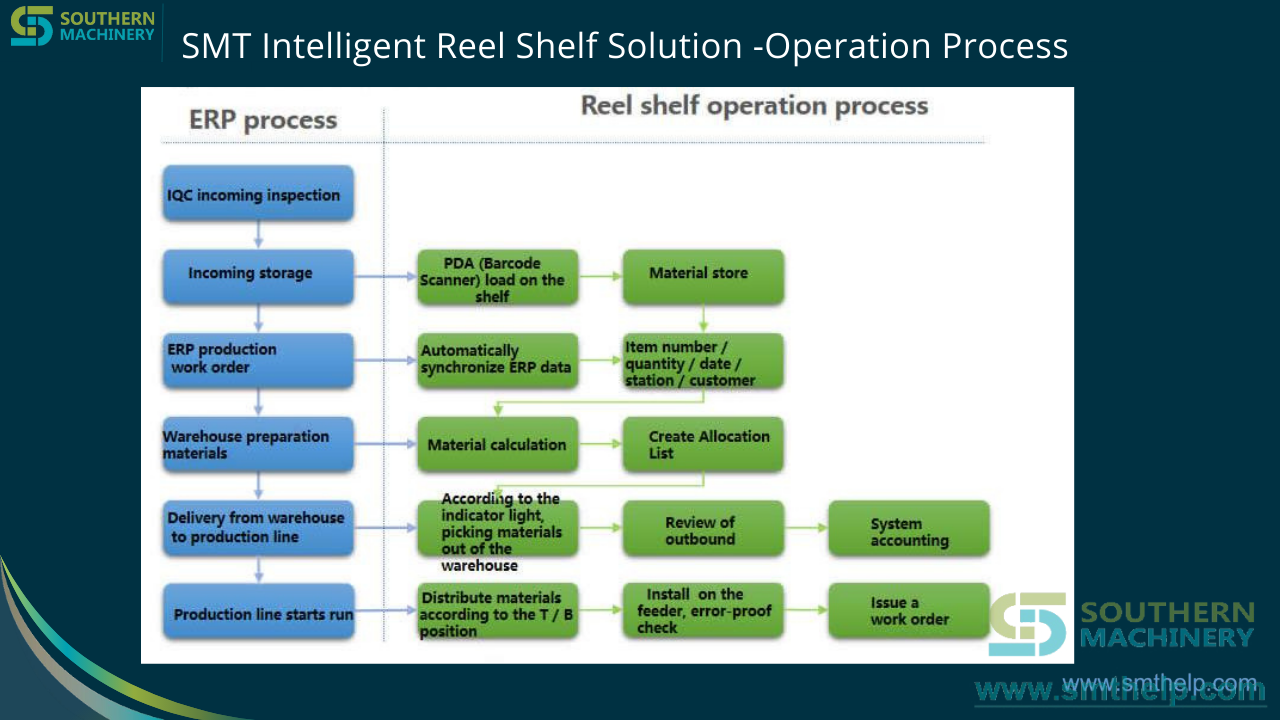
The vehicle: the Intelligent Reel Storage Rack in operation
The framework maps onto the daily workflow.
- Register at receiving → real-time inventory. Barcode entry means the system always knows which reel is where, eliminating the "in stock but missing" gap.
- Store with guidance → no mis-shelving. LED and sensor confirmation put every reel in the right place the first time.
- Pick against the BOM → accurate kits. BOM-linked picking builds kits in minutes instead of hours, with far fewer errors.
- Confirm and feed → starvation-free lines. Sensor-checked reels reach the line ready, keeping placement machines running through changeover.
Specification note: reel size range, storage layers, software fields and MES integration should be confirmed at quotation, because they depend on your component count and IT environment.
In an existing SMT setup, the rack sits beside the stencil printer or loader and talks to the placement line through the MES. When a feeder's reel count falls to its reorder point, the rack alerts the kitting station and stages the replacement reel, so the next changeover starts with material already at the line instead of a walk to the far warehouse.
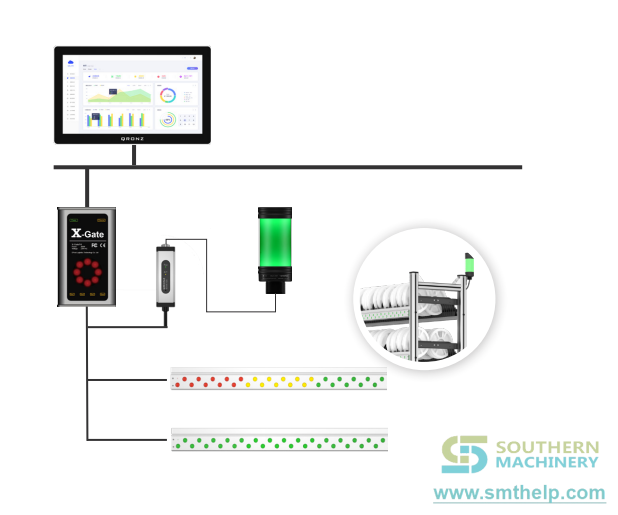
Specifications
| Parameter | Typical value / range |
| --- | --- |
| Reel sizes | 7" / 13" / 15" SMD reels |
| Registration | Barcode on receiving |
| Storage guidance | LED position cue + sensor confirm |
| Picking | BOM-linked, guided |
| Inventory | Real-time reel position |
| Confirmation | Sensor check before issue |
| Integration | MES / ERP (confirmed at quotation) |
| Benefit | Faster, more accurate kitting |
The loop: audit the data every quarter
The system only stays trustworthy if its data is trusted. Build a loop: every quarter, reconcile physical reel counts against the system record, review pick-accuracy and search-time trends, and retrain any operator step that shows drift. If a new product family enters, register its reels before ramping. Treat the loop as routine hygiene — the loop is what keeps the storage rack's data honest instead of slowly diverging from the shelf.
Your next step
Send us your reel sizes, typical BOM kit structure and current kitting time. We will return an operating outline showing how the Reel-to-Kit Operating Loop fits your floor, what capacity to specify, and what to confirm at quotation. Reach Jason at jasonwu@smthelp.com or on WhatsApp +86 13602562576.
FAQ
How does the rack know where a reel is?
Every reel is barcode-registered at receiving, giving the system a real-time record of position and quantity.
How are picking errors reduced?
LED guidance and BOM-linked picking direct the operator to the exact reel, and a sensor confirms placement and issue.
Does it connect to our MES?
Integration is supported; the exact interface is confirmed at quotation.
Is it only for high-volume lines?
No. Capacity is modular, scaling from a line-side buffer to a warehouse system.
What should I send to start?
Your reel sizes, typical BOM kit structure and current estimated kitting time.
Jason Wu
Founder & CEO, Southern Machinery (Shenzhen Southern Machinery Sales and Service Co., Ltd.)
Email: jasonwu@smthelp.com / info@smthelp.com
WhatsApp: +86 13602562576
Catalog & manuals: file.autoinsertion.com | Machine photos: ph.smthelp.com
LinkedIn: linkedin.com/in/smtsupplier | YouTube: youtube.com/c/Smthelping
Comments
Comments appear after approval.