
SMT Label Feeder & Automatic Label Mounter: Eliminate Manual Label Placement
Southern Machinery's own label feeder and T-300 mounter automatically apply traceability and certification labels, removing the error-prone manual step.
Aug 9, 2026 · Updated Aug 31, 2026 · Jason Wu
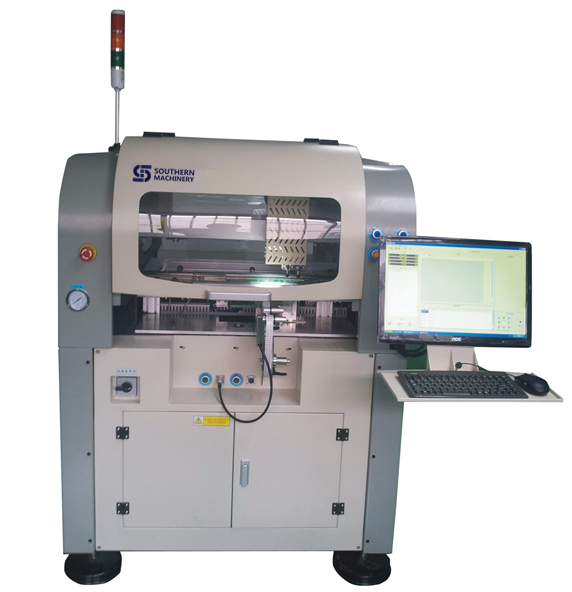
SMT Label Feeder & Automatic Label Mounter: Eliminate Manual Label Placement
An operator peeling and pressing a hundred labels per shift is not adding value—they are repeating the same small, error-prone motion that slows the line and misplaces traceability data. Manual label placement is the one SMT step most factories still do by hand, and it is the step where serial numbers drift, barcodes land crooked, and audit trails break. Southern Machinery builds its own label feeders and the T-300 automatic label mounter to take that step off the operator's hands.
The cost you haven't named: manual label placement
Labeling looks trivial until you count the failures it hides.
- Traceability drift. Hand-placed serial and 2D labels land at slightly wrong positions, so scanners miss them and the audit trail breaks.
- Slow line pacing. Peeling and pressing each label steals cycle time that the placement machine is otherwise waiting on.
- Rework and scrap. A crooked or bubbled label fails appearance or adhesion checks and gets stripped and redone.
- Inconsistent force. Operator pressure varies, so some labels lift later in the field.
- No in-line data link. Manual labeling is disconnected from the assembly sequence, leaving a gap in the build record.
The Four-Point In-Line Label Standard
Frame labeling as a standard the machine owns. Call it the Four-Point In-Line Label Standard.
1. Map the label points. List every label a board needs—serial, UL/CE, date code, customer ID—and where each must land, because each is a placement the machine can own.
2. Score the label types. Sort labels by substrate: paper, polyester, foam-backed, release-liner, curved or recessed surfaces, since each changes how the gripper must pick and place.
3. Quantify the placement tolerance. Decide how straight and how repeatable the label must sit for your scanner and your customer, then set the machine accuracy to hold that on every board.
4. Set the labeling acceptance test. Define a straight, bubble-free, scannable label as the pass criterion and link it to the board's assembly record so the loop closes.
The vehicle: Southern Machinery SMT Label Feeder & T-300 Automatic Label Mounter
This is Southern Machinery's own unit—distinct from the published Samsung/Hanwha label-feeder write-up. The framework maps onto how it runs on the floor.
- Map the label points → reel-fed placement. The feeder pulls a label from a roll, separates it, and places it at the programmed position, covering serial, certification, and customer labels without an operator touching the board.
- Score the label types → vacuum gripper handling. A vacuum gripper picks labels from foam or release liner and places them on flat, curved, or recessed board areas—the same placement family as SMT, purpose-built for thin adhesive media.
- Quantify the placement tolerance → programmed accuracy. Positions are stored in the program, so label straightness and repeatability stay constant across a shift instead of varying with who is on the bench.
- Set the labeling acceptance test → in-line data link. For high-mix EMS lines, the feeder integrates with the SMT line so labeling happens in-line, keeping traceability consistent with the assembly sequence.
Specification note: label size range, placement accuracy, feeder pitch, and integration method should be confirmed at quotation because they depend on your label formats, board geometry, and line layout rather than a single standard unit.
Specifications
| Parameter | Value |
| --- | --- |
| Model | T-300 Automatic Label Mounter |
| Label source | Reel / stacked tube feed |
| Placement method | Vacuum gripper pick-and-place |
| Typical labels | Serial, 2D (DataMatrix/QR), UL/CE, date code |
| Surfaces | Flat, curved, recessed board areas |
| Line integration | In-line with SMT for high-mix EMS (confirm at quotation) |
| Accuracy | Programmed position, confirm at quotation |
| Maker | Southern Machinery (founded 2011, Shenzhen) |
The loop: re-validate label formats every changeover
Label requirements change every time a customer revises an ID scheme, and the manual step quietly falls behind. Build a loop: at every product changeover, re-confirm the label format and placement point in the program, compare a scanned sample against the acceptance test, and update the in-line data link if the board revision changed. Treat the label program as a living loop—not a one-time setup—so traceability holds across every new variant instead of breaking on the first odd one.
Your next step
Send us your label formats and board layout. We will return a labeling review showing where the SMT Label Feeder and T-300 Automatic Label Mounter fit, what placement accuracy to specify, and what to confirm at quotation. Reach Jason at jasonwu@smthelp.com or on WhatsApp +86 13602562576.
FAQ
Is this the same as the Samsung or Hanwha label feeder post?
No. This covers Southern Machinery's own label feeder and T-300 automatic label mounter, built and supported by our team, distinct from the published OEM feeder write-up.
What kinds of labels can it apply?
Serial and 2D traceability labels, UL/CE and certification marks, date-code and revision labels, and customer-specific IDs on finished assemblies.
Does it integrate with an existing SMT line?
For high-mix EMS, it runs in-line so labeling stays consistent with the assembly sequence. Standalone use is also supported for smaller operations. Integration scope is confirmed at quotation.
How does it improve traceability?
By placing each label at a programmed position and linking it to the board record, it removes the position drift and disconnection that manual placement causes.
Jason Wu
Founder & CEO, Southern Machinery (Shenzhen Southern Machinery Sales and Service Co., Ltd.)
Email: jasonwu@smthelp.com / info@smthelp.com
WhatsApp: +86 13602562576
Catalog & manuals: file.autoinsertion.com | Machine photos: ph.smthelp.com
LinkedIn: linkedin.com/in/smtsupplier | YouTube: youtube.com/c/Smthelping
Comments
Comments appear after approval.