
Custom SMT Nozzles & Grippers: the 4-Step Customization Process
A collaborative 4-step process that builds custom SMT nozzles and grippers around your actual components instead of forcing them into catalog tooling.
Aug 11, 2026 · Updated Aug 31, 2026 · Jason Wu
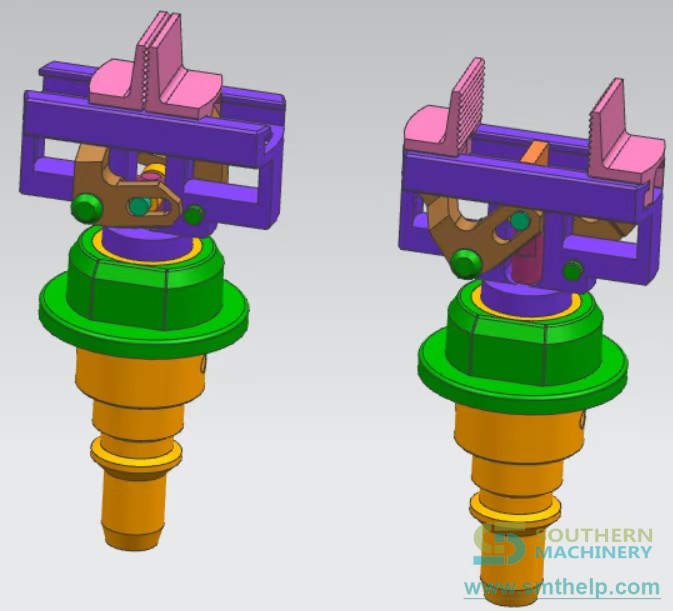
Custom SMT Nozzles & Grippers: the 4-Step Customization Process
Standard nozzles and grippers are built for common chip packages, but most lines carry exceptions: odd-form parts, fragile leads, unusual body shapes. When the tool does not match the part, components shift, misalign, stick to the nozzle, or get damaged. Each incident adds rework and pulls the line below its true capacity. Southern Machinery closes that gap with custom end-of-arm tooling designed around your actual components and machines — without replacing the placement equipment you already own.
The cost you haven't named: mismatched tooling
Standard catalog tooling cannot adapt to every package geometry, so factories either run those components manually or accept higher defect rates.
- Shifted and misaligned parts. A poor vacuum or grip pattern lets components move during travel and placement, breaking registration before the head even reaches the pad.
- Stuck and damaged parts. Wrong bore size or contact geometry traps leads, chips bodies, or leaves residue on the nozzle that contaminates the next pick.
- Manual workarounds. When tooling fails, operators hand-place exceptions, adding labor and inconsistency on every lot that contains them.
- Rejected capacity. The mounter is capable of more, but the tool limits the component mix it can run reliably.
The Four-Step Custom Tooling Build
Treat custom tooling as a managed engineering process, not a one-off purchase. Call it the Four-Step Custom Tooling Build.
1. Submit the component and machine data. Send sample parts or full dimensional drawings, plus the exact mounter or insertion cell model and the head interface the tool must fit. Clear data at this stage prevents redesign cycles later.
2. Engineer the grip or vacuum profile. Southern Machinery designs the nozzle bore, vacuum channel, or gripper jaw geometry around the part's body, lead style, and weight, so the tool holds and releases the component repeatably instead of fighting it.
3. Prototype and prove it on your line. A sample tool is produced and tested on the actual machine with your real component, confirming pick reliability, placement accuracy, and any clinch or release behavior before volume commitment.
4. Validate and deliver the batch. Once the prototype passes your acceptance check, the tooling is produced to matched specification and supplied as a ready-to-run set, with documentation for reordering.

The vehicle: custom SMT nozzles and grippers
The framework maps onto how the tooling is delivered.
- Submit the data → exact fit. Tools are built to your head interface and component geometry, so they drop into the existing mounter or THT cell without machine modification.
- Engineer the profile → stable handling. Purpose-built bore, vacuum, or jaw geometry removes the shift, stick, and damage modes that catalog nozzles create on odd-form parts.
- Prototype and prove → verified output. Testing on your real machine confirms pick-and-place reliability before you commit to a production batch.
- Validate and deliver → repeatable supply. Documented, matched tooling means future reorders and line expansions stay consistent.
Specification note: bore size, material, vacuum requirement, and lead time should be confirmed at quotation because they depend on your component package, head type, and production volume rather than a single default design.

Specifications
| Parameter | Typical range / value |
| --- | --- |
| Compatible machines | SMT mounters, THT insertion cells (model-specific) |
| Nozzle bore diameter | 0.3 – 8.0 mm |
| Gripper jaw material | Hardened steel / engineering polymer |
| Vacuum channel | Single or multi-port, part-dependent |
| Component types | Odd-form, fragile-lead, custom-body |
| Design lead time | Confirmed at quotation |
| Prototype test | On customer machine with real part |
| Reorder | Documented matched specification |
The loop: review tooling at every new product
New component families keep arriving, and each one can reintroduce the mismatch you just solved. Build a loop: every time a new part enters the line, run it against the Four-Step Custom Tooling Build, compare pick reliability to the baseline you recorded, and retire tools that no longer earn their place. Treat the tooling library as a living asset — the loop is what keeps odd-form parts running automatically instead of defaulting back to manual placement.
Your next step
Send us your problem component — a sample, drawing, or photo — along with the mounter or insertion cell model it must fit. We will return a customization plan outlining the right nozzle or gripper geometry, what to prototype, and what to confirm at quotation. Reach Jason at jasonwu@smthelp.com or on WhatsApp +86 13602562576.
FAQ
What kinds of components need custom nozzles or grippers?
Odd-form parts, fragile-lead components, unusual body geometries, and any package that standard catalog tooling cannot grip or vacuum stably.
Do I need to replace my placement machine?
No. Custom tooling replaces the end-of-arm nozzle or gripper only; the existing mounter or THT cell stays in place.
How long does a custom tooling build take?
The timeline depends on part complexity and the prototype test cycle; the schedule is confirmed at quotation after we receive your component and machine data.
Can you supply matched sets for reorder?
Yes. Approved designs are documented so production batches and future reorders stay dimensionally consistent.
What should I send to start?
A sample part or drawing, plus the exact machine model and head interface the tool must fit.
Jason Wu
Founder & CEO, Southern Machinery (Shenzhen Southern Machinery Sales and Service Co., Ltd.)
Email: jasonwu@smthelp.com / info@smthelp.com
WhatsApp: +86 13602562576
Catalog & manuals: file.autoinsertion.com | Machine photos: ph.smthelp.com
LinkedIn: linkedin.com/in/smtsupplier | YouTube: youtube.com/c/Smthelping
Comments
Comments appear after approval.