
"SME-5200 Pallet & Fixture Cleaning Machine: What the Schneider Performance Test Measured"
The SME-5200 aqueous cleaning system was run through a factory performance test on production pallets and fixtures; here is what was measured and why it matters.
Aug 15, 2026 · Updated Aug 31, 2026 · Jason Wu
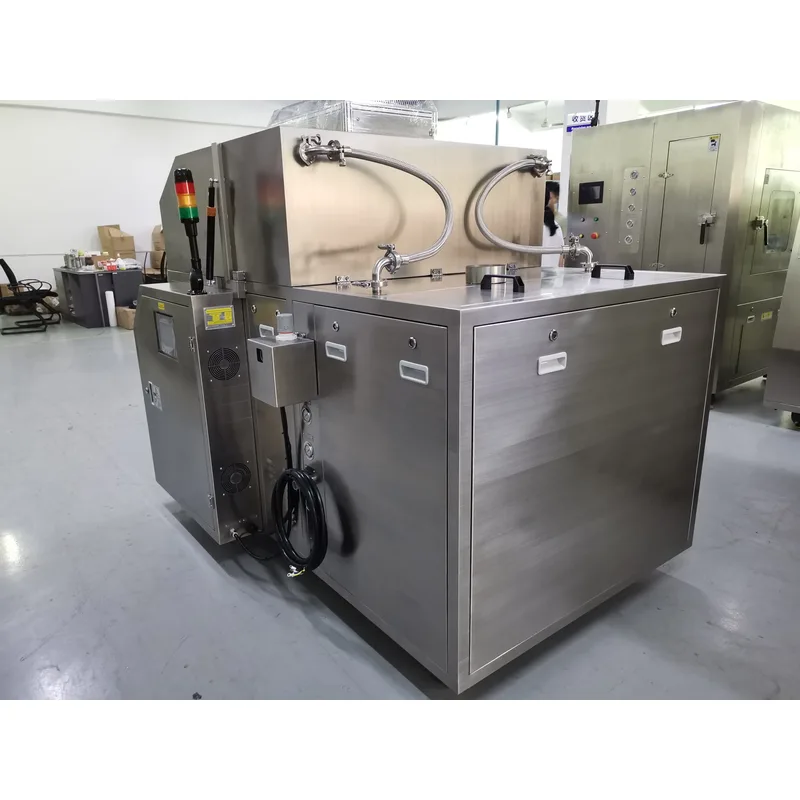
A wave-solder pallet does not fail. It gets dirty, goes back on the line, and quietly transfers flux, dross and grease onto the underside of the next hundred boards. Nobody writes a work order for that. It surfaces weeks later as solder defects, ionic residue readings and untraceable field returns. When Schneider ran a performance test on the SME-5200 aqueous cleaning system, the point was not to watch water spray. It was to measure a controlled cycle against a brush and a bucket.
Why manual pallet and fixture cleaning breaks quality, capacity or cost
Hand cleaning is not a small process problem. It is an uncontrolled variable sitting upstream of everything you solder.
- No two cleans are the same. Brush pressure, solvent age and operator patience vary by shift, so the contamination level returning to the line is unknown and unrecorded.
- Blind geometry stays dirty. Pallet pockets, oven filter fins, claw joints and chain links are exactly where residue collects and exactly where a hand brush cannot reach.
- Wet fixtures go back early. Racks of air-drying pallets create a queue, and under schedule pressure someone loads a damp fixture, dragging moisture into reflow or wave.
- Operator exposure and disposal cost. Open solvent trays mean chemical handling, ventilation issues and waste that has to be documented and paid for.
- Maintenance drifts. With no cycle time attached, manual cleaning is the first task dropped when the line is busy — and coolers clogged with flux volatiles shift your thermal profile.
The Schneider Performance Test
A useful equipment test measures the things that actually decide whether you buy. Here is the structure used, and one you can repeat with your own fixtures.
1. Baseline the contamination. Before anything is loaded, define what you are removing: flux type (no-clean versus water-soluble), grease, solder splash and dust, plus the dirtiest geometry in the batch. Photograph the pallets and record how long manual cleaning currently takes per piece. Without a baseline, the after photo proves nothing.
2. Load the real batch, not a sample. Production pallets, carriers, oven filters and wave-solder claws went into the 1 m rotating basket in the mix the factory actually cycles. Rotation plus top, bottom and front spray is what reaches shadowed surfaces, so basket loading density is part of the result.
3. Run the cycle and record the clock. Wash, rinse and dry ran as one programmed sequence from a single start key: cleaning 3–20 minutes, rinsing 1–2 minutes, drying 10–20 minutes, roughly 30–40 minutes per batch depending on contamination and recipe. Pressure sensors on the cleaning and rinse lines were watched for out-of-range alarms during the run.
4. Inspect, then check the consumables. Fixtures were examined for residue in pockets and joints, and for dryness straight out of the basket — compressed-air cut followed by hot air, so no drying rack. Filtration was then reviewed across the wash and rinse sides, because fluid life is where operating cost is won or lost.
The Vehicle: how the SME-5200 pallet cleaning machine works
The SME-5200 is a water-based batch cleaner combining four stations behind one door: wash unit, rinse unit, hot-air dry unit and a rotating basket, sequenced by a PLC with touch panel. The operator loads fixtures, selects the recipe and presses start. The basket turns through all three stages while nozzles spray from above, below and the front, so residue is attacked from several angles instead of one.
Two separated 80 L tanks keep cleaning fluid and rinse water on independent pipe systems, so wash chemistry is filtered and reused without contaminating the final rinse. The body is SUS304 stainless steel for acid and alkali resistance; controls use Mitsubishi PLC, Schneider contactors and relays, CKD solenoid valves and an OMRON power unit — parts a maintenance team can source locally.
| Parameter | Specification |
| --- | --- |
| Cleaning basket | 1 m diameter rotating round basket; customized pallet holders available |
| Tanks | 80 L cleaning fluid + 80 L rinse water, separated pipe systems |
| Spray coverage | Top, bottom and front spray for all-round fixture coverage |
| Filtration | Wash: 2 mm screen + 100 µm particle + 20 µm flux core; rinse: two-stage |
| Cycle time | Wash 3–20 min, rinse 1–2 min, dry 10–20 min; 30–40 min per batch |
| Drying | Compressed-air cut followed by hot-air drying |
| Construction | Full SUS304 stainless steel, acid and alkali resistant |
| Control | Mitsubishi PLC + touch panel; pressure sensors with out-of-range alarm |
| Power | 380 VAC, 3-phase, 50/60 Hz; 34 kW installed, approx. 13 kW in operation |
| Compressed air | 0.5–0.7 MPa at 800–1000 L/min |
| Dimensions / weight | 1380 (L) × 2000 (W) × 1400 (H) mm; approx. 600 kg |
Where it fits
The SME-5200 is offline support equipment. It sits beside the line, not in it, so it adds nothing to takt time and runs as scheduled maintenance in parallel with production. Typical duties: wave-solder pallets and carriers between campaigns, reflow oven coolers and filters on interval, wave claws, chains and nets, and SMT trays, masks and alignment tooling. It slots into a wider cleaning set — SME800 and S-1688 stencil cleaners, SME6200 and SME5600 PCBA cleaners, S-6200 nozzle cleaner, SME220 squeegee cleaner, SME210 misprint cleaner. Each removes a distinct contamination path.
The ROI case
Model four effects with your own figures. Labour: manual cleaning minutes per fixture times fixtures per week, replaced by load-and-press supervision. Quality: the rework and scrap you attribute to underside solder defects, residue and handling marks. Asset life: clean oven coolers hold heat-exchange efficiency; clean claws and chains wear more evenly, pushing out replacement intervals. Consumables: three-stage wash filtration and separated rinse extend fluid life and cut DI water use — the line item that decides cost per batch.
Then close the measurement loop: re-run the same baseline photographs and cleaning-time records a month after installation and compare. Payback usually comes from reduced rework and predictable maintenance windows rather than headcount alone. Every figure here is a planning benchmark for your own contamination profile, not a promise.
Your next step
Send us your dirtiest fixture: dimensions of the largest pallet, carrier or oven filter, the flux chemistry in use, weekly fixture volume, and photographs of the residue. We will confirm basket fit, propose a customized holder if the geometry needs one, and return the SME-5200 datasheet with a cycle recommendation. Ask for the performance test video, a demo, or a part list for filtration consumables.
FAQ
What does an SMT pallet cleaning machine actually remove?
Flux residue, grease, solder splash and dust from pallets, carriers, trays, SMT tooling, reflow oven coolers and filters, and wave-solder claws, chains and nets — using water-based fluid, then rinsing and hot-air drying.
How long is one cycle?
Roughly 30–40 minutes per batch on the SME-5200: 3–20 minutes wash, 1–2 minutes rinse, 10–20 minutes dry, set by recipe according to how heavily the fixtures are contaminated.
Will it fit our pallet geometry?
The standard basket is 1 m in diameter and customized pallet holders can be built for specific shapes. Send the largest fixture drawing and we will confirm before quoting.
What maintenance does it need?
Stainless filters are cleaned on a routine, and cleaning filter elements are typically changed every 15–30 days depending on contamination. Pressure sensors on the wash and rinse lines raise an alarm outside the set range, which prompts service before performance drifts.
Jason Wu
Founder & CEO, Southern Machinery (Shenzhen Southern Machinery Sales and Service Co., Ltd.)
Email: jasonwu@smthelp.com / info@smthelp.com
WhatsApp: +86 13602562576
Catalog & manuals: file.autoinsertion.com | Machine photos: ph.smthelp.com
LinkedIn: linkedin.com/in/smtsupplier | YouTube: youtube.com/c/Smthelping
Comments
Comments appear after approval.