
Smart SMT Stencil Storage Cabinet: Cut Setup Time, Defects & Training
A QR-coded, light-guided stencil cabinet that brings the right frame to the operator in about 5 seconds and logs every move for audit compliance.
Aug 11, 2026 · Updated Aug 31, 2026 · Jason Wu

Smart SMT Stencil Storage Cabinet: Cut Setup Time, Defects & Training
Stencil changeover looks cheap until it shows up as printer downtime, solder-paste defects, and an audit you cannot reconstruct. In a high-mix SMT factory, operators walk racks matching frame numbers by eye, rotation discipline slips between shifts, and traceability lives on paper. Southern Machinery's Smart SMT Stencil Storage Cabinet puts the right stencil, in the right condition, at the operator's hand — and logs every move.
The cost you haven't named: stencil chaos
Most factories track printer uptime but leave stencil management as an unowned chore that quietly steals it back.
- Manual searching between changeovers. Operators walk shelves matching frame numbers by eye, burning changeover minutes.
- Uncontrolled rotation and maintenance. Without a system, you cannot prove every stencil was cleaned, inspected, and rotated on schedule.
- Heavy traceability workload. ISO 9001 and IATF 16949 audits demand records from stencil receipt to disposal.
- Long onboarding. Learning the full manual workflow can take around 90 days — hard to sustain in high-turnover teams.
The Four-Point Stencil Control Audit
Before specifying storage, frame stencil management as a control audit rather than a cabinet purchase. Call it the Four-Point Stencil Control Audit.
1. Map the changeover demand. Count daily stencil changes per printer and the product families driving them. The goal is to see exactly how often the right frame must appear.
2. Score the retrieval delay. Time how long operators spend locating the correct frame during a changeover. This is the minutes that add up to printer downtime across a shift.
3. Quantify the compliance gap. Tally missing cleaning, rotation, and audit records. The gap is what turns an external audit into a fire drill.
4. Set the storage target. Define acceptable retrieval time, traceability depth, and rotation discipline. That statement becomes your acceptance test at delivery.
The vehicle: Smart SMT Stencil Storage Cabinet
The framework above maps directly onto how the cabinet is deployed on a real SMT floor.
- Map the changeover demand → slot capacity. Each slot is addressed and tracked, so the cabinet holds the stencil set your printers actually cycle through rather than a disorganized wall of frames.
- Score the retrieval delay → QR and light-guided retrieval. Every slot carries a QR code and an indicator light, and the system brings the correct stencil to the operator with an average retrieval time around 5 seconds, depending on configuration.
- Quantify the compliance gap → full traceability. The cabinet logs each stencil from receipt through cleaning, rotation, and disposal, supporting ISO 9001 and IATF 16949 records without paper.
- Set the storage target → enforced rotation. By tracking usage, it sustains cleaning and rotation discipline between shifts, so a stencil's condition is known before it reaches the printer.
Specification note: slot count, cabinet footprint, and retrieval speed should be confirmed at quotation, because they depend on your printer count, stencil sizes, and changeover frequency rather than a single default.
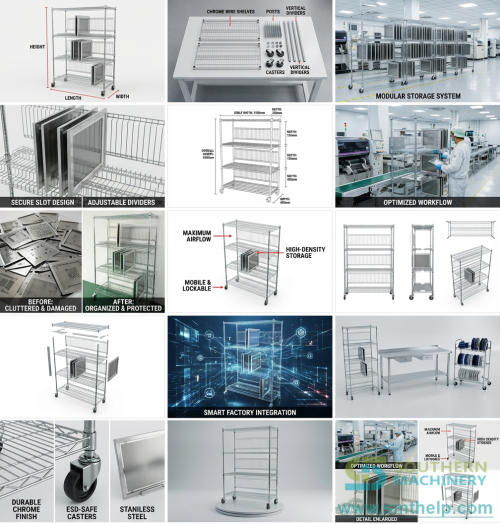
The loop: re-audit stencil discipline every quarter
Rotation and traceability decay once the initial discipline fades. Build a loop: every quarter, repeat the Four-Point Stencil Control Audit, compare retrieval-time and compliance-gap scores against the previous quarter, and review the cabinet's usage logs with your process leads. If a new product family changes your stencil set, re-map before ramping it. Treat the audit as a living document, not a one-time project — the loop is what keeps the cabinet earning its place instead of becoming an expensive shelf. A cabinet whose data nobody reviews drifts back toward the paper habit it was meant to replace, so the review has to stay on the calendar.
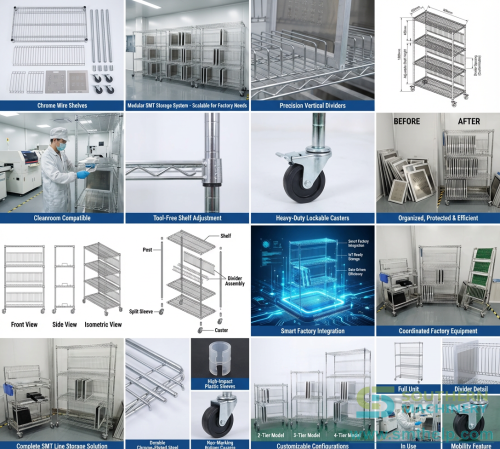
Your next step
Send us your printer count, daily changeover frequency, and current stencil sizes. We will return a storage review outlining where the Smart SMT Stencil Storage Cabinet fits, what slot count and retrieval speed to specify, and what to confirm at quotation. Reach Jason at jasonwu@smthelp.com or on WhatsApp +86 13602562576.
FAQ
How fast is stencil retrieval?
The system brings the correct stencil to the operator with an average retrieval time around 5 seconds, depending on cabinet configuration.
Does it support audit compliance?
Yes. It logs each stencil from receipt through cleaning, rotation, and disposal, supporting ISO 9001 and IATF 16949 records.
Which factories benefit most?
EMS, ODM, automotive, medical, and industrial-control production where the printer needs the right stencil, in the right condition, on time.
How does it shorten onboarding?
By guiding operators to the correct slot with QR and light cues, it removes the ~90-day manual-learning burden for new staff.
Are the specs fixed?
Slot count, footprint, and retrieval speed depend on your printer count and changeover frequency, so they are confirmed at quotation.
Specifications
| Parameter | Value |
| --- | --- |
| System | Smart SMT Stencil Storage Cabinet |
| Retrieval time | ~5 seconds (configuration-dependent) |
| Identification | QR code per slot |
| Guidance | Indicator light per slot |
| Capacity | Per cabinet configuration |
| Compliance | ISO 9001 / IATF 16949 records |
| Onboarding | Replaces ~90-day manual learning |
| Tracking | Receipt-to-disposal traceability |
Jason Wu
Founder & CEO, Southern Machinery (Shenzhen Southern Machinery Sales and Service Co., Ltd.)
Email: jasonwu@smthelp.com / info@smthelp.com
WhatsApp: +86 13602562576
Catalog & manuals: file.autoinsertion.com | Machine photos: ph.smthelp.com
LinkedIn: linkedin.com/in/smtsupplier | YouTube: youtube.com/c/Smthelping
Comments
Comments appear after approval.