
Odd-Form Insertion Machines: Design & Manufacturing for Smart EMS Factories
A vision-guided odd-form inserter that replaces manual THT placement of transformers, relays and connectors on your DIP line with consistent, polarity-checked insertion.
Aug 22, 2026 · Updated Aug 31, 2026 · Jason Wu
Odd-Form Insertion Machines: Design & Manufacturing for Smart EMS Factories
Transformers, relays, connectors, fuse holders, terminal blocks and large electrolytic capacitors arrive in trays, tubes or loose bags — their lead pitches vary and their bodies are asymmetric. On most DIP lines they are still hand-inserted, and that is exactly where throughput and quality problems start. A single 180°-rotated capacitor or a floating-high lead passes wave soldering yet fails in the field. Vision-guided odd-form insertion removes that whole failure class by replacing the manual step with a programmable, polarity-checked process.
The cost you haven't named: manual odd-form insertion
- Throughput variability. A hand-inserted connector takes 4 to 10 seconds depending on operator familiarity and part presentation. On a 5,000-board run with four odd-form parts per board, that variability adds hours of unplanned labor each shift.
- Defect costs surface late. Floating-high, misinsertion and reverse insertion defects are only caught at AOI or functional test — after wave soldering and cleaning, when rework means desoldering, clearing through-holes and re-inserting.
- Field-failure risk. A transformer with 6 to 10 pins needs every pin seated; one open pin can cause a field failure costing many times the board's assembly value.
- Line balance depends on staffing. Production scale tracks your ability to recruit and retain skilled hand-insertion operators rather than your equipment.
The Four-Gate Odd-Form Insertion Audit
Before specifying a machine, frame the decision as a repeatable audit rather than a one-off buy. Call it the Four-Gate Odd-Form Insertion Audit.
1. Map the component portfolio. List every awkward THT part your product family repeats — transformers, relays, connectors, terminal blocks, E-CAP — and note its presentation (tray, tube, vibration bowl) and lead pitch. The goal is to see which parts actually block automation.
2. Score the manual-insertion cost. For each repeated part, tally insertion time per board, defect rate and rework minutes. The high-volume, high-defect parts are where an inserter pays back first.
3. Verify vision and polarity control. Confirm the machine recognizes lead geometry, checks polarity before placement, and seats every lead to a programmed depth — not just a headline CPH number.
4. Confirm line integration. Define the conveyor handshake, board-size range and upstream/downstream compatibility so the station drops into the existing line rather than forcing a rebuild.
The vehicle: S-70LD Odd-Form Insertion Machine
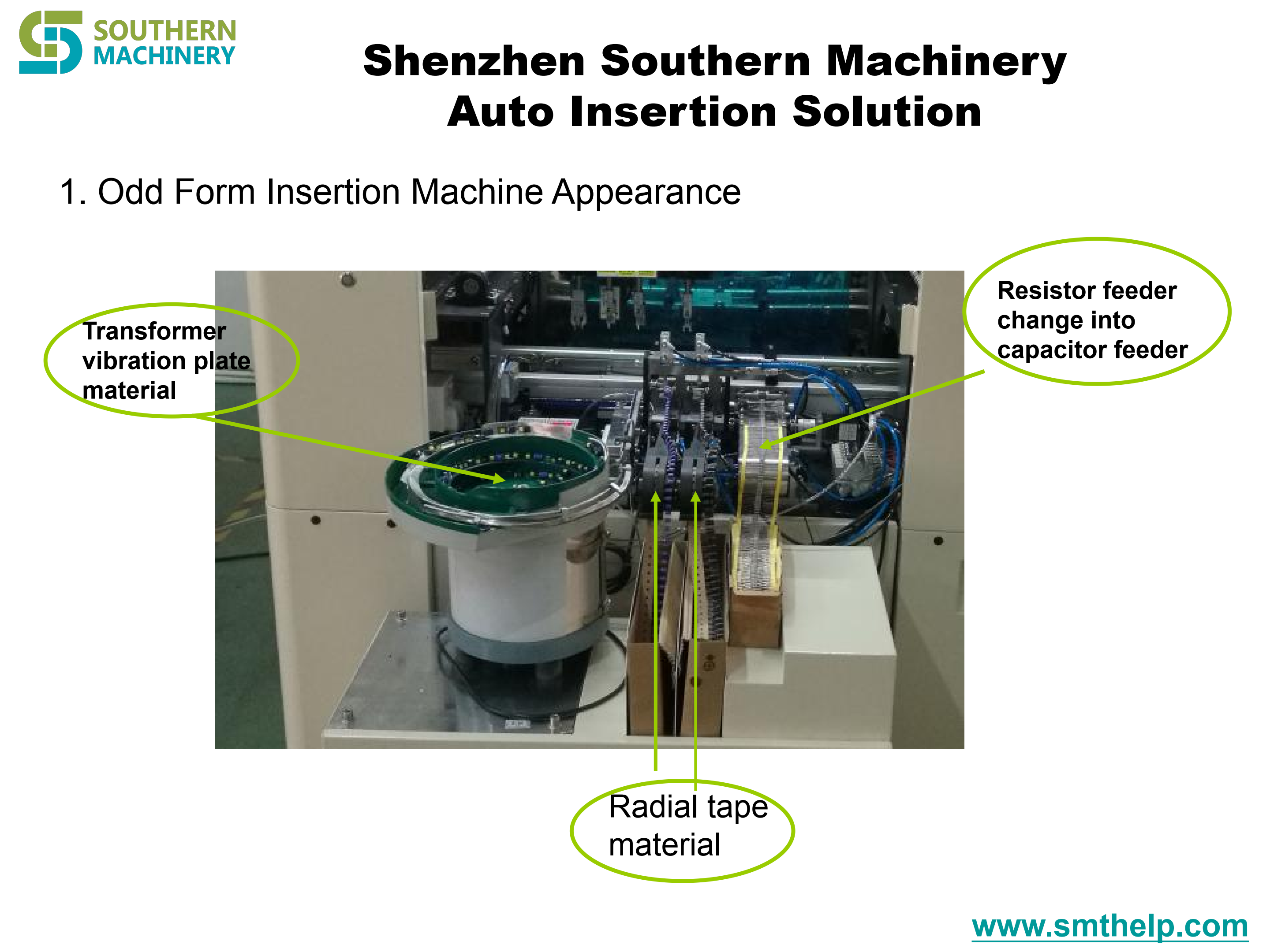
Southern Machinery designs and manufactures the S-70LD in Shenzhen — the insertion heads, tape and vibration-plate feeders, vision integration and industrial-computer control are all built in-house, so the machine matches your component portfolio instead of a generic import.
- Map the component portfolio → tray, tube and bowl handling. Four adjustable feeders (tape or vibration plate) present parts without mechanical re-tooling, so transformers, connectors and E-CAP run from the same inline head set.
- Score the manual-insertion cost → consistent cycle time. Four insertion heads seat every lead to a programmed depth on every shift, removing the 4-to-10-second operator variance.
- Verify vision and polarity control → guided placement. Industrial-computer vision locates each part, recognizes lead geometry and checks polarity before placement, catching 180°-rotated parts before they reach wave soldering.
- Confirm line integration → inline SMEMA design. The machine accepts boards via SMEMA handshake on the conveyor upstream of wave soldering and returns them to the same line, leaving existing infrastructure in place.
Specification note: rated throughput (CPH), air and power demand, and feeder configuration should be confirmed at quotation, because they depend on your component mix, board size and shift pattern rather than a single factory-wide default.
Specifications
| Parameter | Value |
| --- | --- |
| Insertion heads | 4 (programmable) |
| Feeders | 4 adjustable (tape or vibration plate) |
| Component body range | 3 × 3 mm to 30 × 30 mm |
| Max component height | 50 mm |
| PCB size range | 50 × 50 mm to 300 × 300 mm |
| Control | Industrial-computer + vision guidance |
| Polarity / lead check | Pre-placement vision verification |
| Line interface | SMEMA conveyor handshake, inline |
| Rated throughput | Confirmed at quotation (varies by component mix) |
The loop: re-audit every product ramp
Components and volumes drift as new SKUs enter the line. Build a loop: every time a new product family ramps, repeat the Four-Gate Odd-Form Insertion Audit, compare the manual-insertion scores against the baseline, and review reject data from AOI and functional test with your line leads. If a new connector or transformer changes the feeder load, re-map before volume builds. Treat the audit as a living document — the loop is what keeps the S-70LD earning its place instead of becoming a static cell that only runs the original three boards.
Your next step
Send us your component list and the top three odd-form parts you want to automate. We will return a design and manufacturing review outlining where the S-70LD fits, what feeder and head configuration to specify, and what to confirm at quotation. Reach Jason at jasonwu@smthelp.com or on WhatsApp +86 13602562576.
FAQ
What are odd-form components in PCB assembly?
Odd-form parts are through-hole components that do not fit standard radial or axial tape — transformers, relays, connectors, fuse holders, terminal blocks and large electrolytic capacitors. They arrive in trays, tubes or loose bags with varying lead pitches and asymmetric bodies.
How does the S-70LD prevent reverse insertion?
Its vision system recognizes each part's lead geometry and checks polarity before placement. A 180°-rotated part is detected and corrected or rejected, so polarity-sensitive capacitors, diodes and transformers seat in the correct orientation every cycle.
Can the odd-form inserter connect to an existing wave soldering line?
Yes. The S-70LD is an inline station that accepts boards via SMEMA handshake, connects to the conveyor upstream of wave soldering, and returns boards to the same line — existing wave, cleaning and conveyor infrastructure stays unchanged.
Which machine does Southern Machinery offer for odd-form insertion?
The reference model is the S-70LD — a vision-guided inline inserter with 4 heads and 4 adjustable feeders. Southern Machinery also offers the S7000-series odd-form/pin insertion family and complementary DIP-line equipment.
How do I get a catalog or technical proposal?
Contact Jason Wu at jasonwu@smthelp.com for pricing and a proposal, download the catalog from file.autoinsertion.com, and browse machine photos at ph.smthelp.com.
Jason Wu
Founder & CEO, Southern Machinery (Shenzhen Southern Machinery Sales and Service Co., Ltd.)
Email: jasonwu@smthelp.com / info@smthelp.com
WhatsApp: +86 13602562576
Catalog & manuals: file.autoinsertion.com | Machine photos: ph.smthelp.com
LinkedIn: linkedin.com/in/smtsupplier | YouTube: youtube.com/c/Smthelping
Comments
Comments appear after approval.