
Hand Soldering THT Is Slow and Uneven — Make It Selective
Hand soldering THT is slow and uneven. Run the Selective Solder Audit, then see how the SO-300 targets only the joints that need it.
Aug 20, 2026 · Updated Aug 31, 2026 · Jason Wu
Full wave soldering exposes the whole board to molten solder; hand soldering is slow and operator-dependent. Between them sits selective soldering — but many EMS lines still hand-solder THT connectors, transformers and capacitors because a full wave line is unjustified at their volume. The result is uneven joints, thermal stress on nearby SMDs, and a bottleneck that scales only with overtime.
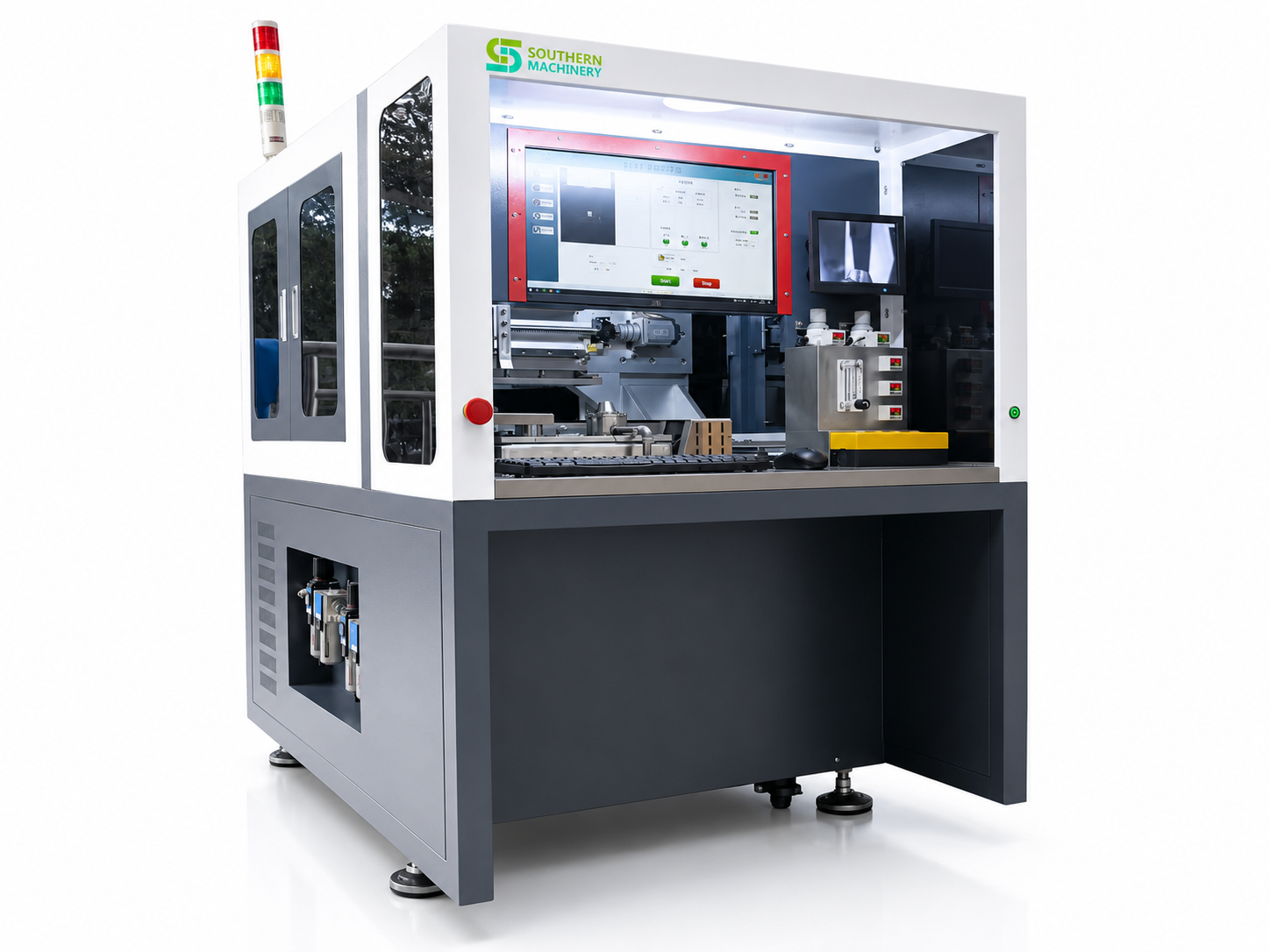
Southern Machinery's SO-300 High-Speed Offline Selective Soldering Machine brings jet fluxing, bottom IR preheating and selective soldering into one compact offline station with ±0.1 mm positioning and PC recipe control — for through-hole soldering, rework and high-mix THT. It is built for EMS, ODM, power supply, automotive electronics and industrial control manufacturers where THT content is real but volumes do not justify a full wave line.
Why hand soldering breaks throughput
- Uneven quality from operator skill and fatigue — joint-to-joint variance.
- Thermal stress on adjacent SMDs when the whole board is heated.
- Slow cycle per board limits output to one operator's hands.
- No recipe record for audits or repeat orders.
- No data trail — hand soldering leaves no recipe, so audits and repeat orders restart from zero.
The Selective Solder Audit
1. List THT joints. Which components need soldering, pitch and lead count decide nozzle and path.
2. Check board exposure. If only selected areas need solder, wave is overkill.
3. Set the thermal budget. Preheat and pot temperature must suit your alloy (lead-free to 350 °C).
4. Plan recipes. One saved PC recipe per board enables fast changeover.
The Vehicle: how the SO-300 works
The PCB moves above fixed fluxing, IR preheat and soldering modules on a servo XYZ table; only programmed joints are soldered. Flux, preheat and solder are applied by fixed modules while the board travels a servo XYZ path, so heat stays local and adjacent SMDs are spared.
Programming uses a Windows-based industrial PC that displays the PCB image as the soldering-path background. The operator sets speed, dwell, Z height and wave height, saves the result as a recipe, and watches a live process camera during the run. Because temperature, speed and pressure are logged, each board is repeatable and auditable — a real advantage for IPC-aligned quality work and customer reviews of high-mix jobs.
| Parameter | Specification |
|---|---|
| Machine type | Offline single-head selective soldering |
| Max soldering area | 300 × 300 mm (customizable) |
| PCB thickness | 0.2–6 mm; edge > 3 mm |
| Positioning accuracy | ±0.1 mm |
| Fluxing | Jet valve, 1 L tank |
| Preheating | Bottom IR 3 kW, 25–240 °C |
| Solder pot | 15 kg, PID, max 350 °C |
| Motion | Servo X / Y / Z |
| Nozzles | 5 pcs (ID 4 / 5 / 6 mm) |
| Power / air | 220 V 50 Hz; 3–5 bar; N2 >99.998% |
Where it fits in a complete line
After SMT reflow and THT insertion, the SO-300 runs as a line-side or standalone station for selective THT joints; full-board THT uses Southern Machinery wave machines (S-WS350B, S-WS450). PC recipes mean changing boards is a program recall, not a line rebuild.
In a high-mix cell the SO-300 runs beside the SMT line as a line-side station, or as a standalone bench for NPI and rework. Because recipes are saved per PCB, moving from a power-supply board to an automotive control board is a program recall, not a tooling rebuild. Southern Machinery can pair it with radial, axial and odd-form insertion and wave soldering for a complete THT cell from one supplier.
The ROI case
Selective soldering applies heat only where needed, cutting thermal stress and rework; ±0.1 mm accuracy and saved recipes support documented, repeatable settings for IPC-aligned audits; and it removes the two hand-solder bottlenecks — inconsistent quality and slow cycles. The payback is strongest where you hand-solder mixed products or where wave is overkill; quantify labor, defect and rework, then model it with your own numbers. Re-run this audit-and-improvement loop when you add a board or alloy.
Quantify the case on three lines your finance team already tracks: manual soldering labor hours, defect rate at test, and rework hours. Where those are material, the SO-300 converts variable hand labor into a fixed, repeatable process with a recorded recipe — useful for IPC-aligned audits. The payback figure is yours to model; we supply the machine data, you supply the volume and labor cost.
Make it a recurring check
Revisit the Selective Solder Audit when adding lead-free alloys, new THT components or NPI builds; Southern Machinery advises on nozzle set, fixture and N2 supply. Re-validate preheat and pot settings when you switch alloy or add a denser board.
Your next step
Send your PCB size, THT joint list and alloy and our engineers recommend an SO-300 configuration. Southern Machinery (Shenzhen, China, since 2011, 237+ global customers) supplies SMT/THT selective and wave soldering, insertion, board handling and inspection with training and spare parts.
FAQ
Is the SO-300 lead-free capable? Yes — PID pot to 350 °C with optional N2 covers common lead-free THT; confirm alloy and profile at configuration.
Does it need a fixture? Offline manual load; fixture needs depend on your PCB and are confirmed with the supplier.
Can it rework boards? Yes — rework and repair soldering is a stated use case alongside high-mix THT and prototypes.
What is the maximum board size? 300 × 300 mm soldering area (customizable), 0.2–6 mm thick, with > 3 mm edge requirement.
Jason Wu
Founder & CEO, Southern Machinery (Shenzhen Southern Machinery Sales and Service Co., Ltd.)
Email: jasonwu@smthelp.com / info@smthelp.com
WhatsApp: +86 13602562576
Catalog & manuals: file.autoinsertion.com | Machine photos: ph.smthelp.com
LinkedIn: linkedin.com/in/smtsupplier | YouTube: youtube.com/c/Smthelping
Comments
Comments appear after approval.