
A Manual Board Transfer Is a Hidden Bottleneck — Add a Shuttle
Moving boards sideways between lines by hand caps throughput. Run the Flow Routing Audit, then see how the SPD330 redirects PCBs automatically.
Aug 17, 2026 · Updated Aug 31, 2026 · Jason Wu
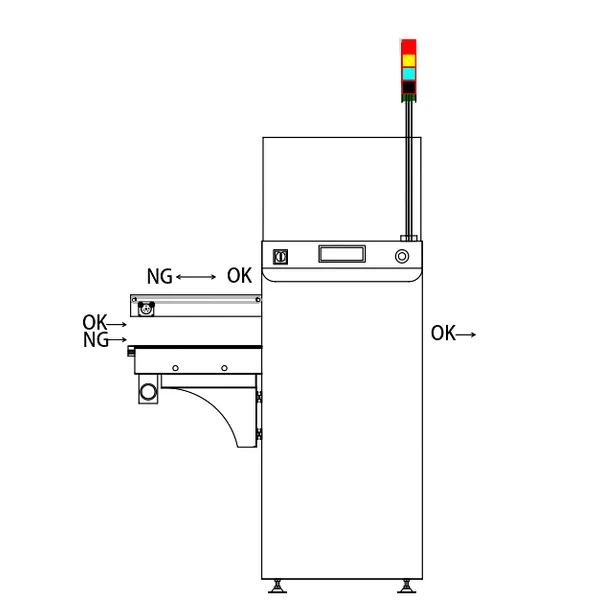
An operator standing between two conveyors, lifting each board and placing it into the next lane, is a bottleneck dressed up as a job. The move is slow, it breaks the SMEMA chain, and it introduces ESD and handling risk on every touch. When one downstream machine stops for changeover, the whole line waits — because nothing redirects the flow around it. Lateral board movement is exactly what manual handling cannot do well.
Southern Machinery's SPD330 Shuttle Conveyor is a servo-driven, SMEMA-compatible translational conveyor that carries a PCB on a sliding carriage and transfers it sideways into a parallel lane. It splits, merges, or bypasses PCB flow inside an SMT, THT, or wave-soldering line, replacing the manual sideways transfer with a controlled, repeatable move.
Why manual board transfer breaks throughput
A hand transfer has no handshake with the line. Across a shift it produces predictable losses:
- Throughput cap — one person moves only so many boards per minute, and the line waits at that speed.
- SMEMA break — removing boards by hand drops them out of the signal chain, so upstream and downstream lose sync.
- ESD and handling risk — every touch is a chance to zap, scratch, or bend a board.
- No bypass path — when a station goes down, boards pile up because nothing reroutes them.
- Traceability gaps — manual moves leave no clean record of where each board went.
Every one of these is a flow defect, not a machine defect. Automating the lateral move removes the human from the routing decision.
The Flow Routing Audit
Map your lateral moves before specifying a shuttle. The audit uses your line layout:
1. List the sideways transfers. Where do boards change lane today — by hand, by a turn module, or not at all? Each hand move is a candidate.
2. Measure the traverse. How far must the board travel between parallel lanes? That distance sets the machine width.
3. Count the channels. How many input and output lanes do you need, and in which direction (left-to-right, right-to-left, reversible)?
4. Check the interface. Confirm SMEMA-compatible I/O so the shuttle plugs into adjacent loaders, printers, ovens, and unloaders without custom protocols.
The audit shows where a single shuttle removes a standing operator and where it also unlocks a bypass loop.
The Vehicle: how the SPD330 works
The SPD330 sits wherever flow must change direction laterally. A servo-driven carriage picks the board from one lane and sets it down in the parallel channel, synchronized through the SMEMA handshake so it only moves when the next station is ready. The PLC program and soft-touch LED membrane panel let the PCB direction flow be customized to the line layout, and the enclosed top cover opens for maintenance.
Verified specification from the Southern Machinery product data:
| Parameter | Specification |
|---|---|
| PCB size range (SPD330) | 50 × 50 mm to 460 × 330 mm |
| Smaller variant (SPD250) | Up to 330 × 250 mm |
| Drive | Servo-driven sliding carriage |
| Control | PLC with soft-touch LED membrane panel |
| Interface | SMEMA-compatible I/O |
| Footprint (SPD330) | 600 mm (L) × W × 1050 mm (H) |
| Footprint (SPD250) | 500 mm (L) × W × 1050 mm (H) |
| Weight (SPD330 / SPD250) | Approx. 200 kg / 140 kg |
| Safety | Enclosed design, top cover opens for service |
Width depends on the traversing distance between your parallel lanes; confirm it during quotation.
Where it fits in a complete line
A typical Southern Machinery SMT/THT line flows: PCB loader → solder paste printer (SP-830-A) → SPI (SH8650) → pick and place → reflow → AOI → THT auto insertion → wave soldering → inline lead cutter → inline PCBA cleaning → final inspection. The SPD330 drops in wherever flow moves laterally: after a magazine loader to split bare boards into two printing lines; between reflow and AOI to feed two inspection machines; after wave soldering to route boards to cleaning or an NG station; or around selective soldering to form a bypass loop. Because it is SMEMA-compatible, it integrates without custom software.
The ROI case
Manual transfer between lines is a hidden cost: a dedicated operator per shift, dropped boards, and a line that stalls when one station is down. The SPD330 removes that labor and makes the move automatic and repeatable, so the shuttle keeps pace with takt time instead of becoming the constraint. It also lets you keep running by diverting to a parallel channel during changeover or maintenance. The exact payback depends on your labor cost, lane count, and downtime — model it with your own numbers, and re-run the Flow Routing Audit whenever you add a lane or a station; this audit-and-improvement loop keeps the board routing matched to the line as it grows.
Your next step
Send us your line layout, board sizes, and the lanes you need to split or merge — our engineers recommend the right SPD model and traverse width. Southern Machinery (Shenzhen, China, since 2011, 237+ global customers) supplies complete board handling systems — loaders, unloaders, destackers, buffers, turn modules, and shuttle conveyors — with installation, training, and spare parts.
FAQ
What is a shuttle conveyor in SMT? A translational conveyor that moves a PCB sideways from one lane to a parallel lane, redirecting flow to split, merge, or bypass lines. The SPD330 does this servo-driven with SMEMA compatibility.
What PCB sizes can the SPD330 handle? The SPD330 covers 50 × 50 mm up to 460 × 330 mm; the smaller SPD250 covers up to 330 × 250 mm. Confirm your board dimensions with the supplier.
Is the SPD330 compatible with my existing line? Yes — it is SMEMA-compatible and PLC-programmed with a soft-touch LED panel, integrating with standard loaders, printers, ovens, AOI, and unloaders.
Where should a shuttle conveyor be placed? Anywhere flow moves laterally: after loaders to distribute boards, between reflow and AOI to feed multiple inspectors, or after wave soldering to route to cleaning or NG/OK stations.
Jason Wu
Founder & CEO, Southern Machinery (Shenzhen Southern Machinery Sales and Service Co., Ltd.)
Email: jasonwu@smthelp.com / info@smthelp.com
WhatsApp: +86 13602562576
Catalog & manuals: file.autoinsertion.com | Machine photos: ph.smthelp.com
LinkedIn: linkedin.com/in/smtsupplier | YouTube: youtube.com/c/Smthelping
Comments
Comments appear after approval.