
Complete THT Auto Insertion Line: Loader to Unloader
A loader-to-unloader THT auto insertion line that carries the board through axial, radial, terminal and odd-form insertion as one connected process.
Aug 11, 2026 · Updated Aug 31, 2026 · Jason Wu

Complete THT Auto Insertion Line: Loader to Unloader
For EMS, ODM, automotive, medical and industrial-control factories, manual through-hole insertion becomes a costly bottleneck the moment volume rises. Separate hand stations multiply labor, inspection and handling risk. Southern Machinery designs cost-effective THT auto insertion lines that carry the board from automatic PCB loading through axial, radial, terminal and odd-form insertion to automatic unloading — one connected process instead of a row of manual benches.
The cost you haven't named: fragmented THT stations
Manual, separated THT stations hide cost at every handoff.
- Repeated handling. Moving boards between hand stations adds touches, carriers and opportunities for damage.
- Labor stacking. Each station needs its own operator, so cost scales with station count, not output.
- Inconsistent quality. Without vision and controlled force, insertion quality varies with the person on the bench.
- Line blindness. Separate benches are hard to instrument, so throughput and faults stay invisible.
- Routing waste. Without a defined flow, boards are batched and carried in totes between benches, so WIP piles up at the slowest station while faster cells wait idle.
The Loader-to-Unloader Line Blueprint
Design the line as one flow before buying machines. Call it the Loader-to-Unloader Line Blueprint.
1. Define the board flow. Map the PCB from load to unload, listing every insertion type — axial, radial, terminal, odd-form — the board requires in sequence.
2. Stage each insertion cell. Assign a machine to each insertion type so the board never waits for a manual carry between steps.
3. Connect with board handling. Link cells with automatic loaders, conveyors and unloaders so the board moves without manual intervention.
4. Verify the closed loop. Confirm vision, insertion force and data reporting at every cell, so quality and throughput are measurable end to end.

The vehicle: the complete THT insertion line
The framework maps onto a connected line design.
- Define the flow → full coverage. The line covers axial (e.g. S4020A up to 24,000 CPH), radial (e.g. S3010A up to 20,000 CPH), terminal and odd-form insertion in one sequence.
- Stage each cell → no waiting. Each insertion type has a dedicated machine, removing manual carries between stations.
- Connect handling → continuous move. Automatic loading, conveying and unloading keep the board moving to the unloader.
- Verify the loop → controlled quality. Vision guidance and controlled insertion force hold quality regardless of shift or operator.
Specification note: per-machine CPH, cell count and layout should be confirmed at quotation, because they depend on your board mix, volume and floor space.
To drop onto an existing SMT-plus-THT floor, the line starts at an automatic loader that receives boards from the SMT unloader and ends at an unloader that hands off to test or conformal-coat. Between those points the axial, radial, terminal and odd-form cells connect by conveyor, and each cell's vision and force data feed the same MES topic, so the whole THT stage reports as one station instead of four separate machines.
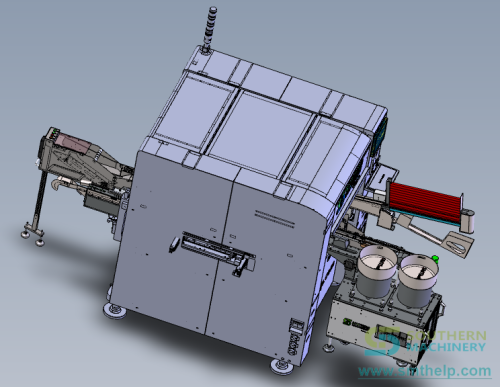
Specifications
| Stage | Machine example | Throughput |
| --- | --- | --- |
| PCB loading | Automatic loader | Per line |
| Axial insertion | S4020A | Up to 24,000 CPH |
| Radial insertion | S3010A | Up to 20,000 CPH |
| Terminal insertion | Dedicated cell | Per program |
| Odd-form insertion | S7900-class cell | Per program |
| Unloading | Automatic unloader | Per line |
| Guidance | Vision + controlled force | — |
| Integration | MES / data reporting | Confirmed at quotation |
The loop: re-balance the line every product change
A line tuned for one board can bottleneck on the next. Build a loop: every new product, re-run the Loader-to-Unloader Line Blueprint, check each cell's load against its capacity, and re-balance machine assignment with your process team. Review throughput and fault logs monthly. Treat the line layout as a living design — the loop is what keeps every cell fed and the unloader busy instead of letting one station become the constraint.
Your next step
Send us your board's insertion list and target volume. We will return a line layout outlining which cells to stage, the loader-to-unloader flow, and what to confirm at quotation. Reach Jason at jasonwu@smthelp.com or on WhatsApp +86 13602562576.
FAQ
What does a complete THT line include?
Automatic PCB loading, then axial, radial, terminal and odd-form insertion, then automatic unloading — one connected process.
How much labor does it save?
It removes manual carries and per-station operators; the exact saving depends on your current baseline and is confirmed at quotation.
What speeds are typical?
Configurations such as S4020A axial (up to 24,000 CPH) and S3010A radial (up to 20,000 CPH) are example rates dependent on board and program.
Can it handle odd-form parts?
Yes, an odd-form insertion cell is included in the line design.
What should I send to start?
Your board's insertion list by type and your target production volume.
Jason Wu
Founder & CEO, Southern Machinery (Shenzhen Southern Machinery Sales and Service Co., Ltd.)
Email: jasonwu@smthelp.com / info@smthelp.com
WhatsApp: +86 13602562576
Catalog & manuals: file.autoinsertion.com | Machine photos: ph.smthelp.com
LinkedIn: linkedin.com/in/smtsupplier | YouTube: youtube.com/c/Smthelping
Comments
Comments appear after approval.